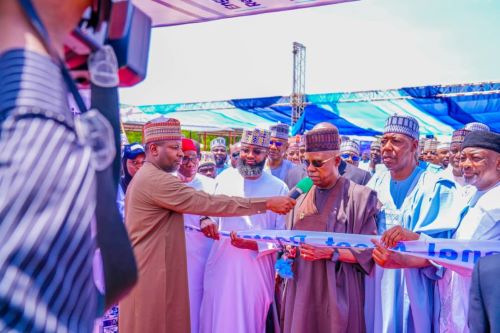

L-R: The Executive Vice Chairman/CEO NASENI, Mr. Khalil Suleiman Halilu; the Vice President, Federal Republic of Nigeria, Sen. Kashim Shettima; the Governor of Borno State, Prof. Babagana Umara Zulum; and the Minister of Agriculture, Senator Abubakar Kyari, as the Vice President commissioned the tractors refurbished by NASENI under its National Asset Restoration Programme in Maiduguri, Borno State.
The Vice President Kashim Shettima has commissioned over 375 tractors for use in mechanised farming revitalised by the National Agency for Science and Engineering Infrastructure (NASENI) under the National Assets Restoration Programme.
The Vice President commissioned the programme on Sunday June 8, at the Borno State Agricultural Mechanization Agency, Farm Centre in Maiduguri, Borno State.
According to Shettima, “this initiative, NASENI Asset Restoration Programme, is a response to our cross-generational dilemma about what to do with abandoned and poorly maintained assets owned by the nation and the people. It’s a powerful shift in how we think about value, sustainability, and innovation, and I believe that’s what we’ve promised the nation.”
“It fits squarely within the broader vision of President Bola Ahmed Tinubu’s administration: to build a productive, self-reliant, and diversified economy. Our goal, therefore, is to ease this transition to expand the potential and productivity of Nigeria’s agricultural, industrial, and creative sectors through smart investments in infrastructure, skills, and innovation. We must commend NASENI for stepping forward with this brilliant idea to mitigate a national tragedy. Beyond this promise to refurbish hardware, NASENI has shown a great capacity to serve as a national nerve centre for technology transfer, home-grown engineering, and adaptive innovation. This is why we must support them.”
In his special remarks, the Chief Host, Executive Governor of Borno State, Prof Babagana Umara Zulum, said these tractors being commissioned were procured by his predecessor, Sen. Kashim Shettima when he was the executive governor of Borno State. “He procured 1,000 tractors with their implements.
“His investment is the single largest not just in Borno state but also in Nigeria. The National Assets Restoration programme we are launching could not have been possible without that foundational investment”, he added, commending NASENI for restoring broken down tractors owned by Borno state government without collecting money from the state government.
The Executive Vice Chairman, NASENI, Mr. Khalil Suleiman Halilu in his keynote address said the Agency was showing that Nigerian problems can have Nigerian-engineered solutions.
“We are building local capacity, developing talent pipelines, and enabling technology transfer at scale. We are turning NASENI into a true national enabler-quietly but boldly proving that government can deliver, and that transformation is possible.”
When we set out to design the Asset Restoration Programme at NASENI, we were not just looking for another project to tick off. We were confronting a reality: that all across Nigeria, from farms to security outposts, public assets worth trillions of naira had been written off, locked away, or left to rust—not because they were beyond repair, but because there was no clear system to bring them back to life.
He said our national survey revealed that Nigeria holds over 47,000 broken-down but serviceable agricultural and law enforcement assets. The cost to replace them would exceed ₦14 trillion. “But at NASENI, we asked a simple question: Why replace what we can restore? With the right engineering, the right people, and the right partnerships, we found that we can recover these assets for just 15 to 25% of their replacement value—and still achieve full functionality. That is over ₦10 trillion in national savings, while reviving productivity, jobs, and security on the ground,” he added.
He thanked President Bola Ahmed Tinubu, and Vice President, Kashim Shettima for their endless support, belief in our mission, and their constant encouragement that we must not only think big—but act fast. He thanked Governor Zulum for his support and leadership which have helped bring this vision to life here on Borno soil—turning his state into the first node in this national restoration network.
In his address, Minister of Agriculture and Food Security, Sen. Abubakar Kyari who reeled out statistics of broken-down tractors nationwide said the National Assets Restoration Programme is a welcome development and it will be instrumental to meeting the foods security goal of the Renewed Hope Agenda of government. He commended the EVC of NASENI for the bold vision in rebuilding and repositioning NASENI.
Earlier, Engr. Mohammed Yadudu, Programme Coordinator, Asset Restore, NASENI, said with support from NASENI’s technical partner, the Machine and Equipment Corporation Africa (MECA) in December 2024, began to restore back idle government assets that have long fallen into disuse but held immense value for agricultural economy.
The dignitaries present at the event included the MD/CEO, Niger Delta Power Holding Company (NDPHC), Engr. Jennifer Adighije; the Director General, Federal Radio Corporation of Nigeria (FRCN), Dr. Mohammed Bulama; Senior Special Assistant to the President on Special Needs and Equal Opportunities, Hon. Mohammed Abba Isa; members of Borno State Executive Council; Dr. Muhammed Dahiru, Chairman, Presidential Implementation Committee on Technology Transfer; Secretary to the Borno State Government, Malam Bukar Tijani; and Borno State Commissioner of Agriculture, Eng. Bawu Musami; Speaker of Borno State House of Assembly, Abdulkarim Lawan; members of the National Assembly, and other top government officials in the State.