

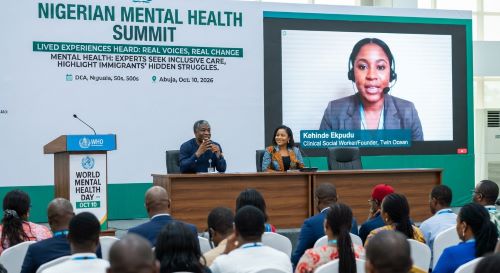

Experts have called for inclusive mental healthcare in Nigeria, stressing the need to recognise lived experiences and address the psychological challenges often hidden behind outward success.
They made the call at the maiden Nigerian Mental Health Summit, held virtually on October 10 to commemorate the 2026 World Mental Health Day.
The World Health Organisation (WHO) marks the day annually on October 10, with this year’s theme: “Lived Experiences Heard: Real Voices, Real Change.”
Dr. Oluyinka Oyeniji, Convener of the Summit, said Nigeria needed a coordinated national approach to mental healthcare that reflected the experiences of patients, caregivers and families.
He said the summit was designed to bring stakeholders together to advance mental health advocacy, research, policy and care.
Oyeniji said the Federal Government’s reported move to decriminalise attempted suicide represented an important development in a campaign spanning more than 14 years.
He stressed the need for sustained collaboration among government institutions, civil society organisations, researchers and other stakeholders to improve access to mental healthcare.
In a presentation titled “Beyond Survival: Nigerian Immigrant Mental Health—Lived Experiences, Identity and the Brain,” Kehinde Ekpudu, a registered clinical social worker in Alberta, Canada, highlighted the psychological challenges Nigerian immigrants could experience despite appearing successful in their adopted countries.
Ekpudu, who is also the Founder of Twin Ocean, said migration involved more than geographical relocation, as it could affect an individual’s identity, emotional well-being and sense of belonging.
“When we talk about immigrant success, we celebrate how well people survive. But what happens when survival becomes a way of being?” she asked.
She explained that Nigerian immigrants often had to balance their cultural heritage, professional roles and family responsibilities while adapting to new social environments and navigating their experiences as Black people.
Citing a 2023 study by Aluh and other researchers, Ekpudu said 51.7 per cent of Nigerian immigrants in Canada screened positive for depression.
She also noted that the study associated longer residence in Canada, particularly more than 10 years, with higher odds of screening positive for depression.
According to her, migration-related pressures, uncertainty and constant adaptation could contribute to chronic stress, manifesting in anxiety, sleep disruption, emotional exhaustion, difficulty concentrating and burnout.
“Sometimes what looks like resilience from the outside is a nervous system that has become very good at surviving,” she said.
Ekpudu said the ability to continue working and meeting responsibilities did not necessarily mean that an individual was emotionally well.
She added that cultural attitudes and expressions such as “I am just tired”, “God will help me” and “I need to be stronger” could sometimes discourage people from acknowledging emotional distress or seeking support.
The social worker called for a shift from a narrow focus on survival towards helping immigrants develop a sense of belonging, integrate multiple identities and build lives in which they could thrive.
She explained that belonging involved feeling accepted without losing one’s identity, while integration required embracing different aspects of oneself without feeling compelled to choose one over another.
On the broader mental health situation in Nigeria, Oyeniji said the summit also addressed the experiences of mothers affected by perinatal mental health disorders, caregivers of children with conditions such as Down syndrome, cerebral palsy, epilepsy and autism, and families caring for relatives with depression.
He said Ololade Sanusi, a mental health coach and corporate governance expert, was scheduled to speak on “Beyond Being Strong: Why Lived Experiences Must Shape Mental Healthcare in Nigeria.”
Oyeniji identified Damilola Seriki and Babajide Balogun as advocates co-ordinating public and non-governmental activities towards the establishment of a federal Mental Health Commission.
He said Lagos and Ekiti were the only states that had enacted mental health laws, while the Nigeria Mental Health Act, 2023, was undergoing amendments under the present administration.
The convener also acknowledged the contributions of the Human Rights Foundation, led by Victor Fakunle, to human rights advocacy and Philip Jakpor of the Renevlyn Development Initiative to public enlightenment campaigns on environmental justice.
He called for discussions on insecurity, terrorism and violence to consider both their underlying causes and their psychological consequences for victims, families and affected communities.
Oyeniji also recognised the contributions of Dr. Olufunto Adeleye, lead of the Ladoke Akintola Neuroscience Group, which co-organised the summit, and the Neuroscience Society of Nigeria to research into brain-related diseases.
He urged participants to use their professional experiences and voices to promote reforms that would make mental healthcare more inclusive and responsive to the needs of Nigerians.
“May God use our voices not only to speak about causes and impact of mental health diseases as lived experiences but even more importantly to deliver real and positive change to Nigerians everywhere,” he said.
Experts, including the Executive Director, Renevlyn Development Initiative, Mr. Philip Jakpor, gave their goodwill messages in solidarity with the summit.
The summit called for a broader understanding of mental well-being, with greater attention to the experiences of vulnerable individuals and families and the psychological challenges that may remain hidden behind apparent resilience and success.