
BudgIT, Nigeria’s leading civic-tech organisation promoting fiscal transparency, accountability and effective public resource management, has launched the 11th edition of its flagship State of States Report, themed “From Allocation to Impact: Rethinking State Spending Priorities.”
The report examines the 2025 fiscal performance of Nigerian states, assessing their revenue mobilisation capacity, expenditure efficiency, fiscal viability, debt sustainability and spending priorities across critical development sectors, including health, education, agriculture and water, sanitation and hygiene (WASH).
The 11th edition adopts a substantially revised assessment methodology, moving beyond conventional measures of revenue growth and expenditure volumes to place greater emphasis on the quality of public spending and its potential developmental impact.
The revised framework evaluates states across four pillars: Pillar A (Revenue Performance, 40%) evaluates states’ Internally Generated Revenue (IGR) as a proportion of total revenue, year-on-year IGR growth, tax revenue as a share of total IGR, and recurrent revenue growth. Pillar B (Fiscal Viability, 30%) examines states’ ability to finance operating expenses using IGR and meet recurrent expenditure, debt servicing and loan repayment obligations from total revenue.
Pillar C (Debt Sustainability, 15%) assesses foreign debt exposure, outstanding payment arrears and liabilities, debt servicing burden and total debt relative to government receipts. Finally, Pillar D (Selected Critical Sectors Spending, 15%) evaluates capital expenditure on agriculture, health, education, and WASH relative to total receipts, actual spending on these sectors and the implementation performance of their budgeted projects.
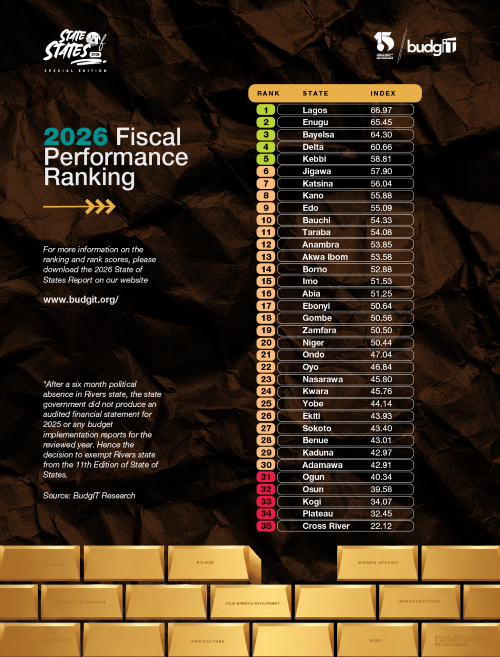
Like last year, Rivers State was excluded from our analysis because the state is yet to publish its audited financial statements and budget implementation reports. The latter, following the declaration of a state of emergency in 2025, has made the state’s data inaccessible. Hence, the 2026 State of States edition assessed 35 states.
In the 2026 fiscal performance ranking, Lagos State secured the position of the best-performing state in the federation, ranking first nationally, supported by its diversified revenue base and IGR of N1.71tn. Kebbi State also emerged as a notable performer, ranking fifth nationally, following a 59.54% increase in total revenue to N228bn.
These performances demonstrate different pathways towards improved fiscal sustainability, although the report emphasises that stronger revenue mobilisation does not automatically translate into better public service delivery.
Other states recorded mixed fiscal outcomes. Zamfara, ranked 19th, recorded improvements in IGR and substantial capital expenditure, but declining aggregate revenue and increasing foreign debt exposure weakened its fiscal position.
Ondo and Oyo ranked 21st and 22nd, respectively, highlighting the challenges of balancing revenue mobilisation, expenditure commitments and fiscal sustainability. At the lower end of the ranking, Yobe (25th), Ekiti (26th), Sokoto (27th), Kaduna (29th), Adamawa (30th) and Osun (32nd) recorded varying combinations of weak domestic revenue mobilisation, expenditure pressures and debt-related vulnerabilities. Kaduna’s rising debt burden and Sokoto’s weak performance in revenue mobilisation and critical-sector spending are particularly concerning.
On revenue mobilisation, the 2025 fiscal year recorded significant improvements in IGR across several states, although considerable disparities remain in their revenue-generating capacities. Lagos maintained its dominance, generating N1.71tn, representing a 35.67% increase from N1.26tn recorded in 2024. Enugu recorded one of the most remarkable performances, with IGR increasing by 125.91%, from N180.5bn to N407.76bn, placing it second nationally.
Oyo and Gombe also recorded significant growth of 112.79% and 111.28%, respectively. Abia’s IGR increased by 64.48%, while Akwa Ibom recorded 45.11% growth. Kano, the leading IGR-generating state in the North West, raised N102.6bn, representing a 35.78% increase.
Despite these improvements, the report highlights the limitations of revenue growth as a standalone measure of fiscal strength.
In Enugu, for instance, non-tax receipts accounted for 90.79% of the absolute increase in IGR, raising questions about the sustainability and institutional foundations of its revenue expansion. Similarly, states such as Yobe, which generated only N13.35bn in IGR, and Ebonyi, with N21.9bn, continue to face constraints in building sufficient domestic revenue to finance their expenditure obligations.
The report further reveals that dependence on Federation Account Allocation Committee (FAAC) transfers remains a defining feature of subnational public finance.
While Lagos recorded total revenue of N2.68tn, with its own-source revenue playing a significant role in recurrent receipts, several states continued to depend heavily on federation transfers. FAAC accounted for approximately 90% of Akwa Ibom’s recurrent revenue, 86.47% in Anambra and 82.90% in Abia. In Kano, statutory transfers accounted for 79.28% of recurrent revenue.
These figures indicate the limited progress towards fiscal independence in many states and the vulnerability of their budgets to fluctuations in federation distributed revenues.
On expenditure, the report identifies a growing concern around the relationship between expanding government spending and developmental returns.
Lagos’s total expenditure increased by 33.24% to N3.16tn, while Oyo’s expenditure rose by 118.71% to N978.64bn. Enugu recorded an 84.80% increase to N880.57bn, while Abia’s expenditure grew by 44.37% to N458.95bn. However, the pace of expenditure growth in some states exceeded revenue expansion, raising concerns about fiscal discipline, the sustainability of government operations and the capacity of states to meet their financial obligations.
A closer examination of operating expenses reveals further pressure on state finances. Lagos recorded operating expenses of N1.29tn, representing a 23.89% increase, while Oyo’s operating expenses rose by 88.85% to N372.68bn.
In Abia, operating expenses nearly doubled, increasing from N64.19bn to N126.68bn, driven partly by a 197.07% increase in overhead expenditure to N70.87bn. Consequently, IGR covered only 53.56% of the state’s operating expenses in 2025, compared with 64.28% in 2024.
These trends demonstrate how rising administrative and operational costs can absorb additional revenue and limit the resources available for development priorities.
On capital expenditure, several states recorded substantial increases in spending. Lagos increased capital expenditure by 46.69% to N1.58tn, while Enugu more than doubled its capital outlays to N693.88bn. Akwa Ibom’s capital expenditure increased by approximately 85% to N970.83bn, while Abia and Anambra recorded N319.91bn and N290.74bn, respectively.
Oyo’s capital expenditure also more than doubled to N423bn. However, the report cautions that higher capital expenditure does not automatically indicate better developmental outcomes. What matters is the composition of expenditure, the projects prioritised, their execution and the extent to which they respond to citizens’ needs.
On debt sustainability, the report identifies significant variations in the debt positions and financial obligations of state governments.
Lagos recorded a total debt stock of approximately N2.90tn at the end of 2025, while Ogun’s debt reached N538.92bn, making it the fourth most indebted state in the assessment. Enugu’s total debt increased by 18.98% to N300.95bn, alongside a widening fiscal deficit of N110.95bn.
Conversely, Abia and Anambra recorded reductions in their total debt stocks of 8.86% and 15.49%, respectively. Nevertheless, foreign-currency exposure remains a significant concern, accounting for 76.06% of Abia’s debt, 92.73% of Anambra’s and 93.48% of Ondo’s total debt.
The burden of debt servicing and accumulated liabilities further compounds fiscal pressures. Osun’s debt service stood at N100.17bn, equivalent to 28.60% of its total revenue, while Ebonyi spent N42.51bn on debt servicing, representing 15.99% of its total revenue.
Ebonyi’s debt service obligations were almost twice its IGR of N21.9bn. The state also reported N43.32bn in contractor arrears. Abia recorded combined pension, gratuity and contractor arrears of N41.16bn, while Kwara recorded N15.96bn in contractor arrears and N23.87bn in pension and gratuity arrears. These outstanding obligations represent additional claims on future public resources and constrain the fiscal space available for development investments.
The 2026 edition introduces a more deliberate assessment of spending in critical development sectors, particularly agriculture, health, education and water, sanitation and hygiene. By assigning 15% of the overall fiscal performance assessment to selected critical-sector spending, BudgIT seeks to strengthen the link between fiscal sustainability and human development outcomes.
This represents a significant departure from the previous methodology, which placed greater emphasis on the relative prioritisation of capital expenditure without sufficiently examining the composition and developmental orientation of that spending.
Commenting on the findings, Engr. Adejoke Akinbode, BudgIT’s Head of Research and Policy Advisory, said, “The expansion in public revenue presents an important opportunity for Nigerian states to accelerate development, but the real measure of fiscal performance must go beyond how much money governments receive or spend. Our analysis shows that states are operating with significantly larger revenue envelopes, yet important questions remain about expenditure priorities, budget execution, debt management and the quality of investments in critical sectors. The ultimate test of fiscal responsibility is whether public resources are translated into better healthcare, improved education, productive infrastructure and other essential services that directly improve citizens’ lives. States must move beyond celebrating revenue growth and demonstrate measurable developmental returns on public expenditure”.
BudgIT maintains that the current fiscal environment demands greater responsibility from state governments in managing public resources. While increased FAAC allocations provide an opportunity to address infrastructure deficits and strengthen essential public services, governments must resist the temptation to expand administrative spending at the expense of productive investments.
States should strengthen domestic revenue institutions, adopt conservative revenue forecasts, improve budget credibility, prioritise high-impact development programmes and ensure that borrowing is directed towards investments capable of generating sustainable economic and social returns.
Ultimately, the 2026 State of States Report reinforces the need to shift the conversation on subnational fiscal performance from allocation to impact.
As governments continue to manage expanded revenue envelopes and competing development demands, citizens must be able to see tangible improvements in their living conditions.
Public resources must be managed with transparency, prudence, equity and accountability, ensuring that the benefits of fiscal reforms extend beyond government accounts to the communities and people they are intended to serve.