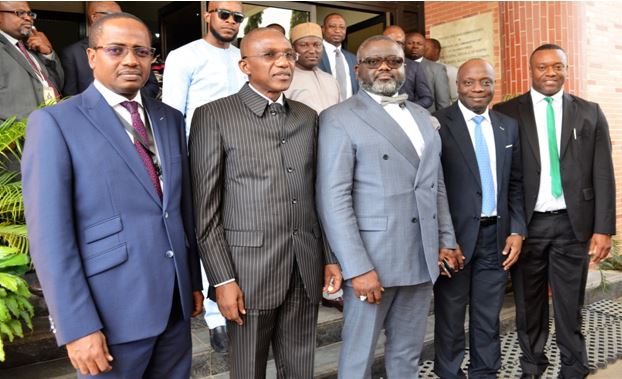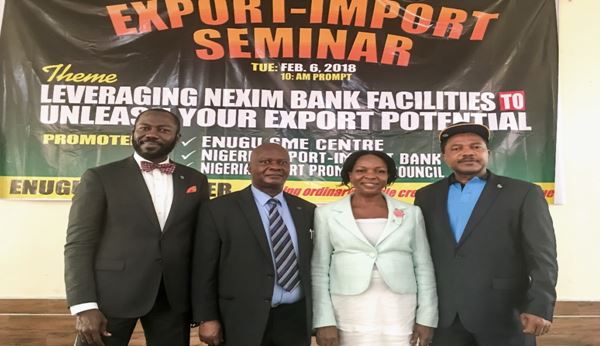

L – R: Chinedu Moghalu, Regional Head, NEXIM Bank, Enugu; Dr.Obiora Madu; Mrs. Gertrude Ukoa, Head, NEPC, Enugu; and Hon. AnayoAgu, SME Centre, Enugu.
The Nigerian Export-Import Bank (NEXIM) has called on export-oriented Small and Medium Entrepreneurs in the Southeast and Delta States to access the N500 billion Export Stimulation Facility (ESF) and the N50 billion Export Development Fund being managed by the Bank to boost their businesses, create more jobs, and contribute to the foreign exchange revenue earnings of the country.
This call was made in a statement by the Managing Director and CEO of NEXIM, Mr. Abba Bello, and made available by the Bank’s Enugu Regional Office after a one-day seminar on “LEVERAGING NEXIM BANK FACILITIES TO UNLEASH YOUR EXPORT POTENTIAL.”
The facilities were made available to NEXIM Bank last December and will lend at a maximum of 9% interest rate. The funds were designed to redress the declining export credit to SMEs and reposition the non-oil sector to increase its contribution to the country’s revenue generation and economic development. The improved export financing for non-oil exporters will enable them to upscale and expand their businesses and improve their competiveness.
Speaking on behalf of the Bank’s MD/CEO, the Head of the Bank’s Enugu Regional Office, Mr. Chinedu Moghalu stated that the funds are being made available to the NEXIM by the Central Bank of Nigeria at a time the Bank has decentralized its operations to all the regions of the country for easier accessibility of its products and services to maximize their impacts. According to him,“NEXIM Bank is determined to ensure these funds achieve the desired impact of triggering non-oil export development, growth and economic progress in line with its mandate as the Trade Policy Bank of the Federal Government and the applicable CBN guidelines for the implementation of the facilities.”
The representative of the Enugu State Governor and Special Assistant on SME Development, Honourable Anayo Agu, stated that the programme has come at the right time. According to him, “the opening of NEXIM Bank Regional Office for the Southeast and Delta States in Enugu, and the invitation to the SMEs to access affordable non-oil export facilities, had been the missing link in the efforts of various Governments in the region to derive maximum benefits from their investments in the SME value chain, especially in the agriculture and other non-oil sectors. It provides us the platform to reach heights we could only dream about before now.”
The objectives of the ESF as contained in the CBN guidelines are to: a) Improve access of exporters to concessionary finance to expand and diversify the non-oil export baskets; b) Attract new investments and encourage re-investments in value-added non-oil exports production and non-traditional exports; c) Shore up non-oil export sector productivity and create more jobs; d) Support export oriented companies to upscale and expand their export operations as well as capabilities; e) Diversify and increase the level of contribution of non-oil exports revenue towards sustainable economic development; and f) Broaden the scope of export financing instruments.
The transactions permissible for funding under the ESF include, export of goods wholly or partly processed or manufactured in Nigeria; export of commodities and services, which are permissible and excluded under existing export prohibition list; imports of plant and machinery, spare parts and packaging materials, required for export oriented production that cannot be produced locally.
Other businesses eligible under the ESF are export value chain support services such as transportation, warehousing and quality assurance infrastructure; resuscitation, expansion, modernization and technology upgrade of non-oil exports industries. Stocking facility and working capital can also qualify for funding under the ESF.
Potential applicants to the ESF can either send their requests through their local commercial banks or directly to NEXIM as the revised CBN guidelines assigns the Bank a dual role of both manager and participating financial institution.
The N50 Billion Export Development Fund will be managed by NEXIM and implemented in collaboration with the State governments. NEXIM has earmarked at least N1 billion for each State under the State Export Development Programme component aimed to catalyse and incentivize export investment to promote diversification and industrialization.
Through the Programme, NEXIM Bank will also have a programme for Women/Youth Development, especially to provide support to industries that are involved in Apparel/Garmenting, Cashew, Shea, etc.
The Central Bank Governor, Mr. Godwin Emefiele had stated at the announcing of the funds in December 2017 that the ESF can also be implemented by adapting the Anchor Borrowers Programme framework while promoting the PAVE initiative.
According to Moghalu, “The overall aim of the ESF and EDF is to lower the costs of Nigerian exporters so that their products can be priced at a level where they can compete with other products around the world.”
The NEXIM Bank Regional head urged eligible export-oriented companies in the Southeast and Delta States with permissible transactions under the schemes to participate in the funding scheme by submitting proposals for consideration through the financial institutions of their choice or directly to NEXIM Bank. He emphasised that as Nigeria’s sole export credit agency, NEXIM Bank remains the only window through which the Government can provide export financing for non-oil products and services.
Thanking the participants and other stakeholders on behalf of the NEXIM MD, Mr. Moghalu gave assurance that the Bank is committed to working assiduously, in line with its mandate, to fully realise the objectives of the schemes and stated a readiness to provide the necessary advice, additional information or clarifications as may be required.
He thanked the Nigerian Export Promotion Council (NEPC), the Manufacturers’ Association of Nigeria (MAN), the commodity associations and other organised private sector for their relentless technical support, partnership and collaboration as well as the commitment to work with the Government and private sector in Nigeria to diversify the economy, create jobs, boost industrial production and exports.
Other participants at the seminar were Southeast Government officials; representatives from the members of various chambers of commerce and industries; SME professionals in the banking sector; as well as the media.