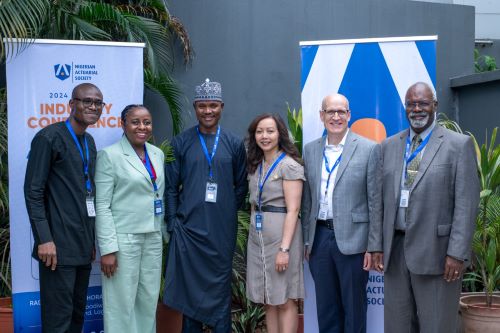

The 2024 Nigerian Actuarial Society Annual Conference held in Lagos. From Left: Miller Kingsley, President, NAS; Yeside Kazeem, Immediate Past President, NAS, Dr. Usman Jankara Jimada, Deputy Commissioner, NAICOM; Kartina Tahir Thomson, President-Elect, Institute and Faculty of Actuaries, David Cummings, President-Elect, Casualty Actuarial Society and John W. Robinson, President-Elect Society of Actuaries.
The National Insurance Commission (NAICOM) has expressed deep concern over the number of professional actuaries in the Nigerian insurance sector.
In a keynote address at the 2024 Nigerian actuarial Society (NAS) Annual Conference in Lagos, the Commissioner for Insurance, Mr. Segun Omosehin said as follows:
It is a rare privilege for me to address this gathering as the keynote speaker on behalf of Mr. Olusegun Omosehin, the Commissioner for Insurance of the Federal Republic of Nigeria.
This year’s Annual Industry Conference, themed “Actuaries and AI: Strengths, Opportunities, Weaknesses, and Threats” is timely and crucial, as it perfectly captures an exciting yet critical conversation needed today.
As we gather here today, the world is experiencing a significant transformation, driven by technological advancements and data revolution. The financial sector, in particular, is at the point of a significant shift, with artificial intelligence (AI) poised to revolutionise the way we conduct business. As the Nigerian insurance industry continues to evolve, the intersection of actuarial science and AI presents a unique opportunity to further utilize the power of technology to shape the future of insurance in Nigeria.
Today, actuaries play a critical role in risk assessment, pricing, and financial stability using advanced techniques such as data science and predictive analytics to analyze complex data and make informed decisions. The profession has become increasingly important in a data-driven world, with actuaries in high demand across various economic sectors.
One of the things that some older actuaries talk about is the time before spreadsheets existed, when calculations were done by hand. The advent of spreadsheets did not eliminate actuaries; rather, it allowed them to do more and explore new aspects of their work. AI may represent another major leap forward, but it is very unlikely to replace actuaries.
It is therefore exciting to witness conversations around AI especially since the release of Chat-GPT in 2022 which was followed by other AI Chatbots and other technologies to integrate these advancements to improve operational efficiency.
It is in recognition of these developments that the Federal Government of Nigeria plans to position Nigeria as the AI hub for AI solutions in Africa. This is to be achieved through the development and implementation of a National Artificial Intelligence Strategy aimed at accelerating AI adoption in Nigeria. It is thus important that the insurance industry and, by extension, actuaries are at the forefront of its adoption. In conformity with the above, the Commission is committed to the Federal Government strategy. We will ensure that our sectoral regulatory policies are consistent with the outlined goals of the Federal Government while enhancing the stability of the Nigerian Insurance Industry.
Even though, there are perceptions that disruptive technologies like AI will replace every job and make a lot of skills obsolete. There may be credence to this sentiment, if like actuaries, we are to observe historical patterns. However, technological advances have always changed the landscape regarding jobs and relevant skill-sets. Like other technological disruptors, AI has the potential to transform the insurance industry and by extension the actuarial profession.
Ladies and gentlemen, the pace at which AI is evolving means that actuaries have to also continuously evolve and develop skill sets that utilise AI and other machine learning tools or risk being left behind. The Nigerian Actuarial Society (NAS) has a vital role to play in equipping its members with access to the necessary skills to navigate the world of AI. This is why I am inclined to believe that this is one of the reasons we are having this conference.
In the changing landscape, using AI for vast data analysis will be common place. This will enable actuaries delve deeper into large data; uncovering insights, and developing more accurate risk pricing models and innovative insurance products for the Nigerian populace. AI would readily be instrumental in the emerging Insurtech landscape and financial inclusion by enabling the development of microinsurance solutions that cater to the underserved population, Insurtech AI underwriting, etc. Accordingly, as an insurance industry regulator, we believe that this is the time to strengthen our collaborative efforts to ensure responsible AI adoption in order to maximize the strength and opportunities of Actuaries and AI.
I wish to enjoin delegates at this conference to be expectant and open to ingenuities that will be offered by the presenters in the course of this conference as well as harness the true potential of AI in the Nigerian insurance industry. To this extent, our mutual collaboration will seek to consider:
- Regulation and Governance: Where we would need robust regulations to ensure the ethical use of AI in insurance, focusing on data privacy, fairness, and transparency.
- Collaboration: Fostering partnership between actuaries and AI developers where actuaries bring domain expertise, while AI developers provide the technical know-how. This would therefore create solutions that are both effective and ethically sound.
- Upskilling and Reskilling: The actuarial profession needs to embrace continuous learning to stay relevant in the AI age. Therefore, equipping actuaries with skills in data science, machine learning, and AI will be essential.
Permit me to reiterate that the Commission is seriously concerned about the current inadequate professionally qualified actuaries in the Nigerian insurance industry and is committed to supporting all initiatives and developments that are likely to facilitate actuarial capacity development in Nigerian and/or enable the Nigerian insurance industry to access qualified actuaries. This is part of the reasons we, at the Commission, are excited about the prospects that AI brings to the actuarial profession in Nigeria.
In conclusion, the convergence of actuarial science and artificial intelligence holds immense potential for transforming our industry. By embracing the strengths and opportunities of AI while addressing its weaknesses and threats, we can navigate this new landscape with confidence and foresight.
I therefore call on the NAS to seize this moment to collaborate, innovate, and lead the way in shaping the future of the Nigerian insurance industry in order to facilitate the enthronement of a more sustainable and inclusive insurance ecosystem that benefits all stakeholders.