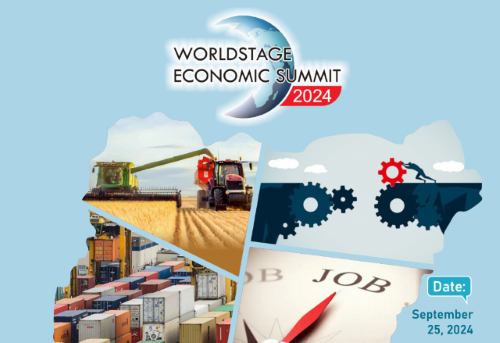

With Nigeria’s economy still struggling to shake off the impact of serious challenges such as COVID-19, Naira re-denomination, fuel subsidy removal among others, WorldStage Economic Summit has resolved to focus on “Nigeria: Setting a Stage for Business and Economic Recovery” as the theme for the 2024 edition.
World Stage Limited, the organiser of the annual summit in a statement said WES 2024 will hold on September 25, 2024 at the Event Centre, Nigerian Exchange Limited, 2/4 Customs Street, Lagos.
The statement said the critical stakeholders for business and economic recovery that will take the front seats at the summit are federal, state governments and private bodies responsible for food production, technology transfer, job creation, energy supply, blue economy, banking and export promotion.
“Specifically, the summit will attract those in the Manufacturing, Oil and Gas, Housing, Agriculture, and Water Resources, Banking, Insurance, Maritime, ICT, Aviation, Mining, Hospitality & Tourism, Healthcare, Education, Transportation, Local and Foreign Investors, Media and Other Relevant Stakeholders,” the statement said.
“WES 2024 will put stakeholders that are critical to the economic turnaround on the spotlight to stimulate case discussions, public buy-in and lasting solutions.”
Mr. Segun Adeleye, President/CEO World Stage Limited was quoted as saying that the “the economy has been subjected to different policy reviews since the election and inauguration of President Bola Ahmed Tinubu in 2023.
“The new administration has set a tall agenda with the Presidential Policy Advisory Council coming up with a strategic blueprint to propel the country into a $1 trillion economy within the next eight years and achieve an average annual GDP growth rate of seven (7) percent and GDP per capita of $3,631.
“As the new administration is challenged to improve the economic prosperity of Nigerians, inherited fundamental macroeconomic issues such as poor policy implementation, infrastructure deficit among others will demand strategic reforms with long-term gains, albeit with some short-term pain as seen in high energy cost, Naira devaluation and runaway inflation.
“Currently, the economy is at a cross road with businesses and populace at the mercy of tough measures with unintended consequences which have pushed many to breaking points, thereby forcing governments to roll out palliative measures in order to avert backlash and total collapse.
“The current reality has put government and businesses in no choice situation than to align strategies for common good in economic recovery through stable power supply, job creation, exchange rate management, inflation control, banking recapitalization, fiscal and debt management, structural reforms, human capital development and economic diversification.”