



Communiqué
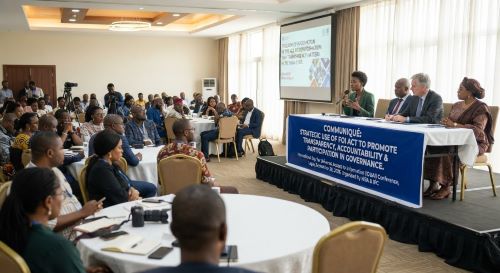
Issued at the close of a Multi-stakeholder Conference to Commemorate International Day for Universal Access to Information (IDUAI) 2026 organised by Media Rights Agenda (MRA) and the International Press Centre (IPC), on September 28, 2026.
Preamble
Media Rights Agenda (MRA) and the International Press Centre (IPC) organised a one-day multi-stakeholder conference in Lagos on September 28, 2026 to commemorate the International Day for Universal Access to Information (IDUAI) 2026, under the theme, “Freedom of Information in the Age of Disinformation: Why Transparency Matters More Than Ever.”
The event brought together journalists and other media professionals, representatives of civil society organisations (CSOs), lawyers, and other stakeholders to examine the importance of access to information in promoting transparency and accountability, particularly in an information environment increasingly affected by misinformation and disinformation.
In his welcome address, the Executive Director of the International Press Centre (IPC), Mr Lanre Arogundade, noted that combating disinformation could not be reduced to telling citizens to “check the facts,” stressing that public institutions have a responsibility to make credible information available, explain decisions clearly, and respond appropriately to legitimate requests for information.
He further observed that the challenge was not simply whether information was available, but whether systems for accessing, verifying and using public information were sufficiently strong to support democratic accountability.
The event allowed participants to reflect on the implementation of Nigeria’s Freedom of Information (FOI) Act, 2011, and the roles of different stakeholders in strengthening access to information. It featured other presentations and interactive discussions on the implementation of the FOI Act, including the roles of CSOs, lawyers, and the media in advancing access to information, as well as the gender dimensions of FOI implementation.
Participants also shared experiences and perspectives on the practical challenges of using the FOI Act, as well as its implementation, while examining the importance of transparency and access to reliable information in addressing misinformation and disinformation.
Observations
Participants noted with concern that:
Despite the existence of the FOI Act for over 15 years, compliance by public institutions across all levels of government remains largely poor, with many agencies refusing to respond to requests for information, denying requests without legitimate reasons, failing to proactively publish information as required by law, and violating the provisions of the Act in other ways.
There appears to be a high degree of ignorance of the provisions of the FOI Act among public officials and members of the public, which continues to hinder usage of the Law and its effective implementation. In addition, a pervasive culture of secrecy within many public institutions means public officials are frequently unwilling to disclose even the most harmless information.
Delays in responding to requests for information continue to undermine the usefulness of information sought, particularly where such information is required for investigative journalism, public-interest reporting, civic monitoring, or other time-sensitive purposes.
The frequent absence of timely, reliable information from public institutions creates an information gap that can make it more difficult for citizens, journalists, and other stakeholders to verify claims and distinguish accurate information from misinformation and disinformation.
Information disorder, including the widespread circulation of misinformation and disinformation, is increasingly undermining public trust in government, the media, and the information environment, making access to accurate, reliable official information more critical than ever.
The gender dimensions of FOI implementation remain inadequately addressed, with women and other marginalised groups often facing additional barriers in accessing information and participating fully in transparency and accountability processes.
The lack of effective sanctions for non-compliance with the provisions of the Act is engendering a culture of impunity among public institutions and has contributed significantly to undermining the effectiveness of the law.
The increasing volume and speed of information circulating through digital platforms make access to authoritative and verifiable public information increasingly important to public discourse and accountability.
Resolutions
Participants reaffirmed their belief that access to information is a fundamental right and essential to transparency, accountability, and democratic governance. They further recognised that access to reliable information is particularly important in an information environment affected by misinformation and disinformation.
Accordingly, participants resolved to:
Make greater, more strategic use of the FOI Act in their professional and advocacy work to promote transparency, accountability, and public participation in governance, integrating it systematically in investigative reporting, civic monitoring, research, and advocacy campaigns.
Strengthen collaboration among media organisations, legal, and civil society organisations in using the FOI Act to investigate issues of public interest, monitor government programmes and expenditure, counter misinformation, and promote accountability.
Pay greater attention to the gender dimensions in FOI implementation by identifying information needs that affect women and other underserved groups and addressing barriers that may limit their ability to exercise their right to information.
Advocate for and integrate gender considerations in FOI advocacy, implementation, and practice to ensure equitable, meaningful access to information for women and other marginalised groups.
Increase public awareness of the right of access to information and provide practical information to citizens and communities on how to make effective requests under the FOI Act.
Document and share knowledge and experiences of using the FOI Act, including challenges encountered in requesting and obtaining information, to strengthen collective knowledge and advocacy for effective implementation.
Pursue legal remedies, including litigation, where necessary, to enforce compliance with the Act, particularly wrongful denials of requests for information.
Recommendations
Participants called on:
Governments at all levels to demonstrate stronger commitment to the effective implementation of the FOI Act and ensure public institutions comply with their obligations under the law.
Public institutions to take steps to ensure full implementation of the Act, particularly by complying with their statutory obligations, including establishing dedicated FOI Desks staffed by trained personnel and proactively publishing a wide range of information in accordance with Section 2(3) and (4) of the Act.
Public institutions to improve record-keeping and information management systems to ensure that requested information can be readily identified and accessed in a timely manner.
Public institutions to provide information in formats that are accessible and usable by different categories of information seekers, including women and other groups that may face barriers to accessing public information.
The media to make more systematic use of the FOI Act as a tool for investigative and public-interest journalism and to strengthen journalists’ capacity to formulate, submit, and follow up on FOI requests.
Civil society organisations to intensify public enlightenment, monitoring, and advocacy efforts around the implementation of the FOI Act and support citizens in exercising their right of access to information.
Media and civil society organisations to facilitate or strengthen collaboration, as the case may be, in monitoring compliance with the FOI Act and documenting cases of wrongful denial, delay, or other barriers to access to information.
The Attorney-General of the Federation to exercise his oversight responsibilities with greater rigour to ensure compliance with the law by issuing appropriate directives against officials and institutions that persistently and willfully violate the provisions of the Act, including wrongfully denying requesters information.
The judiciary to give expedited hearings and judgments in FOI cases to guarantee the timeliness and continued relevance of any information that may ultimately be disclosed as a result of litigation, in accordance with the intent of Sections 20 and 21 of the Act.
The National Orientation Agency (NOA) to be more proactive in its public enlightenment responsibilities by intensifying awareness campaigns on the right of access to information and the provisions of the FOI Act, particularly at the grassroots level, to ensure that citizens are aware of and able to exercise their right to information.
Relevant authorities and stakeholders to adopt gender-responsive approaches in FOI implementation to address barriers faced by women and other marginalised groups and ensure inclusive access to information.
All stakeholders, particularly public institutions, the media, and civil society organisations, to prioritise transparency and the proactive disclosure of accurate information as a critical means of combating misinformation and disinformation and upholding information integrity.
Public institutions and other relevant stakeholders to leverage digital technologies to improve the publication, accessibility, storage, and dissemination of information while ensuring that such technologies do not create additional barriers to access.
All stakeholders to strengthen cooperation and information-sharing to promote an information environment in which citizens can access reliable information, participate meaningfully in public affairs, and hold public officials and institutions accountable.
Conclusion
Participants reaffirmed that the right of access to information remains central to transparency, accountability, public participation, and democratic governance. They noted that, in an information environment increasingly affected by misinformation and disinformation, timely access to credible information held by public institutions is more important than ever.
Participants commended Media Rights Agenda and the International Press Centre for their continued efforts to promote access to information, media freedom, transparency, and accountability in Nigeria.
They reaffirmed their commitment to working collaboratively to advance the effective implementation of the FOI Act, and to uphold the public’s right to know as a cornerstone of democracy, good governance, and a healthy information environment in the age of disinformation.
Adopted in Lagos this 28th Day of September 2026.










