

‘Stop National Assembly Budget Secrecy’–BudgIT tells Saraki

That Nigeria’s National Assembly, an arm of government that supposedly upholds accountability, has remained an impregnable black box which defies public scrutiny is an irony of all ironies.

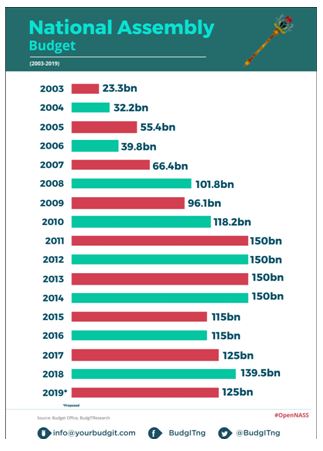
Aside from the lawmakers being ranked as world’s top-paid legislators, at public expense, the annual budget of the National Assembly is a one-line statutory transfer which is neither reviewed by any authority nor, at the very least, made accessible to the public thus enabling unbridled corruption.

At this age of digital governance plus global calls for transparency in public institutions, it is a national disrepute that the parliament has refused to eschew anti-democratic practices, as it continues to bury its yearly allocations under the hallowed chambers.

More disappointing is the fact that, despite Nigeria’s membership in Open Government Partnership and tons of pledges by Senate President, Bukola Saraki to run an “open NASS,” the National Assembly immediately relapsed into its default setting after a breakdown of the budget was made public in 2017, thanks to public pressure.

Asserting that the 2017 record must be made permanent, we are making a renewed demand from the leadership of the eighth assembly to fully redeem its promise. Starting again with the 2019 budget, a line-by-line breakdown of the NASS allocation must be made public going forward.

“That is the ultimate way the legislature can lead by example in making public accountability a Nigerian culture,” said Gabriel Okeowo, BudgIT’s Principal Lead.

It is worth the call that Senate President, Bukola Saraki and House Speaker. Yakubu Dogara should leave behind a great legacy, one that history would never forget, by truly and finally opening NASS.
spot_img
spot_img
spot_img
spot_img
spot_img

Hot this week

Sub-Saharan Africa Food Import Bill to Hit $70.2bn in 2026, a Rise of 10.5%

  The UN Food and Agriculture Organisation expects sub-Saharan...

NECA to Reward Employers for Resilience, Contribution to National Development

The Nigeria Employers’ Consultative Association (NECA) says it will...

IGP, Olatunji Disu, Emerges Nigeria Judo President, Unveils Championship in Lagos

The Inspector-General of Police (I-G), Mr. Olatunji Disu and...

AI-Generated Voters Register: SERAP Sues INEC, NDPC

The Socio-Economic Rights and Accountability Project (SERAP) has filed...

Google Selects 10 Startups for Inaugural Africa Applied AI Lab Cohort

Google has selected 10 startups for the first cohort...

Topics

GCR Affirms Leadway Assurance’s AA+NG Financial Strength

Leadway Assurance Company Limited's solid financial position as an...

NPA Reiterates Commitment to CSR in Visit to IDPs

The Management of the Nigerian Ports Authority (NPA) has...

‘Global Cancer Deaths Top 10m in 2018, 18m New Cases’

The Mass Medical Mission is set to launch its...

CBN Revokes Licence of Heritage Bank over Financial Incompetence

The Central Bank of Nigeria (CBN), in accordance with...

Wecass Braun Integrated Energy Showcases Management Team

From left to right: Mrs. Ezeonuegbu Scholar Ifeyinwa -...

Case Study: The Collapse of Lehman Brothers

Overview On September 15, 2008, Lehman Brothers filed for bankruptcy. With $639 billion in assets and $619 billion in debt, Lehman's bankruptcy filing was the largest in history, as its assets far surpassed those of previous bankrupt giants such as WorldCom and Enron. Lehman was the fourth-largest U.S. investment bank at the time of its collapse, with 25,000 employees worldwide. Lehman's demise also made it the largest victim, of the U.S. subprime mortgage-induced financial crisis that swept through global financial markets in 2008. Click here to make a lazy tweet

NCDMB Launches ‘Champions of Nigerian Content Awards’

The Nigerian Content Development Monitoring Board (NCDMB), in partnership...
spot_img

Related Articles

Popular Categories

spot_imgspot_img