
Indigenous operators and service companies in the oil and gas industry have been advised to identify with appropriate Sectoral Working Groups under the Nigerian Content Consultative Forum (NCCF) to be able to receive adequate attention on operational difficulties of whatever nature.
The Forum, established to “identify issues and responsibilities, and propose interventions that can address issues and harness opportunities,” has helped many indigenous companies to find their footing in the industry.
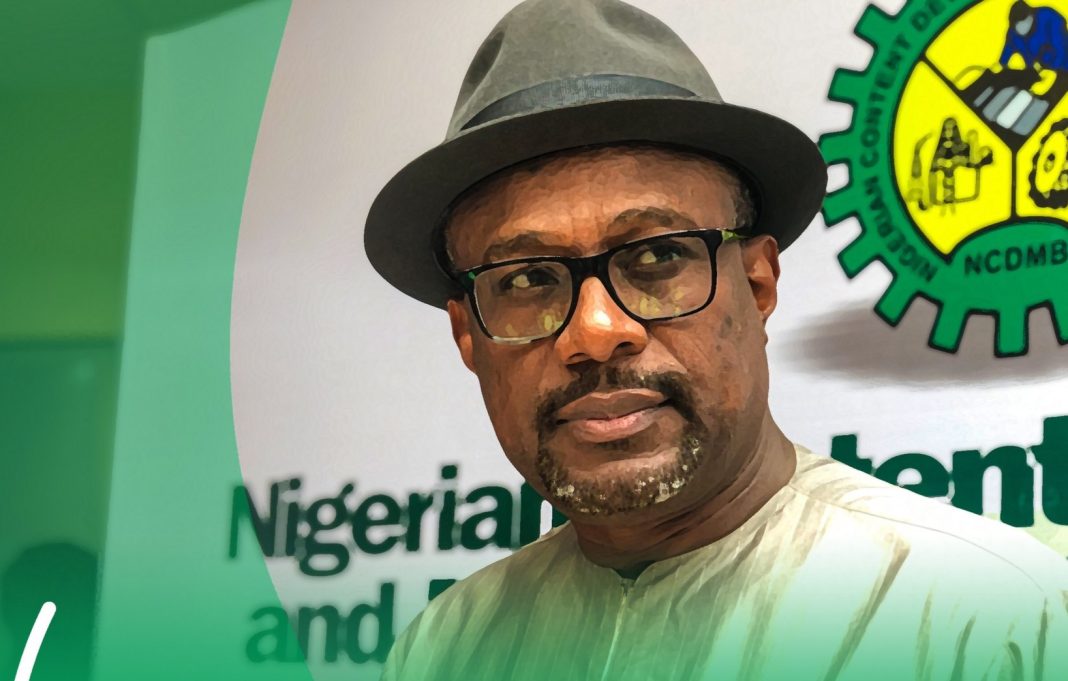
These were part of explanations provided by the Executive Secretary of the Board, Engr. Simbi Kesiye Wabote, on Day 3 of the Practical Nigerian Content Conference which held in Uyo, Akwa Ibom State. He was responding to a question by a participant on how challenges confronting a member could be resolved. The NCDMB boss advised any such business owners not to hesitate to approach the NCCF.
It was a day that energy sector chief executives subjected the oil and gas industry regulatory framework and the enabling statute, Nigerian Oil and Gas Industry Content Development (NOGIC) Act, 2010, to critical evaluation, commending the implementing agency, the NCDMB, for phenomenal success in actualising objectives.
The energy chiefs were specifically interested in how what is known in industry as ‘The 7 Ministerial Regulations’ has impacted on oil and gas operations and, generally, how implementation of the Act has advanced objectives such as enhanced Nigerian content and value addition through sectoral and regional linkages.
All were in agreement with the explanation of a legal expert, Barrister Ilu Ozekhome, that “The regulations are a framework within which provisions of the Act could be enforced.” Preparatory work on the regulations had gone through several processes in which stakeholders had been fully engaged.
The Chairman, Petroleum Technology Association of Nigeria (PETAN), Nigerian Content Consultative Forum (NCCF), and member, Oil and Gas Trainers Association of Nigeria (OGTAN), Mr. Akin W. Osuntoki, noted that “The regulations have helped in bridging capacity” in the oil and gas industry.
He pointed out that with effectiveness and efficiency in enforcement of the regulations, indigenous companies found all the space and material support to grow their capacities and capabilities.
According to him, “The role of the NCDMB has been very strategic,” and that the Board has been “a referee and gate-keeper.” Continuing, he added, “Not only is NCDMB able to chart in-country demand, it is able to chart regional demands, and this enables investors to plan and to expand.” “Today,” he revealed, “PETAN is shaking hands across Africa,” a reference to Nigeria’s service companies now operating as international oil companies (IOCs) through creation of regional linkages.
Another industry chief, Dr. Timi Austen-Peters, Chairman, Fabrication, Nigerian Content Consultative Forum (NCCF) declared: “We are beneficiaries of the [NOGICD] Act,” explaining the many ways effective implementation of the statute has fostered growth among his and other oil and gas companies. He said cost-savings arising from NCDMB’s approach in ease of doing business enabled to take advantage of business opportunities.
The Managing Director, Tenaris, Mrs. Rosario Osobase, said, “NCDMKB is doing so much in mentoring other African countries” in local content practice. Dr. Pius Okigbo, Jnr, Chairman, ICT, NCCF, echoed the views of the other industry chiefs on the successes of the Board.
Other speakers commended the Management of the NCDMB for its Nigerian Oil and Gas Parks Scheme (NOGAPS), which is aimed at creating industrial parks for companies engaged in the manufacture of equipment components, spare parts and tools required in oil and gas industry operations.