NAICOM Chief, Sunday Thomas, Tasks Federal, State Govts on Insurance of Public Buildings

The Commissioner for Insurance and Chief Executive Officer of the National Insurance Commission, NAICOM Mr. Sunday Thomas has enjoined federal and state governments to begin to make adequate provisions for insurance of public buildings and buildings under construction in their respective annual budgets.

He said these categories of insurance are made compulsory by extant insurance laws in Nigeria and, thus, must be complied with by all.

According to Thomas, Section 64 of the Insurance Act 2003 makes it mandatory for individuals, governments and corporate organisations that undertake the construction of any building above two (2) floors to procure a builder’s liability insurance policy (building under construction) from any of the NAICOM’ licensed Insurer in Nigeria.

Speaking further, he said Section 65 of the Insurance Act 2003 also makes it compulsory for all public buildings in the country to be insured. This is to protect innocent victims in the events of accidents and other disasters that may occur while they are within such premises.

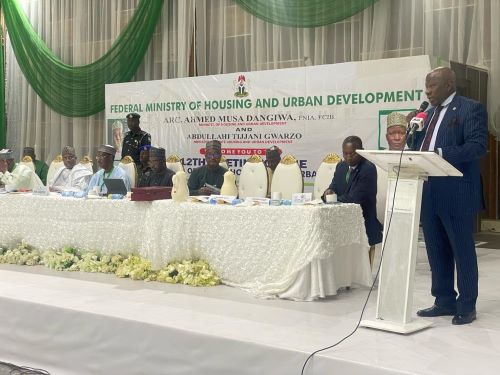
Mr. Thomas spoke at the 12th meeting of the National Council of Lands, Housing and Urban Development, holding in Kaduna State. Participants at the session include the Honourable Minister of Housing and Urban Development, Arc. Ahmed Musa Dangiwa; Minister of State, Housing and Urban Development, Abdullah Tijjani Gwarzo; Chairman, Senate Committee on Housing and Urban Development, Sen. Aminu Tambuwal; Chairman, House Committee on Housing and Habitat, Hon. Balele Aminu and Chairman, House Committee on Urban Development and Regional Planning, Hon. Abiante Awaji, The Permamnent Secretary, Federal Minstry of Works and Housing, Mahmuda Mamman;  Commissioners, Permanent Secretaries, Directors of Lands and Housing from the 36 States of the federation; Managing Director of Federal Mortgage Bank of Nigeria, Nigeria Mortgage Refinancing Company, Shelter Afrique, etc.

Thomas urged the various state governments to emulate the Lagos State government by domesticating the insurance laws in their respective states.

He listed some of the benefits from compliance with these compulsory insurances to the Federal and State Governments to include:

  • Reduction in the Federal and State Government expenditure in event of disaster that may affect citizens by shifting the burden to the risk-bearers (Insurance Companies), hence restoration would not be settled from tax payer’s money
  • Creation of employment opportunities for citizens of the State
  • Opportunity for enhancing the Internally Generated Revenue (IGR) of the respective states amongst others

spot_img
spot_img
spot_img
spot_img
spot_img

Hot this week

AEDC Bemoans Power Supply Disruption in Maitama after Invasion of Sub-station by Land Grabbers

The Abuja Electricity Distribution Company (AEDC) regrets to inform...

INTI International University Appoints Dr. Walter Duru as Research Fellow

Renowned Nigerian communication scholar, public relations leader, and Associate...

World Skin Health Day 2026: Skin Health Beyond Skin Colour – Better Knowledge, Better Skin Health

Dr. Folakemi Cole-Adeife Consultant Physician and Dermatologist LASUTH Every year on...

Stanbic IBTC Deepens Commitment to MSME Growth through Strategic Partnership with Abia State

Stanbic IBTC has reaffirmed its commitment to accelerating the...

Tinubu’s Biggest Opponent is Not Obi or Atiku… It’s Tinubu

  By Moses Braimah "A government that spends more time explaining...

Topics

Invitation to Business Journal 2nd Annual Lecture/Awards 2019

The Board, Management & Staff of Business Journal (print...

Africa-Singapore Business Forum for August 24

The premier platform for fostering investment, trade and...

NAICOM, Stakeholders Applaud Daily Economy, Author at Insurance Book Launch

L-R: General Manager, Production, Punch Nigeria Limited, Mr Olayinka...

Pension Industry Paid N271bn to Retirees in 2014

Operators in the pension industry paid out total of N271.15 billion as lump sum to retirees in 2014 under the new Contributory Pension Scheme (CPS) and an average monthly pension of N3.84 billion. In addition, another sum of N62.20 billion was paid as premium to insurance companies to provide life annuity for 14, 784 retirees. Mrs. Chinelo Anohu-Amazu, Director-General, National Pension Commission (PenCom) told Business Journal in an Executive Chat that a total of 115,529 workers had retired as at 31 December, 2014 with 87.20 percent (100,745) of the retirees on Programmed Withdrawal, while the remaining 12.80 percent (14,784 retirees) were on Life Annuity.

IATA Holds 72nd AGM in Dublin June 1

The 72nd IATA Annual General Meeting (AGM) and World...

CBN: Banking Sector Recapitalisation on Course as 20 Banks Meet Capital Requirement  

The Governor, Central Bank of Nigeria (CBN), Mr. Olayemi...

Afreximbank to Support Development of Veenocks Porcelain Tiles Plant in Nigeria

  The African Export-Import Bank (Afreximbank) has signed a project...

ADB Delivers $100m Loan to Africa Infrastructure Fund

In the bid to reduce the huge infrastructure financing...
spot_img

Related Articles

Popular Categories

spot_imgspot_img