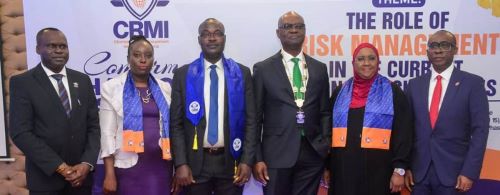

L-R: Registrar/Chief Executive, Chartered Risk Management Institute of Nigeria (CRMI), Victor Olannye; Divisional Head, Risk Management Securities and Exchange Commission (SEC), Grace Abioye; Immediate Past President, CRMI, Ezekiel Oseni; President, CRMI and Executive Director/Chief Risk Officer, Fidelity Bank Plc, Kevin Ugwuoke; Director, Enterprise Risk Management, Nigeria Deposit Insurance Corporation (NDIC), Amal Haruna; and Rep. Keynote speaker, Deputy Group Management Director, United Bank of Africa (UBA), Chukwuma Nweke; at the CRMI Conferment Handover/Sent-Forth ceremony, held in Lagos recently.
Kevin Ugwuoke, Executive Director and Chief Risk Officer of Fidelity Bank Plc has formally assumed office as President of the Chartered Risk Management Institute of Nigeria (CRMI).
His leadership promises a reform-focused era anchored on policy advocacy, ethical standards, and digital innovation to deepen risk governance across sectors in the country.
Speaking during the presidential handover ceremony in Lagos over the weekend, Ugwuoke — who also doubles as acting President of the Federation of African Risk Management Associations (FARMA) — described his election as “a call to action.”
He pledged to reposition CRMI as a thought leader and institutional partner in shaping the future of risk management in Nigeria’s national development.
“Our mission is more than just certification; it’s about strengthening the culture of risk governance across sectors. We will collaborate with regulators, raise awareness, and provide practical tools to help organizations embed risk discipline at all levels.”
Ugwuoke outlined a five-pronged strategy to guide his administration: strengthening professional education and certification; deepening policy and regulatory engagement; accelerating digital transformation; integrating ESG and climate risk into corporate strategies; and mentoring the next generation of risk practitioners.
He explained that CRMI will align its initiatives with key policy institutions — including the Nigerian Economic Summit Group, the National Assembly, and sub-national governments — to help embed robust risk frameworks into economic development plans.
“We must integrate risk thinking into how we plan, govern, and invest. We will advocate for more inclusive regulations to empower small and medium enterprises, improve macroeconomic stability, and foster institutional resilience.”
Ugwuoke also announced plans to revise the Institute’s curriculum, introduce specialised certifications to reflect emerging risks, and implement a new National Risk Observatory to provide real-time risk data to both the public and private sectors.
“Digital innovation will be central to how CRMI operates going forward. We are automating our backend, delivering more virtual training, and employing technology to scale our impact across the country and beyond.”
In his remarks, the outgoing President of CRMI, Ezekiel Oseni, challenged the new leadership to consolidate on the achievements made under his tenure — from securing chartered status and strengthening partnerships to gaining greater international recognition — and take the Institute to the next level.
Also speaking on the occasion, Chukwuma Nweke, deputy managing director of United Bank for Africa (UBA), delivering a goodwill message on behalf of Group Managing Director, Oliver Alawuba, described Ugwuoke as a worthy successor.
“As Professor Oseni hands over the baton to Kevin Ugwuoke — a well-respected leader in the risk management ecosystem — we are assured CRMI is poised for greater achievements under his watch.”
Nweke stressed that growing economic uncertainties — from inflation and exchange rate volatility to growing debt — underscore the need for a more strategic view of risk. “Risk must be recognised not as a compliance obligation or a cost center but as a key enabler of resiliency and growth. Institutions that embed risk into their strategies will absorb shocks more effectively, unlock value, and inspire investor confidence.”
As part of the day’s ceremonies, 11 distinguished practitioners were conferred with the Fellow of Chartered Risk Manager (FCRMI) award, while 21 new members were formally inducted as Chartered Risk Managers (CRM).
Furthermore, a new Governing Council was inaugurated to oversee the affairs of the Institute for the 2025–2027 term, marking a decisive step forward in institutional renewal and policy direction.