
Generation Z is entering the workforce, bringing with it a tech-first mentality that will propel businesses further into the digital era while potentially deepening the divide among five generations in the workplace. According to global research commissioned by Dell Technologies, post-millennials – those born after 1996 and known as Gen Z – have a deep, universal understanding of technology and its potential to transform how we work and live.
“It’s almost a given that these digital natives have advanced technology and data science skills, but what is surprising is the level of digital maturity they are bringing to the workplace,” said Danny Cobb, corporate fellow and vice president of Technology Strategy, Dell Technologies. “Yet we haven’t raised a generation of robots. Gen Z sees technology not only as a tool for enabling human progress, but also as a means for leveling the information empowerment playing field. Their combination of vision and optimism is remarkable.”
The survey of more than 12,000 high school and college students in 17 countries reveals the younger generation’s outlook on technology and future jobs. Specifically:
98% have used technology as part of their formal education
91% say the technology offered by an employer would be a factor in choosing among similar job offers
80% want to work with cutting-edge technology; of those 38% are interested in IT careers, 39% want to work in cybersecurity and 46% aspire to do technology research and development
80% believe technology and automation will create a more equitable work environment by preventing bias and discrimination
An overwhelming 89% recognize that we are entering the age of human-machine partnerships: 51% of those surveyed believe that humans and machines will work as integrated teams, while 38% see machines as tools for humans to use as needed.
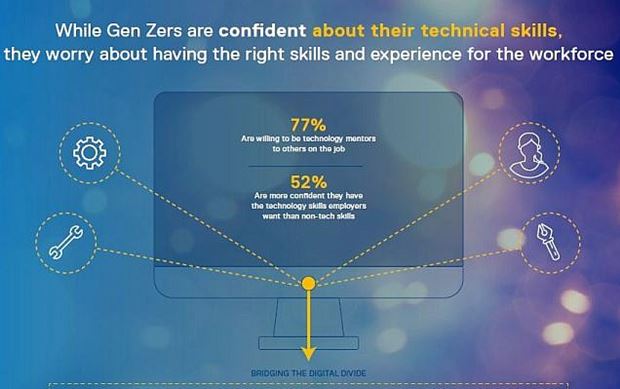
While most Gen Zers are confident with their technical prowess, they also worry about having the soft skills and experience that employers are seeking. Seventy-three percent rate their technology literacy as good or excellent and 68% say they have above-average coding skills. Even more telling, 77% are willing to mentor an older coworker who may be less experienced with technology. Yet nearly all new grads (94%) have some concerns about future employment.
Only about half (57%) rate their education as good or excellent in preparing them for their careers
52% are confident they have the tech skills employers want but not necessarily the non-tech skills
At the same time, senior professionals are concerned they are being outpaced and that a majority of leadership roles in the future will be filled by digital natives. According to previous Dell Technologies research, 87% of business leaders fear that their organizations will struggle to offer equal opportunities across generations.
With up to five generations now in the workplace, businesses must help workers find common ground as they push to create a digital-first culture. Cross-functional teams with complementary skillsets can encourage knowledge exchange and a fresh approach to problem-solving. Internships, rotation programs and other early-career development opportunities can help young professionals gain experience and develop soft skills on the job. And reverse mentorship programs can enhance technical competencies throughout an organization, with Gen Z leading the way.
“At Draper, we thrive on cross-discipline collaboration. It’s not unusual for us to bring together military experts, rocket scientists and students from area universities to solve some of the world’s most complex challenges,” said Mike Crones, CIO at Draper. “In these scenarios, the student provides a unique perspective to solution development. Many of the technologies we work on are highly interactive and Gen Z brings a curious, user-first approach that we might not otherwise consider.”
Although they have interacted with electronic devices practically since birth and grew up with social media, Gen Z yearns for more human interaction in the workplace.
In-person communication (43%) is the preferred method for communicating with coworkers, followed by phone (21%); messaging apps and texting ranked last
75% expect to learn on the job from coworkers or other people – not online
82% say that social media can be a valuable tool in the workplace
More than half (53%) prefer to go to a workplace versus working from home and 58% prefer to work as part of team rather than independently
“Today’s young professionals grew up in a collaborative educational environment and they are bringing those same expectations to the workplace,” said Maribel Lopez, technology industry analyst and strategic advisor at Lopez Research. “Though face-to-face communication isn’t always in possible in today’s modern workplace, immersive technologies are enabling all types of workers to collaborate in both the physical and virtual worlds.”
Added Cobb, “Ultimately, those organizations that create a workforce in which all generations are supported will thrive in the era of hum