World Bank Report: Remittances to Developing Nations Hits $432bn in 2015

The World Bank in its report entitled “Migration and Development: A role for the World Bank Group” said remittances to developing countries have tripled public development aid to $432 billion in 2015.

Despite migration affecting welfare of migrants, their households’ as well that of the community they left, and that of host country, it has a few advantages of which benefits of remittances and their associated sending-reception fees. The global impact of migration on migrants’ home countries is usually significant and positive, the report states.capture
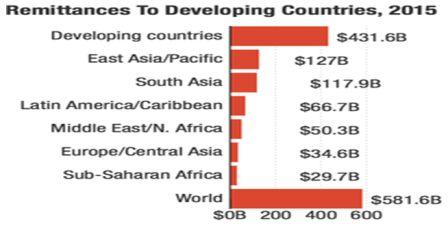
Remittances are one migration’s main advantages, for home nations, since migrants often send part of their revenues to their families back there.

Unlike public aid which is which flows through official institutions, remittances are directly sent to the families of migrants and thus meet the needs of beneficiaries more efficiently. Also, in opposition to private capital inflows which are highly cyclical, remittances are often stable and are insurance for households affected by economic crises and natural disasters.

For example, in 2013, remittances to India exceeded its IT services exports. In 2015, remittances to Egypt were four times greater than revenues generated by the Suez Canal. In most small countries and insular countries like Tajikistan, Nepal, or Haiti, remittances represent a third of GDP.

Remittances are a great way of sharing prosperity between different places. They can reduce the level of poverty by directly augmenting the incomes of poor households, the report indicates.

 -Alain Okpeitcha

spot_img
spot_img
spot_img
spot_img
spot_img

Hot this week

AEDC Bemoans Power Supply Disruption in Maitama after Invasion of Sub-station by Land Grabbers

The Abuja Electricity Distribution Company (AEDC) regrets to inform...

INTI International University Appoints Dr. Walter Duru as Research Fellow

Renowned Nigerian communication scholar, public relations leader, and Associate...

World Skin Health Day 2026: Skin Health Beyond Skin Colour – Better Knowledge, Better Skin Health

Dr. Folakemi Cole-Adeife Consultant Physician and Dermatologist LASUTH Every year on...

Stanbic IBTC Deepens Commitment to MSME Growth through Strategic Partnership with Abia State

Stanbic IBTC has reaffirmed its commitment to accelerating the...

Tinubu’s Biggest Opponent is Not Obi or Atiku… It’s Tinubu

  By Moses Braimah "A government that spends more time explaining...

Topics

Universal Insurance Paid N1.2bn Claims in 5 Years

Mr. Ben Ujoatuonu Managing Director/CEO Universal Insurance Plc Universal Insurance Plc paid...

SEC Targets N5tn Market Capitalisation from 50 Shari’ah-compliant Products by 2025

The Securities and Exchange Commission (SEC) has reiterated that...

Red Star Express Restates Commitment to Compliance with Regulations

Red Star Express Plc, a licensee of Federal Express...

T2 Unveils Nigeria’s First Electronic KYC SIM Registration Web App

 T2 proudly announces the launch of its revolutionary electronic...

IWD 2023: Interswitch Reiterates Call for Gender Parity

  L-R: Founder/CEO, MH Worklife, Blessing Adesiyan; Founder/CEO, Gush Lifestyle, Deborah Odim; Human...

NSE Reports N1.86bn Surplus in 2015, Plan EGM

The Nigerian Stock Exchange held its 55th Annual General...

$3tr Emerging Markets Debt Threatens Global Economy

The International Monetary Fund (IMF) says emerging markets have over-borrowed over $3 trillion in debt, thus posing the greatest risks to the global economy amid a fifth straight year of slowing growth. "We estimate that there is up to $3 trillion in over-borrowing in emerging markets," Jose Vinals, a top IMF official, said in presenting the body's Global Financial Stability report at its Annual Meetings in Lima, Peru.
spot_img

Related Articles

Popular Categories

spot_imgspot_img