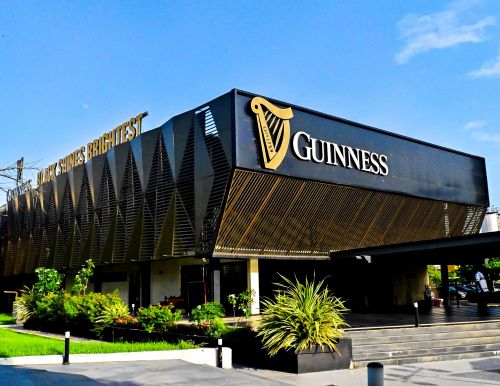

The Managing Director/CEO of Guinness Nigeria Plc, Girish Sharma has attributed the company’s strong start in 2026 to a blend of operational efficiency, localised decision-making, and expanded market reach – factors he says have fundamentally repositioned the business for sustained growth.
Speaking in an interview with CNBC Africa, Sharma said the results reflect not only financial resilience but the strength of a deliberately re-engineered operating model.
“We grew distribution, we’ve become far more efficient today, and we were able to make our people more agile because we brought decision-making down to Nigeria,” he said. “The past year has been a year of reset, but expecting 144 per cent revenue growth might not be what we should be looking at. However, I don’t see why we’d not be growing by double digits at the very least.”
His comments come as Guinness Nigeria Plc opened 2026 on a notably strong footing, delivering a performance that underscores financial resilience and strategic discipline in a challenging operating environment.
The company reported a 48 per cent year-on-year increase in Profit After Tax to ₦10.39 billion, alongside a 4 per cent rise in revenue to ₦122.77 billion. Earnings per share improved, while net finance costs declined significantly, signalling tighter cost management and improved capital efficiency.
In a strong show of confidence, the Board approved an interim dividend of ₦2.00 per share, amounting to approximately ₦4.38 billion in total payout.
The results position Guinness Nigeria among a select group of consumer-facing firms sustaining shareholder returns despite macroeconomic pressures, including inflation and currency volatility. More broadly, the performance reflects disciplined execution, a strengthened balance sheet, and a business increasingly optimised for long-term value creation.
Beyond the topline figures, Sharma emphasised that the company’s performance is rooted in a deliberate strategic reset executed over the past year. According to him, the leadership team developed a structured blueprint anchored on four key pillars.
“From a strategy perspective, I spent the first 100 days drawing the blueprint,” he explained. “At the end of it, we actually broke the strategy into four pillars. First was culture; we needed to make people feel more empowered, more than anything else. Second was operational excellence by localising what we do; we wanted to achieve more efficiency with this.”
He added that consumer-centric innovation remains central to the company’s growth ambitions. “Thirdly, we are very obsessed with the consumers, so we had them at the centre of our strategy – we took out a few products and became a lot more innovative in adding some. And finally, is the financial performance.”
Looking beyond the numbers, Sharma pointed to a portfolio strategy increasingly shaped by Nigeria’s cost-of-living realities.
While premium brands will continue to receive investment, he noted that future growth is likely to be driven by value-led innovation tailored to pressured consumer wallets, pointing to the recent launch of Orijin Beer in PET format as an early example of how pack sizes and propositions are being reworked to meet shifting demand.
He also mentioned that he sees growth opportunities across several categories over the next two to three years, including ready-to-drink beverages, mainstream spirits, beer, and malt.
“Consumer tastes are evolving quickly,” he said, “and our job is to stay close to those shifts and respond with the right products.”
For Guinness Nigeria, the reset year has cleared the pathway to a sharper phase of execution, one focused on translating operational discipline into category leadership and durable consumer relevance.