Sunday, May 17, 2026
27.8 C
Lagos

#VisaFreeAfrica Initiative Introduces Writing Competition

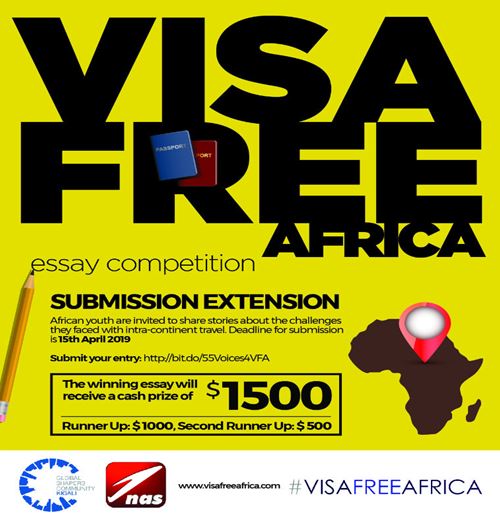
#VisaFreeAfrica (VFA) recently introduced the 55 Voices for a Visa Free Africa  (55Voices4Africa) writing competition, inviting all African youth to share stories about the challenges they faced with intra-continent travel.
VFA is a global campaign to facilitate mobility in Africa driven by the Kigali Global Shapers in partnership with National Aviation Services (NAS), the fastest growing aviation services provider in the emerging markets.
Kigali Global Shapers, a community whose vision is to create a platform that engages with the youth to inspire innovation and change launched the writing competition to build further awareness on the important of achieving a visa free Africa. This campaign will help put a face to a large number of young Africans with missed opportunities in areas of education, tourism, health and work among many sectors they would thrive in.

Participation
The “55Voices4Africa” competition is open to all African nationals between the ages of 18 to 30 years, based in any African country.
To participate in the competition, one should submit a story that is a narrative based on an experience writer or someone they know has faced when traveling to or from an African country that involved a tedious process to acquire a visa.
The essay should be no more than 1,000 words in a narrative nonfiction style written in English, French, Arabic or Portuguese.
Deadline for submissions is 15 April 2019 at 11:59 PM GMT.
The submitted story must be an original work, entirely owned by the entrant, and does not infringe on the copyright, trademark, intellectual property privacy or other rights of any third party under applicable laws, rules and regulations.
Winners will be announced by 30 April 2019.
To submit your entry visit: www.VisaFreeAfrica.com

spot_img
spot_img
spot_img

Hot this week

CIG Motors: Pay ₦3m For a Brand New Car in May Splash Promo on Electric, Petrol Vehicles

New campaign introduces EasyPay auto-financing, major discounts and nationwide...

Understanding Why Corporates Need Credit Rating

In today’s dynamic financial landscape, silence leaves room for...

Distinguished Industry Veteran, Olusola Teniola, to Chair NDSF 2026

The organising committee of the 2026 Nigeria DigitalSENSE Forum...

The Nigeria Prize for Science & Innovation Hits New Peak as 2026 Edition Attracts 237 Entries

The 2026 edition of The Nigeria Prize for Science...

Heirs Insurance Group Named among Africa’s Fastest-Growing Companies in Financial Times Ranking

Heirs Insurance Group has achieved a landmark double recognition,...

Topics

Global Airlines Financial Monitor: September 2016

The latest financial results indicate that industry profitability...

Africa, Middle East Tablet Market Shrinks 13.3% in Qtr2

Sluggish demand from consumers across much of the Middle...

NCC-CSIRT: The Countermeasures Against Website Scams on Microsoft Edge Browser

The Nigerian Communications Commission's Computer Security Incident Response Team...

NCC Says It’s Not Responsible for Monitoring Social Media Content

L - R: Nafisa  Rugga, Head, Digital Media, Nigerian Communications...

UK Corporate Pension Plans End 2016 with $533bn Record Deficit

The total deficit of all U.K. corporate pension funds...

Niteon Unveils First African Manufacturers Bank to Unlock $200bn Digital Export Market

Niteon, one of Nigeria's largest digital export marketplaces, has...

NCDMB Chief: Local Content is Africa’s Route to Economic Development

  African nations seeking to achieve economic prosperity must develop local capabilities to process, utilise, and...

Sub-saharan Africa, Most Expensive Region for Remittance

Sub-saharan Africa is the most expensive region for sending money inform of remittance from other parts of the world, according to the latest report by the World Bank Group. The report listed South Asia as the least expensive. The World Bank said over $62.5 billion has so far been saved for migrants who send money home to their families in an initiative began in 2005 by the Bank and the international community to reduce the cost of sending money home. Each quarter the World Bank publishes data on how much it costs to send money home.
spot_img

Related Articles

Popular Categories

spot_imgspot_img