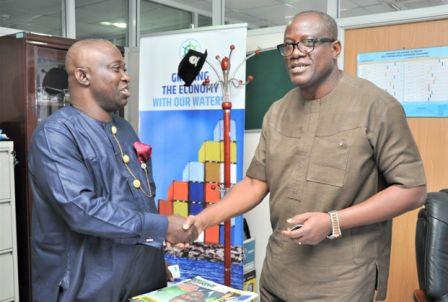
The Nigerian Maritime Administration & Safety Agency (NIMASA) and Business Journal have jointly agreed a partnership to ensure sustainable growth of the maritime sector in Nigeria and the larger economy.
During a courtesy visit to the management of NIMASA by the management of Business Journal yesterday in Lagos, Engr. Rotimi Fashakin, Executive Director, Operations at NIMASA expressed the desire of the Agency to work with Business Journal to sustain the rebranding and achievements of NIMASA.
Fashakin, who represented Dr. Dakuku Peterside, Director-General/CEO of NIMASA, described the Agency as a responsible agent of the federal government in the maritime environment.
He added that the new logo of NIMASA was designed to effectively identify and project its core values to stakeholders in the maritime industry.
Fashakin said that NIMASA is ready to partner Business Journal to create and achieve greater media mileage for the Agency in the process of discharging its statutory functions in the industry.
The NIMASA Executive Director said:
“I must commend the courage and spirit of entrepreneurship of Prince Cookey, Publisher/CEO of Business Journal in starting and sustaining the publication since 2008 despite the problems of venturing into such business in Nigeria. It is people like him that we need to do business with. NIMASA is ready to do business with Business Journal.”
Earlier in his address, Cookey commended NIMASA for granting the management of Business Journal the opportunity to visit the Agency to explore areas of mutual co-operation.
He said the time has come for the maritime sector to rise to the challenge of diversification of the economy away from oil dependency. He said a sustainable maritime sector under the leadership of NIMASA will lead to sustainable growth of the Nigerian economy.
The Business Journal publisher cited a 2012 report by Oxford Economics stating that shipping contributed as much as €56 billion to the Gross Domestic Product (GDP) of Europe while the African Development Bank (AfDB) also declared that Nigeria accounts for 65 percent of total maritime trade traffic in West/Central Africa as at 2011.
Cookey said:
“A sustainable maritime sector will ensure sustainable economy for Nigeria. The diversification policy should start from the maritime industry given its potential to generate sustainable revenue and jobs for the economy. NIMASA needs more visibility and media engagement to effectively project its values, corporate performance and lead the sector towards greater contribution to the nation’s GDP. We stand ready to support the transformational agenda of NIMASA under the leadership of Dr. Dakuku Peterside.”
He added that Business Journal which has three distinct segments: Online (businessjournalng.com), weekly business newspaper and monthly magazine, has a policy of strategic partnership with major operators in key sectors of the economy.
ABOUT NIMASA
The Nigerian Maritime Administration and Safety Agency (NIMASA) is the apex regulatory and promotional maritime agency.
The Agency was created from the merger of National Maritime Authority and Joint Maritime Labour Industrial Council (former parastatals of the Federal Ministry of Transport) on the 1st August 2006. The obligation of regulating the Maritime industry in Nigeria rests on the Agency through the relevant instruments:
1: Nigerian Maritime Administration and Safety Agency Act. 2007.
2: Merchant Shipping Act. 2007.
3: Coastal and Inland Shipping (Cabotage) Act 2003
The Agency was established primarily for the administration of Maritime Safety Seafarers Standards and Security, Maritime Labour, Shipping Regulation, Promotion of Commercial Shipping and Cobatage activities, Pollution Prevention and Control in the marine environment, the Agency also implements domesticated International Maritime Organisation (IMO) and International Labour Organisation (ILO) Conventions.
Photo Gallery