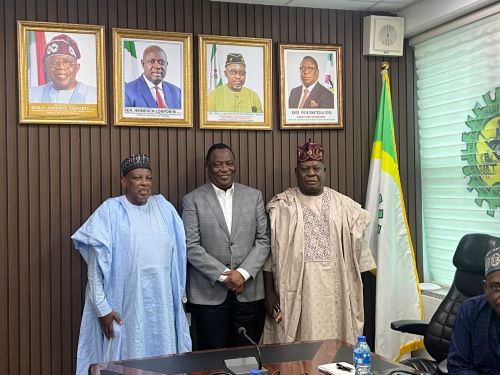

L-R: Executive Secretary, Universal Basic Education Commission (UBEC), Dr Hamid Bobboyi and the Executive Secretary, Nigerian Content Development and Monitoring Board (NCDMB), Engr. Felix Omatsola Ogbe after the meeting between the chief executives at NCDMB’s Abuja liaison office. Executive Secretary, Universal Basic Education Commission (UBEC), Dr Hamid Bobboyi and the Executive Secretary, Nigerian Content Development and Monitoring Board (NCDMB), Engr. Felix Omatsola Ogbe with top management staff of both agencies after the meeting between the chief executives at NCDMB’s Abuja liaison office on Tuesday.
The Nigerian Content Development and Monitoring Board (NCDMB) and the Universal Basic Education Commission (UBEC) have agreed to collaborate towards upgrading basic education in the country and building capacities of young Nigerians towards meeting the needs of the ever-changing oil and gas industry and the linkages sectors.
The partnership opportunities were explored on Tuesday when the Executive Secretary NCDMB, Engr. Felix Omatsola Ogbe hosted his counterpart from UBEC, Dr. Hamid Bobboyi at the Board’s Abuja liaison office. The leaders agreed to set up a joint committee that would finalise details of their agencies’ collaboration, with the overall goal of contributing meaningfully to the future of the Nigerian economy.
The kernel of the meeting attended by the top management of both organisations centred on how NCDMB could partner UBEC to upgrade some dilapidated primary and junior secondary schools dotted across the country, train teachers and upgrade critical facilities to meet the demands of the present age. Conversations also hovered around making basic education work sustainably, developing digital resource centres and smart school systems as well as synergising efforts of stakeholders in the education sector for maximum impact.
Before this engagement, NCDMB had developed over 150 ICT centres in secondary schools across the country and upgraded select technical colleges as well as intervened in some universities as part of its institutional strengthening programme, supported by international and indigenous oil producing companies.
In his remarks, the Executive Secretary of NCDMB announced the introduction of a bespoke capacity-building project tagged “Back to the Creeks/ Villages.” The initiative would seek to revamp dilapidated primary schools, especially in the creeks of the Niger Delta and other parts of the country, develop their infrastructure, teaching personnel and curriculum to world-class standards and make the interventions sustainable.
Ogbe revealed his passion for contributing to the development of remote parts of Nigeria and mentioned that he had started engaging some international oil producing companies. He hopes the oil companies will embrace the initiative and channel their human capacity development (HCD) budgets to the new programme for symbiotic benefits.
He underscored the strategic need to begin at the basic education level to develop capacities of young Nigerians, rather than intervening at the senior secondary or tertiary levels.
The Executive Secretary said the detailed strategy for the “Back to the Creeks/Villages” was still being fine-tuned and would soon be unveiled to industry stakeholders.
He assured the UBEC boss that NCDMB would partner with the agency, beginning with the training of teachers, harping that the success of the collaboration would attract other entities to partner with UBEC.
He emphasised the need to develop complete project scopes and to make every intervention sustainable. This can be achieved he explained, by deliberately getting the benefitting communities to take ownership of the projects. .
Earlier in his remarks, the Executive Secretary of UBEC suggested that NCDMB should partner with the agency to develop, equip and operate Digital Resources Centres and Smart School Solutions in states of the federation.
The UBEC boss bemoaned the embarrassing state of basic educational institutions across the country and remarked that a nation that neglected the first level education had invariably embraced a bleak economic future and dysfunctional society.
He rued several challenges that impact the development of basic education in the country, such as insufficient budget, and lack of interest by some state governors. among other issues. He highlighted the need for collaboration with stakeholders, to leverage extra resources for the sub-sector.
In their contributions, the Director, Corporate Services NCDMB, Dr. Ama Ikuru commented that NCDMB’s interventions in schools and other centres of learning in the past 14 years were in furtherance of its mandate of building requisite capacities for the Nigerian oil and gas industry and linkage sectors.
Likewise, the Director, Monitoring and Evaluation, Mr. Abdulmalik Halilu advised that the Board’s collaboration with UBEC must be guided by four pillars, notably needs assessment, sustainability plans, enablers for execution and identification of funding sources.