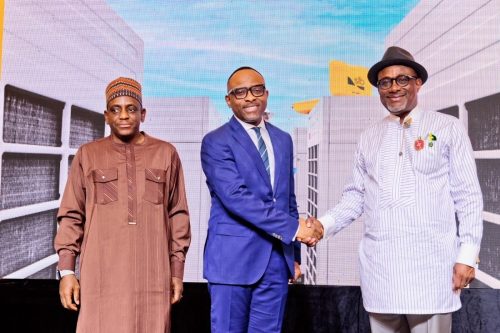

L-R: Director, Planning, Research and Statistics, Nigerian Content Development and Monitoring Board (NCDMB); Mr. Abdulmalik Halilu; Group Managing Director, West Africa, SLB, Mr. Sops Ideriah and Executive Secretary, NCDMB Engr. Simbi Kesiye Wabote, at the unveiling ceremony of NCDMB-SLB Technology Enhancement Program (N-STEP) in Lagos, Nigeria.
The Nigerian Content Development and Monitoring Board (NCDMB) and SLB, a global technology company on Tuesday in Lagos unveiled the first three products of their joint program, the NCDMB-SLB Technology Enhancement Program (N-STEP), a platform whereby students of higher institutions develop software plugins for diverse oil field applications.
The programme was unveiled at the sidelines of the 2023 Nigerian Association of Petroleum Geologists (NAPE) and it showcased nine students representing three prestigious universities in Nigeria who had developed software solutions that would address live oil and gas challenges.
The unveiling ceremony was witnessed by industry stakeholders, academia and representatives of the beneficiary institutions.
The N-STEP program provides a unified framework for the rapid development and deployment of software solutions to address oil and gas challenges. Deployed through a phased, multidimensional approach, the program is focused on the development of software plugins by students for diverse oil field applications.
As part of its 2023 cohort, the projects highlighted machine learning, Artificial Intelligence and new innovations that could unlock potentials in the Nigeria oil & gas sector. The universities represented by this cohort were: University of Lagos; Federal University of Petroleum Resources Effurun; and Abubakar Tafawa Balewa University Bauchi.
In his opening remarks, Executive Secretary, NCDMB, Engr. Simbi Kesiye Wabote’s commented: “The N-STEP program is an industry-education partnership under NCDMB’s Adopt a Faculty Initiative for STEM courses. It is designed to drive collaboration between industry, universities, and Government through Research and innovation, curriculum review, infrastructure, and equipment, and learning and knowledge exchange in Nigeria. Nigeria spends an estimated $400 million annually on foreign software, which is a huge drain on our Forex. We embraced the NSTEP to demonstrate our commitment to reverse this trend. The program has also targeted undergraduates because we believe Nigerian youths have the innovation drive, to be solution providers and not job seekers.”
Speaking to the impact of the N-STEP program, Group Managing Director, West Africa at SLB, Sops Ideriah, said: “We want to empower software developers to create and deploy plug-ins that extend the utilization of E&P software platforms. This is why we collaborated with both the public sector and the best of academia to deliver a structured training program, where selected students will gain the knowledge and skills necessary to apply their expertise to develop innovative software solutions that address specific E&P industry challenges. The program also provides mentorship, internship opportunities, and cutting-edge training tailored to industry needs, empowering future generations of innovators and leaders for the energy industry of tomorrow. Our joint ambition in this collaboration is to extend the program scope to cover a minimum of one university in each key region in Nigeria.”
For SLB, the N-STEP program will not only serve to foster education, but also to detect and eventually tap into local talent. “At the forefront of global technology, we are relentlessly looking for exceptional individuals with the potential to revolutionize the energy landscape. This program provides us with a strategic opportunity to identify and nurture future leaders within our organization,” Ideriah added.