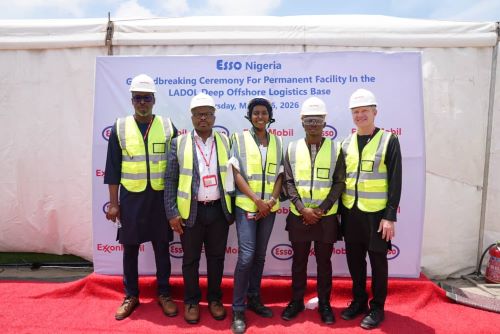

The Nigerian Content Development and Monitoring Board (NCDMB) has applauded ESSO Nigeria on the groundbreaking of its permanent shore-base facility at the LADOL Deep Offshore Logistics Base, describing the project as a major demonstration that Nigeria has become a prime hub for global oil and gas logistics.
ESSO Nigeria is an affiliate ExxonMobil, an international operating company and the shorebase facility is valued at $23 million and will include an administrative building, warehouses, and other storage areas.
Speaking at the event held at LADOL base, Lagos, the Executive Secretary of NCDMB, Engr Felix Omashola Ogbe congratulated ESSO and LADOL on the project, and reaffirmed the Board’s commitment to working with industry players to deepen capacity development in the country’s upstream supply chain.
He praised LADOL’s track record of consistency, tenacity and forward-looking momentum, and noted that the qualities had been evident over many years of close engagement with the facility.
He situated the groundbreaking within the broader context of the ongoing global logistics crisis triggered by instability in the Middle East, noting that supply chain disruptions had driven up costs from Singapore to Eko Hotel and across markets in the United States, sparing no economy.
The Executive Secretary who was represented by his Senior Technical Adviser, Engr. Austin Uzoka noted that LADOL’s emergence as a credible deep offshore base represented a direct and tangible response to vulnerability in the logistics sphere of the Nigerian oil and gas industry.
“Today, we’re pleased that Nigeria has an alternative” he stated, drawing a parallel between the completion of the Dangote Refinery and the expansion of LADOL, and harping that Nigeria’s supply chain was measurably stronger than it was 10 years ago.
The NCDMB chief urged ESSO’s leadership to adopt a front-end-loaded payment structure in its contractual arrangements with LADOL, arguing that timely and adequate funding from the client side would enable the facility to complete the project without recourse to bank loans at cut-throat interest rates.
He noted that cash flow constraints had become a recurring challenge for Nigerian suppliers across the industry, with many approaching the Board for funding support precisely because payment timelines from operators were not aligned with project delivery demands.
“I would like to encourage you to pay LADOL more. Make sure that it is front-end-loaded, so they can have money to finish this on time without having to go to the banks and pay high interest rates to get the job done.”
He emphasised that supply chains are at the bedrock of national development and that the NCDMB, as the agency mandated to grow capacity in Nigeria’s oil and gas industry, will continue to deepen its partnership with both the LADOL and ESSO to build more capacity within the country.
He described ESSO as a measured and deliberate operator that moved decisively once committed, expressing confidence that the groundbreaking signalled the commencement of a project that will be delivered on schedule.
He further charged that ESSO Nigeria to remain committed to the utilizing the Nigerian capacities and capabilities on delivering the project.
The Chairman and Managing Director ExxonMobil affiliates in Nigeria, Mr. Jagir Baxi had earlier indicated that the project reflects an important milestone investment by ESSO Nigeria in its 70-year long partnership with the country. The project also underscores the company’s steadfast commitment to enhance Nigeria’s deepwater offshore operational capabilities.
The structures will be constructed predominantly by Nigerian companies, thereby supporting local job and development of expertise in engineering, construction and commissioning, the company’s chief executive added.
The ceremony was attended by representatives of the Bank of Industry, leadership of ESSO Nigeria, the LADOL management led by Dr. Amy Jadesimi, as well as officials from the Nigeria Customs Service, the Nigeria Immigration Service, and other relevant government agencies.