
Close partnership and collaboration among African oil and gas producing countries are some of the strategies that would enable sustainable development of Africa’s oil industry, according to discussants at the Africa Content Forum, a segment at the 2025 Africa Oil Week holding in Accra, Ghana.
The Executive Secretary, Nigerian Content Development and Monitoring Board (NCDMB), Engr. Felix Omatsola Ogbe delivered the keynote address at the forum. Represented by the Director Corporate Services, Dr. Abdulmalik Halilu, the Executive Secretary pointed out that no single African country can fully develop its local content potentials and support her the oil and gas industry without the collaboration of other nations, hence the need for close partnership with other nations.
He pointed out that the Africa continent holds more than 10 percent of global crude oil reserves and eight percent of proven natural gas resources, and is also host to critical resources for renewable energy. He argued that the continent’s oil and gas wealth must fuel intra-country trade, industrialisation, value retention and prosperity, rueing the current situation where many African countries export raw materials to more developed countries across the globe, whereas there is minimal inter-country trade within the continent.
Speaking on the need for consolidation and scaling of local content programs beyond borders, Halilu canvassed for an enduring policy framework with full complements of governance and enforcement oversight as well as Human Capital Development and cross border deployment as critical pillars.
He noted that the continent must continue to reward efforts focussed at technology development as local content policy without research and development will remain static.
On cross border partnerships and collaboration, the Director posited that “Africa’s diverse capabilities are its greatest strength with strong collaboration. Just as a Boeing or Airbus is built with components from different countries, we can build a thriving African energy sector by specializing and trading with one another, where each country specialises in areas where it has a comparative advantage.”
Halilu reiterated the need for mindset change of seeing local content as social responsibility initiative but about ensuring that capital stays within our borders, and our nations build the technological and industrial capacity to compete on a global scale.
“Let us build an African energy sector that is owned, operated, and sustained by Africans. A sector that provides jobs for our youth, creates wealth for our nations, and brings true prosperity to our continent,” he said.
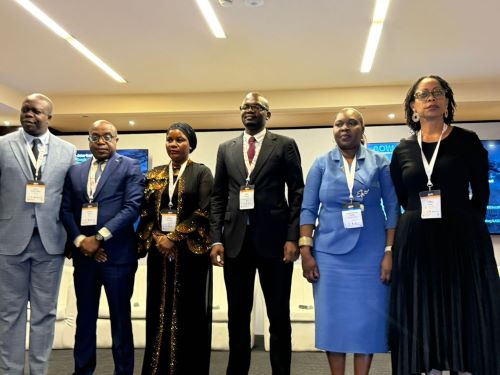
The forum featured four panel sessions and was attended by policymakers, oil and gas operating and service companies, original equipment manufacturers (OEMs) and other stakeholders from various Africa countries and other continents.
The first session focused on strategies for African content growth, and the panelists recommended that the future of the continent lies in deliberate planning, strong policies, and the courage to take bold steps that position African solutions at the center of Africa’s development.
The second session examined African capacity and expertise, while the third session discussed cross-border projects and knowledge exchange. Panelists underscored the power of partnership, the necessity of breaking silos, and the immense potential of sharing best practices to accelerate progress across our markets.
The fourth session focused on funding African content and was moderated by the General Manager, Corporate Communications, NCDMB, Dr. Obinna Ezeobi.
Discussions on the panel highlighted strategies for attracting sustainable funding for oil and gas projects, and the need for African oil and gas companies to decarbonise their operations and comply with environmental, social and governance (ESG) regulations.
Other themes included innovative funding options that are available in the continent and how companies can position themselves appropriately to access them.
The NCDF model was also showcased, highlighting how it has been applied successfully to grow capacities and capabilities in the Nigerian oil and gas industry.