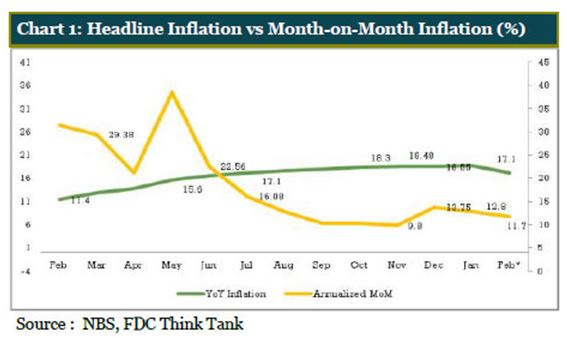

The National Bureau of Statistics (NBS) has released its CPI and Inflation report for the month of June 2018, revealing that Nigeria’s headline inflation rate moderated on a year-on-year basis for the 17th consecutive month to 11.23%, from 11.61% in May.
Compared to Cordros Capital’s forecast of 10.90%, the number came in 33 bps higher and also 27 bps ahead of Bloomberg compiled average estimate of 10.96%. Parsing the released data, we establish a number of instructive takeaways, including:
- The continued weakening of the mechanical impact of the well-known base effects. It is good to note that the pace of moderation (38 bps) recorded in June, relative to May, was the slowest since February 2018 and stood at a significant discount to the average deceleration rate of 75 bps achieved thus far this year.
- The strong increase in month-on-month headline inflation rate at 1.24%. Dissecting that number, we found it to be the highest m/m inflation rate posted in the last twelve months. Apart from that, the rate is equally higher, by 39 bps and 4 bps respectively, than the average m/m rates recorded in H2-17 (0.85%) and 2017FY (1.20%).
- The consistent downtrend and uptrend of y/y and m/m numbers respectively for the headline index and its food and core components.
- The ubiquitous nature of the m/m upward trajectory across the entire CPI basket.
Monetary Policy Committee Meeting: Further Justification to Maintain Status Quo
The Central Bank of Nigeria’s (CBN) Monetary Policy Committee (MPC) in its third meeting of the year yesterday decided to maintain the status quo.
Drawing on prevailing realities and insights from the last meeting in May, we expect members of the Committee will find the case for maintaining status quo most compelling. We would like to reiterate the MPC’s shift from a potential rate cut to a more proactive view of inflation, amid upside risks to liquidity injection over H2-18.
Outlook
Following the latest numbers, we revisit our model and revise our July inflation projection higher by 45 bps to 11.16% y/y (1.15% m/m), previously 10.71% y/y (1.04% m/m). Our workings were largely guided by our view that base effects will weaken further. Consequently, we now expect 2018 average inflation to be slightly higher at 12.29% (previously 12.09%).
While we share consensus view that elevated liquidity profile over the rest of the year portends upside risk for inflationary conditions, we equally posit that supply-side dynamics will play even a much greater role.
We establish that circa 87% of the entire CPI basket is driven by factors independent of liquidity position owing to the autonomous consumption nature of the specific constituent elements.
Very instructive in that regard, for instance, we highlight likely pressure from higher food prices (domestic and imported food inflation jointly account for 64% of the entire CPI basket) over the rest of the year amid the unresolved security upheavals in the agricultural space and rising global inflation.