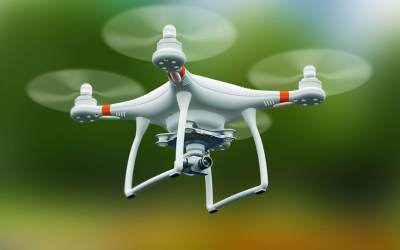

Putting drones at the centre of a technology-led transformation of Indian agriculture, with support from emerging business models such as digital financing, precision agriculture and rapid awareness building, can boost GDP by 1%-1.5% and create at least 5,00,000 jobs in the coming years in India, according to a new World Economic Forum report, Using Technology to Improve a Billion Livelihoods.
The report, which was written by the World Economic Forum’s Centre for Fourth Industrial Revolution, India in collaboration with Adani Group, was launched in Gandhinagar, Gujarat, today.
“Arguably, aviation is one of the most regulated sectors globally. India’s bold and measured approach to spur unmanned aviation has been celebrated across a wide spectrum of stakeholders. To make the most of this regulatory landscape, drones must be part of the core agri-equipment repertoire alongside tractors, cultivators, ploughs, diggers and combine harvesters to fortify our farms,” said Vignesh Santhanam, Project Lead, Aerospace and Drones, India, World Economic Forum.
“The cross-industry application of drones is nearly limitless and continues to make great strides. It offers countries like ours the opportunity to leapfrog generations of infrastructure, healthcare, logistics, agriculture and defence advancements and break several process barriers. When combined with next-generation imaging technologies, edge-based artificial intelligence and machine learning capabilities, the possibilities are endless. We have always believed that the most meaningful revolutions happen at the intersection of various domains – between military and civil, between drones and AI and between physical and digital. India has taken a lead to establish several forward-looking policies under the guidance of the Prime Minister to make India the drone hub of the world by 2030,” said Ashish Rajvanshi, CEO, Adani Defence & Aerospace; President, Strategy & Chairman Office, Adani Group.
Powerful use cases for drones, merging aerospace, AI and digital finance
Different studies have highlighted the immense potential in improving agricultural outcomes for farms through precision agriculture expertise and advisory that can enable a 15% increase in productivity in India’s $600 billion agriculture sector.
Drones can play a critical role in unlocking this value as they provide an effective medium to collect data and apply inputs, directly impacting yields and farmers’ income. Scaling drones in agriculture sector will also boost farm mechanisation and nudge India closer to global peers.
Coordinated research between civilian and defence technologies
The report also examines how civil-military convergence can accelerate research to benefit civil society applications. The report highlights different use cases for drones in agriculture such as crop monitoring, collecting data for advisory and application of farm inputs.
“Drones are poised to be the enabler of different use cases that leverage Fourth Industrial Revolution technologies. The need is to create a business model that drives rapid adoption and active usage of drones at farm level. It is possible only if the strengths of different ecosystem stakeholders are leveraged and unit-level value proposition is created for farmers,” said Abhay Pareek, Project Lead, Fourth Industrial Revolution for Agriculture, World Economic Forum, India.
Robust local supply chain and support system
In addition, given the nascent state of the drone sector and significant import dependence on various key components, there is a need to build a robust local support system including a “Made in India” supply chain, targeted skill development programmes, next-generation digital financing mechanisms and strong awareness-building programmes in Farmer Producer Organisations, Krishi Vigyan Kendras (KVKs), farmers and policymakers.
The report points out that a well-orchestrated set of interventions can add nearly $100 billion to GDP and help India leapfrog multiple challenges in the agriculture sector with the use of technology.
The need for a “drone microcosm” while mainstreaming
The mainstreaming of drones in the agricultural sector needs to be aided with the creation of a “green microcosm” where an integrated “drone-centric rural hub” is set up and stabilized across crop cycles. The microcosm would be a controlled environment that would test varied use cases pertinent to agriculture as well as other rural applications.
Further, considering the complexity of India’s agriculture system including different agro climatic zones, range of crop varieties, despaired use of irrigation technologies etc. drones’ integration in Indian agriculture can be achieved with form factor of drones and mission-based approach in partnership and ownership of stakeholders
“Drone costs fall significantly with local scale. There are multiple use cases on the same drone that can be achieved with a quick switch of payloads – from spraying to broadcasting to logistics. Creating local hubs where these applications can be deployed at scale can establish the business case and help players grow rapidly,” said Rangarajan Vijayaraghavan, Vice-President Strategy & Chairman Office, Adani Group.