Tuesday, April 21, 2026
29.3 C
Lagos

Brokers Initiate 10-Year Strategic Plan

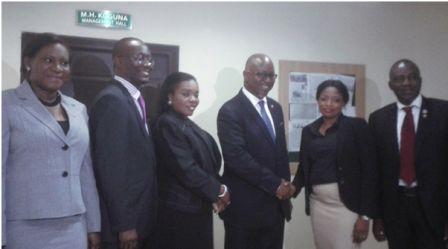
L-R Council member, Nigerian Council of Registered Insurance Brokers (NCRIB), Mrs. Ekeoma Ezeibe , Executive Secretary, NCRIB; Fatai Adegbenro, Deputy President, NCRIB; Dr. Mrs Bola Onigbogi, new President, NCRIB; Shola Tinubu, President, National Association of Insurance and Pension Correspondents; Omobola Tolu-Kushimo and council member, NCRIB; Tunde Oguntade at the maiden press briefing addressed by the new NCRIB president in Lagos.

The Nigerian Council of Registered Insurance Brokers (NCRIB) has initiated a 10-year strategic plan to further develop the broking arm of the Nigerian insurance industry and consolidate on the gains of the past and present.

Mr. Shola Tinubu, the 19thPresident of NCRIB, said the Plan will roll-over with two successive presidencies of the Council and lead to autonomy as part of the 8-point agenda of his administration. He also emphasized the importance of self-regulation by brokers to avoid running foul of the law guiding the conduct of their business.

“I want to champion self-regulation by brokers. This implies our members meeting their obligations in-house before assessment by regulators. That would strengthen our level of professionalism and practice in the sight of regulators and customers. We also need more brokers beyond the current number of 500 to achieve greater insurance penetration in the country.”

On the issue of rate-cutting, the NCRIB chief said: “There is no need for rate regulation. It is like taking the industry back to the era of marketing boards for cocoa etc of 50 years ago.” He added that each corporate entity should be able to fix its own rate taking cognizance of its competencies since there is currently no official or mandatory rate in the market.

Tinubu said the federal government has so far released 62 percent of the premium on its group life assurance policy, meaning that the policy might not take full effect until December 2017 in accordance with the ‘No Premium, No Cover’ policy of the industry.


spot_img
spot_img
spot_img

Hot this week

The Nigeria Prize for Literature 2026 Receives 223 Entries

Second from left: Abdul Umar, Manager, Government Relations, representing...

Stanbic IBTC Leads High-Level Trade, Finance Engagements at Global Trade Review West Africa 2026

Stanbic IBTC Bank, a subsidiary of Stanbic IBTC Holdings,...

Beyond Digital: Why Nigerian Banks, Corporates Still Bet Big on Print Media Advertisements 

P + Measurement Services Nigeria’s leading independent media intelligence...

BUA Foods MD Highlights Real Sector Transformation as Key to Nigeria’s Economic Future

BUA Foods Plc has been recognised as the Outstanding...

Bank of Industry Signs Strategic Partnership with RMRDC to Foster Agric Value-Chain Growth

Managing Director and Chief Executive Officer of the Bank...

Topics

ITU Targets $100bn Funding by 2026 to Accelerate Global Digitalisation

The International Telecommunication Union (ITU) has issued a worldwide...

Nigeria’s 2015 Appropriation Bill: Legislators Adopt the Ostrich Strategy

A week after the House of Representatives passed the 2015 Budget, the Upper Chamber fulfilled its part of the Appropriation process by passing a N4.5tn budget. This is N134.4bn in excess of the N4.4tn submitted by the Executive arm late 2014. Meanwhile, recurrent expenditure was reduced slightly by N0.5bn to N2.6tn while capital expenditure was scaled down by additional N85.9bn to N557.0bn from N642.8bn proposed by the Executive arm. Effectively, this implies that recurrent expenditure is approximately five times the capital expenditure.

NAICOM Chief, Sunday Thomas, Loses Wife

  Mrs. Oyinade Folashade Thomas The National Insurance Commission (NAICOM) is...

IMF Projects 3.9% Global GDP in 2018, 2019

The upturn in economic growth prospects for the global...

NCDMB ES Counsels Heritage Energy, Indigenous Firms on Corporate Governance

L-R: Government Relations Advisor, Heritage Energy Operational Services Limited...

DHL Expands Africa eShop Online Shopping App to 34 Countries in Africa

Since its initial introduction in April of this year,...

BUHARINOMICS: Charting Path to Sustainable Economic Renaissance

The presidential election was over on Saturday, March 28, 2015. It is now a historical document for academic research and street political analysis. On March 28, CHANGE triumphed over TRANSFORMATION AGENDA, leading to the emergence of General Muhammadu Buhari as President-Elect, Federal Republic of Nigeria. On May 29, Buhari will assume the leadership of the nation, bringing to an end, the regime of Goodluck Jonathan. For Buhari, it is a long road to Aso Rock. Three times he contested and lost. And three times he dusted the stinking ashes of defeat to rise again to seek for the same office. And on the fourth effort, he won. Either fortune smiled on him or the Gods took pity on him and handed him the office to break the cycle of defeat and save him from the poisoned pen of harsh historians and political propagandists.
spot_img

Related Articles

Popular Categories

spot_imgspot_img