Hackers have successfully infiltrated the internal SMS system of First Bank of Nigeria Limited by sending out fraudulent text messages to customers of the bank claiming that their account and ATM had been blocked due to the cashless policy of the Central Bank of Nigeria (CBN) and asking the customers to call a particular GSM number to rectify the situation.
The text message by the hackers using the name of First Bank read thus:
Dear customer, as regard to cashless policy, Your Account, ATM has been Locked due to change in date of birth, Contact customer care on 08111282787 to rectify.
But some customers that called the number reported the response thus:
You are not allowed to call this number.
During a visit this morning to First Bank branch at Ikotun in Lagos, a customer care officer said the message came from hackers and not from the bank. He warned customers of the bank not to call the number or disclose their account and ATM details for any reason.
He said the bank is aware of the situation but could not explain why First Bank has failed to send out a counter text message to its customers nationwide to protect them from falling victims to the hackers.
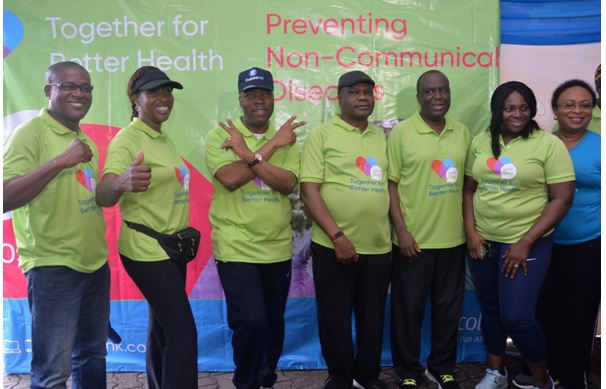
Left; Chief Risk Officer, Biyi Olagbami; Executive Director, Commercial Banking, Carol Oyedeji; Managing Director, Patrick Akinwuntan; Chief Audit Executive, Felix Igbinosa; Executive Director, Corporate Banking, Akin Dada and Chief Financial Controller, Ibukun Oyedeji, all of Ecobank Nigeria during the bank" commemoration of Ecobank Day 2019 in Lagos on Saturday.
Ecobank Nigeria has pledged its commitment and financial support to the fight against non- communicable diseases, especially cancer.
The Managing Director, Ecobank Nigeria Mr. Patrick Akinwuntan said this over the weekend during the bank’s cancer awareness walk in Lagos as part of the commemoration of Ecobank Day.
Ecobank Day is a special day set aside every year by Ecobank Group, for management and staff of the bank to embark on CSR activities that impact its immediate environment and people. The theme for this year’s edition is “Preventing Non-Communicable Diseases” with special focus on “Cancer Awareness” Ecobank Day holds simultaneously in the 33/countries in Africa where the bank operates.
Left; Chief Risk Officer, Biyi Olagbami; Executive Director, Commercial Banking, Carol Oyedeji; Managing Director, Patrick Akinwuntan; Chief Audit Executive, Felix Igbinosa; Executive Director, Corporate Banking, Akin Dada and Chief Financial Controller, Ibukun Oyedeji, all of Ecobank Nigeria during the bank” commemoration of Ecobank Day 2019 in Lagos on Saturday.
According to Akinwuntan, “We started the Ecobank Day in 2013 where we picked the first Saturday of every October to come together across our 36 countries to pick an item where we can add value to the society. This year, we decided that non communicable diseases deserve to be highlighted.’
He said the bank choose to support these cause because of its mortality rate and the need to encourage the people on regular check-ups to prevent the disease.
He said this year the bank would financially support a few selection of cancer patients nationwide and as well as cancer prevention awareness campaigns.
“For 3 years, we are going to focus on preventing non-communicable diseases and this year we are focusing on cancer.”
Furthermore he added: “For us, across all the venues today, we are offering either subsidised or free check-up for all the participants, work force, family and friends in order to check our health status and take care of early prevention.”
“And for those that the cancer impact is much higher, we would bring people together to contribute money to support them as they go through their cancer treatment. So for us in Ecobank Nigeria, you can go to our mobile app and you would see under our pay bills Ecobank cares and you are able to contribute so we support people battling cancer.”
On his part, the Chief Risk Officer Mr. Biyi Olagbami who also doubles as the lead CSR champion for Ecobank Nigeria said the bank plans to intensify its CSR activities nationwide.
He said: “In Ecobank, we take our CSR very seriously and we do this across all our presence countries “This should be the spring board to a stronger impact going forward. We have been doing this for a few years and we don’t intend to stop instead we intend to increase the intensity of our activity in this area.”
The cancer awareness walk took place simultaneously in Lagos, Abuja and Port Harcourt. The “walk” in Lagos led by its Managing Director and other Management staff kicked off at the bank’s headquarters on Ahmadu Bello Way through major streets on Lagos Island and it attracted accolades from passersby along the route.
The event also witnessed health talk by cancer specialists, speeches and testimonies from cancer survivors including free cancer screening.
The MTN Group today launched its “We’re good together” initiative. This is aimed at demonstrating how, in partnering with our host countries, we can change lives by improving digital access, driving financial inclusion, empowering and enabling SMEs, creating jobs and broad community development, among many others.
As a pan-African company with roots that are deeply anchored in the continent, MTN is telling its story that doing good business extends far beyond corporate social investment initiatives.
Speaking about the role of MTN on the continent, Group CEO and President Rob Shuter said: “To harness the potential of Africa and ensure our youth are productively employed we need affordable, safe and relevant digital services which are matched with the required digital skills. This in turn will support the global development agenda and national priorities. As one of the major infrastructure investors across Africa, MTN through partnership and collaboration can accelerate this digital inclusion.”
The global telecommunications industry has made significant progress on the Sustainable Development Goals but more still needs to be done to bridge the digital divide and MTN is prepared to do its part. Since inception 25 years ago, MTN has been a significant contributor to the economies and communities within which we operate.
A lot of this has been with respect to the infrastructure that is the backbone of the economies that we operate in, and often, that enables connectivity of people in the most remote areas. Our operations have also increasingly become a broader part of the economy through varying efforts including employment creation as well as Mobile Money.
“Over the last 25 years MTN has built high-speed networks covering 560 million people, created jobs for over 5 million people and through MTN Mobile Money connected 30 million people to the benefits of easy, cost-effective mobile financial services across the continent,” said Shuter.
MTN has also worked to use this extensive mobile reach and technology to enable access to education with the goal of promoting and enabling digital teaching and learning. This has been driven by our aim to empower students with the knowledge required to seize opportunities, improve their quality of life and realise their ambitions.
“MTN only succeeds if Africa succeeds. Being a partner in development also means that we have a responsibility to enable the youth to unlock economic opportunities in every country we operate in. We have therefore enhanced our focus on more actively demonstrating what can be achieved if we work together to enable a shared value system and drive a prosperous Africa,” added Shuter.
In commemoration of Nigeria’s 59years’ independence anniversary, Nigeria’s leading retail bank, Access Bank Plc has unveiled a cash incentive campaign tagged “DiamondXtra Independence Splash” to reward over 30 DiamondXtra customers daily with cash prizes.
The campaign is set to run from October 2to October 31, 2019 and will reward over 600 customers during the campaign period.
Speaking at the unveiling ceremony in Lagos, the Executive Director, Retail Banking, Access Bank Plc, Victor Etuokwu said the bank introduced the daily rewards promo in commemoration of the country’s independence to give as many Nigerians as possible financial freedom and empower them to fulfil their day to day needs as they celebrate Nigeria at 59.
“The DiamondXtra Independence Splash which is going to run from October 2 to October 30, 2019 is a testimony to our commitment to empower Nigerians financially irrespective of their educational, religious and social status.
For 30 days of celebrating Nigeria at 59, we will be rewarding more than 30 lucky customers daily with cash prizes ranging from, N10,000, N20,000 and N50,000 respectively. This is our own little way of giving back to our loyal customers.
To qualify for the DiamondXtra Independence Splash reward scheme which is open to both new and existing customers, new customers are required to open a DiamondXtra savings account with just N5,000 by dialling *901# or walking into one of our branches to open the account. However, the more multiples of N5,000 both new and old customers save, the higher their chances of winning at the daily draw” Victor concluded.
DiamondXtra is an interest yielding hybrid account which allows deposit of both cash and third party cheques. Hybrid means a combination of both savings and current account features. The DiamondXtrareward scheme has given away over N5 billion in cash and household items to over 15,000 loyal customers over the last 11years.
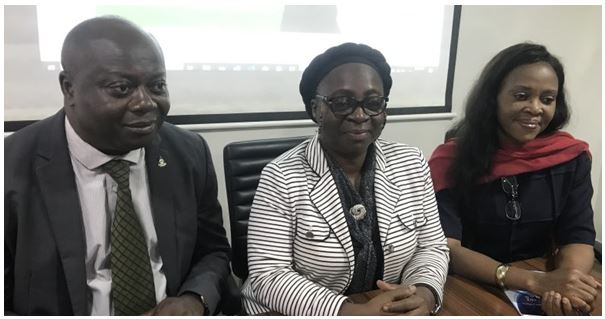
Mrs. Yetunde IIori (Centre), Director-General, Nigerian Insurers Association (NIA); Mr. Davis Iyasere, Head of Corporate Affairs (left) and Mrs. Bola Omole, Controller, IT, Research & Statistics at the unveiling of ‘Wetin U Carry’ campaign by NIA.
The Nigerian Insurers Association (NIA) has launched a campaign “Wetin U Carry” to ensure that motorists in Nigeria are plying the road with genuine motor insurance policies.
Mrs. Yetunde IIori, the Director-General of NIA said in Lagos that of the estimated 12 million vehicles on Nigerian roads, only 2.5 of them are captured on the insurance industry motor insurance platform for vehicles operating genuine licences.
IIori said the campaign will commence from Wednesday, October 2, 2019 in Lagos as a pilot scheme before extending to other parts of the country. The essence said is to know whether motorists are carrying genuine or fake motor insurance certificates on them.
Mrs. Yetunde IIori (Centre), Director-General, Nigerian Insurers Association (NIA); Mr. Davis Iyasere, Head of Corporate Affairs (left) and Mrs. Bola Omole, Controller, IT, Research & Statistics at the unveiling of ‘Wetin U Carry’ campaign by NIA.
Going forward, the NIA DG said the industry body will also launch a unified platform from where people can purchase motor insurance policies in the near future.
On how the insurance market has fared in Nigeria after 59 years of independence, the NIA DG said: “A lot has happened in the insurance industry since independence in 1960. The industry has evolved positively and has become a lot more innovative.”
Stanbic IBTC Pension Managers Limited (SIPML), a subsidiary of Stanbic IBTC Holdings PLC, has announced its sponsorship of the 2019 edition of Art X Lagos. This year, SIPML is sponsoring Art X Modern which is a newly created section dedicated to celebrating pioneers of African modern art from the 20th century.
Art X Modern will comprise three galleries: Bloom Art and Mydrim Gallery, which are Nigerian, and Gallery 1957 from Ghana. The newly introduced section will also feature Uche Okeke and Obiora Udechukwu, both Nigerian artists, as well as Professor Ablade Glover from Ghana, amongst other reputed names.
SIPML will also host a dedicated sponsored talk session which will be open to the public.
Mr. Eric Fajemisin, Chief Executive, Stanbic IBTC Pensions said the company’s sponsorship of Art X was hinged on its commitment towards promoting Nigeria’s art sector.
He said: “Our interest in promoting arts is hinged on the belief that creativity and intellect can serve as sources of livelihood for individuals who decide to make a career out of their passion for painting and drawing. In other climes, art is cherished, and patrons sometimes pay a fortune for works of art that are considered collectors’ items. We want to promote a culture which ensures that artists are appreciated for their ingenuity and adequately rewarded with the premium and royalties that their works attract.”
He added that the company decided to host the Art X Modern section as a means of ensuring that artists get the recognition due them during their lifetime. The Stanbic IBTC Pensions Chief Executive said: “Being Nigeria’s largest pensions manger, we have the responsibility to ensure that our customers retire well, so that they have something to fall back on post work-life. We are also promoting that principle which holds that those who contribute actively to enriching lives and enhancing our creative industry get their due, even after leaving active work life.”
This year’s edition of Art X Lagos will hold at Federal Palace Hotel from Friday, November 1 to Sunday, November 3, 2019. This year’s Art Festival will feature 23 gallery booths including Nigerian gallery exhibitors such as: The Space, Bloom Art, Nike Art Gallery, Retro Africa and SMO Contemporary, among others.
The roll call of artists who will showcase their art includes: Abe Odedina (Nigeria / UK / Brazil), Soly Cissé (Senegal), Sam Nhlengethwa (South Africa), Tizta Berhanu (Ethiopia), Peju Alatise (Nigeria) and Lady Skollie (South Africa).
ART X Lagos is West Africa’s first international art fair, designed to showcase intriguing and innovative contemporary art from the African continent and diaspora.
From left: Vice Chairperson ADU Women Wing Lagos, Mrs. Gift Nebeani; Chairperson ADU Women Wing Lagos, Mrs. Nkem Nweke; chairman, Ebenebe Town Union Lagos, Chief Sunday Nnarah; awardee, Chief Benard Nebeani; Representing President Association of Anambra State Development Union Lagos, Barr. Ubaka Nwonwu; Chairman, Awba-Ofemili Development Union (ADU) Lagos, Mr. Remmy Nweke; Father of the day, Benard Chidebe and his wife, Mother of the day, Lolo Gloria Chidebe, during the 2019 ADU Lagos Award and Civic Center Fund Raising at Welcome Centre Hotels, Lagos.
The Lagos branch of Awba-Ofemili Development Union (ADU) has launched a N100m fund for a multi-purpose civic centre, just as call went out for building of institutions than individuals for the town to thrive.
The Chairman of ADU Lagos, Mr. Remmy Chuks Nweke, disclosed this in his address to the branch’s maiden award and civic centre fundraising held Saturday at the Welcome Centre Hotels, International Airport Road, Lagos, calling for strong institutions rather than individuals to pave the way for peace and development to flourish.
Nweke also said that the launch of N100m fund for the civic centre is important and strategic, as “it marks the beginning of a journey to a stronger socio economic base for our dear Union in Lagos.”
ADU Lagos, he said, conceived the idea of a multipurpose civic center, to serve as a focal point for the community gathering with facilities for indoor sporting events, theaters, concerts and shopping centre.
“Specifically, the ADU Lagos Civic Centre building is estimated to cost about N100million for completion; which outside acting as ADU Lagos meeting point, will be an income generating venture through offer of services to the public by renting out its halls for events when completed.
From left: Vice Chairperson ADU Women Wing Lagos, Mrs. Gift Nebeani; Chairperson ADU Women Wing Lagos, Mrs. Nkem Nweke; chairman, Ebenebe Town Union Lagos, Chief Sunday Nnarah; awardee, Chief Benard Nebeani; Representing President Association of Anambra State Development Union Lagos, Barr. Ubaka Nwonwu; Chairman, Awba-Ofemili Development Union (ADU) Lagos, Mr. Remmy Nweke; Father of the day, Benard Chidebe and his wife, Mother of the day, Lolo Gloria Chidebe, during the 2019 ADU Lagos Award and Civic Center Fund Raising at Welcome Centre Hotels, Lagos.
“ADU members wishing to use the hall will benefit from a special discount package,” he assured.
The chairman, equally urged invited guests for support to achieve this goal, “please donate generously and you’ll be richly blessed. God loves a cheerful giver.”
Additionally, he disclosed that a given percentage of the fund raised will be set aside for women empowerment, especially for widows in the town and specifically those who may have links with ADU Lagos.
He recalled that Awba-Ofemili indigenes have been in Lagos for over 40 years and deserved to have a meeting point of their own, reiterating that what the town needs urgently is not necessarily strong men or women, but strong institutions in Awba-Ofemili to prosper.
“What Awba-Ofemili urgently needs are accountable individuals and institutions, which focus should be to support good governance and ensure that dissenting voices are heard; to ensure equal administration of justice for all Ndi Awba-Ofemili; civic participation, so that our young people get involved,” Nweke declared.
The fundraising, chairman said, offered a great opportunity to recognise and honour great men and women who laid the foundation for ADU Lagos.
“We had great men like Chief Alex Chidebe (Mayor n’Awba-Ofemili) and wife, Mama Agnes Chidebe, Chief Peter Chidebe (NkeOnadi) and wife, Mrs Rose Chidebe and later Chief Charles Ifesike and wife, Mrs. Theresa Ifesike. These are of blessed memory,” he said, with a minute silent observed for all the heroes of the town departed.
Women participation in town union development, he said, cannot be over emphasised, and enjoined all ADU men to encourage their wives to socialize with ADU Women Wing, considering that it is only what the women know they can teach their children, especially the Awba-Ofemili culture and tradition.
He commended the leadership of ADU Women Lagos led by Mrs. Nkem Nweke, vice chairperson, Mrs. Gift Nebeani, and supported by the Mother of the day, Lolo Gloria Chidebe, among others.
The Father of the Day, Ide Awba-Ofemili, Chief Benard Chidebe, said that the first indigene of the town came to Lagos in 1945 in the name of Col. Joseph Chidebe and ever since, Lagos has been a home to them, urging ADU members to remain law-abiding as they strive for success in their worthy endeavours.
Awba-Ofemili, he further said, is an agrarian community reputed for its quality rice production and fishery in Awka-North Local Government Area of Anambra State and is a border town between Anambra and Enugu States.
A total of 36 indigenes of Awba-Ofemili both home and abroad as well as some friends of the town were honoured at the occasion including the chairman, Fidwax Group, Chief Fidelis Nweke, who was the chief launcher as well as the Transition Chairman, Awka-North Local Government Area, Hon. Ferdinard Onwuje; Chief Dr. Nnamdi Okafor, CEO, Edinho Limited; and Mr. Benard Nebeani, to name but a few.
Over 86 indigenes were also presented with their certificates of membership by the leadership of ADU Lagos.
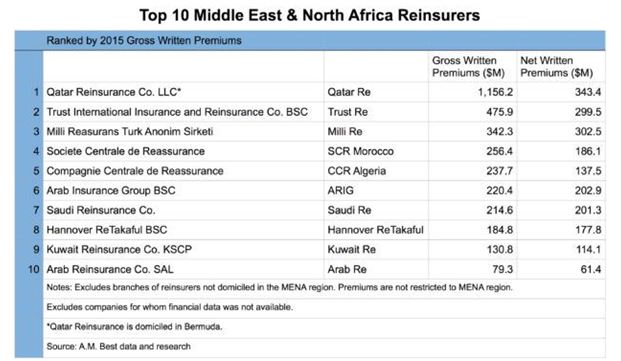
The mood among Africa’s reinsurance executives has become more bearish as declining rates and rising claims weigh on the profitability of the African reinsurance markets with a current premium volume of roughly US$ 7.5 billion.
While Africa’s economies are still recovering from the commodity crisis of 2016, which highlighted the continent’s vulnerability to external shocks, executives are once again concerned about the current outlook in light of renewed economic and political uncertainties.
This is the main outcome of the 4th edition of the Africa Reinsurance Pulse, which was published at yesterday’s 24th African Reinsurance Forum in Tunis, Tunisia.
Verve has celebrated 10 years of transforming the payment system in Nigeria and is now accepted in 185 countries around the world, including 22 nations in Africa.
Mr. Mitchell Elegbe, the Founder/Group Managing Director of Interswitch, owners of Verve, said the future target of Verve is to reach every country in Africa. He lamented that despite the existence of 42 million card holders in Nigeria, cards account for only 10 percent of transactions while the use of cash is still dominant in day-to-day transactions to the tune of 90 percent.
Mr. Mike Ogbalu 111, the CEO of Verve International described Verve as a unique solution from Nigeria transforming payment across the world.
He said: “Verve is a story of victory for Nigeria and Africa. It is a story of resilience and it is growing more than the competition. We see a brighter future for the next 10 years as Verve continues to serve the unserved in Nigeria, Africa and the world. The ultimate dream of Verve is to process payment and ensure better lives across Africa and the world. It is also to solve customer needs and become an international brand.”
The Verve CEO expressed satisfaction that Nigerian banks have embraced and issued the payment card to millions of their customers across the country.
During a panel discussion, stakeholders identified digital identity, access, affordability and competition as some of the challenges facing card business in Nigeria.
Nigeria has one of the highest company income tax rates globally which is a disincentive for business growth, Tax leader, PwC Nigeria, Taiwo Oyedele has said.
He spoke on Saturday at the Finance Correspondents Association of Nigeria, FICAN annual workshop themed “Unlocking Opportunities in Nigeria’s Non-Oil Sector.”
According to Oyedele, Nigeria is in the top 10 in the world, for highest income tax rate.
“We pay Company Income Tax, CIT 30%, education tax, 2%, whatever is left, we pay withholding tax of 10%. If you add it together, it is more that 40% already. If you now make a mistake of having a group and you say it’s a holding company, another 30%. Who does that?” he said.
Speaking further, he said: “When you start a business today, there is something called commencement rule. It is supposed to punish you during commencement, so that you pay tax twice. It does not make sense.”
To address this challenge, the tax expert advised that operators in the private sector should focus on demanding for removal of some of these disincentives that affect business operations.
“What I keep saying to government is that I can insist that I have a pot that is this small and I say I must get 60% of this pot by all means. Or I allow this pot to be big enough and then get 10% of it. Government must remove tax disincentives. One thing I am asking the business community is stop asking the government for incentives because they will think they are doing you a favour. Ask them to remove the disincentives that are not allowing us to do business,” he said.
He also called on the authorities to change their thinking about taxation as current approach has only made compliance difficult.
He said: “Our thinking around taxation is completely upside down as a country. Nigeria does not seem to understand that you need to be prosperous so that you can pay tax. So, tax does not just fall from heaven.”
“As a government, I should help you make money so that you can pay me tax. Its just common sense. Nigeria has a tax system that does not allow businesses to thrive, whether you are small or big,” he added.
He noted that “the reason Nigeria cannot make money from tax, and is not a curse, is that it continues to beat up the people at the bottom of the ladder. But they cannot give you what they don’t have. In societies where they think things logically, they focus on the top 1% who are the rich and big companies and they will get the desired tax result,” he said.
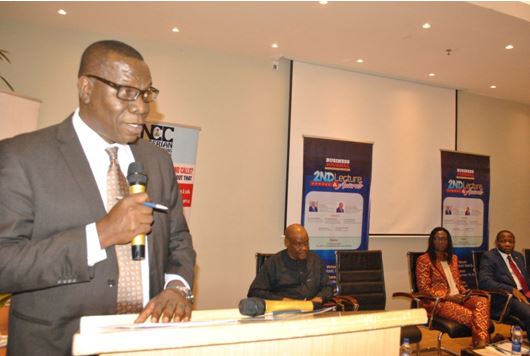
Dr. Henry Nkemadu, Director, Public Affairs, Nigerian Communications Commission (NCC) delivering the keynote address at the Business Journal 2nd Annual Lecture/Awards last Friday in Lagos. He represented Prof Umar Danbatta, the EVC/CEO of NCC.
Professor Umar Danbatta, Executive Vice-Chairman/CEO, Nigerian Communications Commission (NCC) says the regulator is committed towards Digital Nigeria for sustainable economic growth of the country.
Danbatta made the pledge at the Business Journal 2nd Annual Lecture held last Friday in Lagos.
Represented by Dr. Henry Nkemadu, Director of Public Affairs at NCC, Danbatta said Digital Nigeria is when the country will be able to utilise electronic devices online and offline and in which case most transactions/activities will be in digital format.
Dr. Henry Nkemadu, Director, Public Affairs, Nigerian Communications Commission (NCC) delivering the keynote address at the Business Journal 2nd Annual Lecture/Awards last Friday in Lagos. He represented Prof Umar Danbatta, the EVC/CEO of NCC.
“Our world is becoming ever more connected. Billions of intelligent devices and machines generate massive amounts of data, creating a bridge between real and virtual worlds. Turning these vast amounts of data into value is a key success factor.
In Nigeria, the number of active mobile subscriptions is over 174 million as at August 2019 and the active ICT infrastructure deployment continues to rise to support the telecommunications sector. A subscriber tele-density of 91.6 Million, Internet subscribers of over 111 million, and a broadband penetration of above 33%, Digital Nigeria has become a reality and not a myth. Having contributed 13.86% to the GDP, as at 2nd quarter of 2019, the ICT Sector in Nigeria has attained remarkable milestones in ensuring that the Sector continues to play a great role in Nigeria’s economic diversification and sustainability. This is done by consistently ensuring that the necessary policies and infrastructure are enhanced, so that the requisite technological platform for a viable economic diversification can ensue. Certainly, no economy is sustainable on a mono product.”
He added that the NCC as the telecommunications regulatory body facilitates universal access to ICT services by providing enabling regulatory interventions to stimulate competition among the industry players:
Implementation of the National Broadband Plan Initiatives.
Pervasive infrastructure support
Granting of more Spectrum Resource Licenses for the delivery of broadband wireless access service at the wholesale level, to ISP’s and other Retail Telecoms Service Providers for the provision of retail high speed internet access services.
Facilitate the Participation of Young Entrepreneurs in ITU Global ICT Competitions for SMEs, Business Start-Ups and Innovators
USPS Initiatives That Impact on Economic Growth
Industry Capacity Building and Promotion of Innovations – DBI, New Media & Information Security.
Collaboration of Other Government Agencies – CBN, Health, Agriculture, Works, etc.
“The NCC continues to promote and facilitate universal access to ICTs to ensure implementation of the following areas identified for economic diversifications needed for the Nigerian economy:
E- government
E-education
E-agriculture
Industrialization
Entrepreneurship, Youth Empowerment and SMES
E-Taxation to boost Revenues
E-Commerce
E-health
The NCC chief said the Commission will continue to promote and facilitate, through appropriate regulatory interventions, the expansion of pervasive broadband infrastructure that will stimulate the provision of e-products and e-services across Nigeria.
“The NCC will encourage the digitalization of information to be transformed into business and economic activities that drive national growth and development.The economic diversification of the Nigerian economy will give impetus for increase mobilization of all resources and increase revenues accruable to government. This will cause an exponential increase in productive activities in industry, manufacturing, infrastructure development, health, and agriculture to stimulate growth and development of the Nigerian economy. The NCC shall continue to provide the conducive regulatory environment for increased private sector investment and expansion of economic activities.”
The interventions of the NCC play a vital role in supporting the evolution of digital processes and appreciation in various sectors of the economy.
From Setting up Public Access Points and ICT Training Centres, the Digital Awareness Programme (DAP), the Advanced Digital Awareness programme for Tertiary Institutions (ADAPTI), the School Knowledge Centre (SKC), all of which have benefitted over 500 schools across the country, the educational sector in Nigeria has definitely felt the digital wand of the NCC.
The NCC continues to promote and facilitate universal access to ICT to ensure implementation of e-taxation, ecommerce and e-government financial sector areas, which were identified as the economic enhancement needed for sustainability of the Nigerian economy. Improving user (traveler) experience such as online ticketing, boarding, and check in processes; and Vehicle tracking and navigations through mobile and Internet services, are also some key examples of how telecommunications is enhancing Nigeria’s digital profile.
The deployment of Optic Fibre transmission network has been adopted in the “Open Access Model” to bridge the current digital gap and deliver fast and reliable broadband services to households and businesses and the success of this model is evident in the tremendous growth witnessed in the provision of broadband services by all major players in the industry through one technology or the other.
Presently, Nigeria has achieved 33.72% Broadband penetration, thus over 64 million Nigerians are presently connected to broadband internet services. This is an encouraging leap from the 8.5% penetration in 2015.
Six Infraco licensees are to cover Lagos, South-West, South-South, South-East, North-West and North-East regions while the process leading to the licensing of an Infraco for North-Central is on-going.
The Infraco licensees are to provide IP fiber Optic capacity, to all the 774 LGAs of the federation on an open access, price regulated basis, with a 10 Gbps Point of Access (PoA) capacity in each local government of the federation. The project is for a four- year period with the negotiated subsidies to be paid to the Infraco licensees at the attainment of agreed and verified milestones.
“Let me conclude by leaving a picture in your minds of what an enhanced digital Nigeria will look like:
Increased GDP
Increased emergence of new services and industries
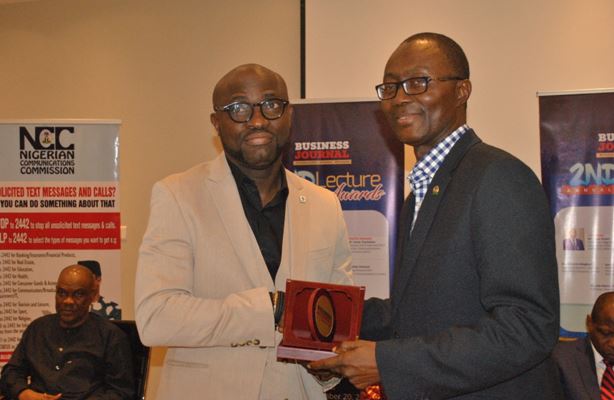
L-R: Mr. Segun Bankole, DGM, Sovereign Trust Insurance Plc receiving the ‘Most Innovative Insurance Retail Brand’ award on behalf of the company from Mr. Fatai Adegbenro, executive Secretary, NCRIB at the Business Journal 2nd Annual Lecture/awards in Lagos.
The journey to greatness has a lot of hard work and sense of purpose attached to it.
For Sovereign Trust Insurance Plc, consistency, professionalism, integrity, creativity, an uncompromising stance for providing far-reaching retail products and services has earned the organisation another Award at the 2018 Annual Lecture/Award organised by Business Journal.
L-R: Mr. Segun Bankole, DGM, Sovereign Trust Insurance Plc receiving the ‘Most Innovative Insurance Retail Brand’ award on behalf of the company from Mr. Fatai Adegbenro, executive Secretary, NCRIB at the Business Journal 2nd Annual Lecture/awards in Lagos.
In recognition of the immense contributions of the organisation to the development of retail and affordable insurance products to the insuring public, the organisers of the annual Lecture/Award through its Award Committee nominated Sovereign Trust Insurance Plc as one of the possible recipients of the award and at the end of it all, the company emerged the winner of the Award for year 2018.
The event was gracefully attended by Captains of Industries, Brand Management and Marketing Practitioners, the Media and members of the Public.
The event was chaired by the Chairman of the Nigerian Insurers Association, Mr. Tope Smart and also Group Managing Director/CEO of NEM Insurance Plc.
The criteria for the Award as given by the Technical/Award Committee included, efficiency in service delivery, creativity in product development, branch network, the use of technology, media presence of the Brand, adherence to Ethics and Corporate Governance and the quality of Human Resources available to the organisation within the period of the nomination and the screening process.
According to Prince Cookey, Publisher/CEO of Business Journal, the screening process for the companies nominated for the award was carried out by a group of seasoned Brand Management and Marketing Consultants and some notable members of the Public. “
It was a very rigourous process in determining the eventual Winner for the award but at the end of the day, Sovereign Trust Insurance Plc was adjudged by all as the Winner for the award category in question.”
Cookey further reiterated that insurance companies still need to do a lot of work in terms of product development that will impact positively on the lives of the average Nigerian as insurance in the country is still viewed by many as a service for only the rich.
It will be recalled that Sovereign Trust Insurance Plc launched a Personal Accident Cover with the acronym SWIS-F, (Sovereign Wellbeing Insurance Scheme for the Family with an annual premium of N1,500 for adults and N250 for children under 6-17 years with benefits to cover medical expenses for injuries sustained as a result of an accident, permanent disability compensation, burial expenses with a nationwide geographical coverage. In 2018, the company also introduced the Enhanced Third-Party Motor Insurance Policy, (E3P), a hybrid of the conventional Third-Party Cover and Comprehensive Motor Insurance with varied premium ranging between N10,000-N25,000 for the Insured to choose from depending on the range of cover he/she wants.
while receiving the Award on behalf of the organisation, the Head of Sales and Corporate Communications Mr. Segun Bankole thanked the organisers of the event for the honour they have bestowed on the organization and promised that the company will not rest on its oars in ensuring that the insurance Industry find a credible voice in the Financial Services Sector in the country and beyond.
In his words: “We will continue to provide top-of-the-range insurance products and services that will delight our customers anytime they come in contact with our Brand”. We are open to new ideas from members of the public in as much as those ideas will add value to what we do as an organization.
He also used the occasion to enjoin the gathering to embrace insurance if they have not yet been exposed to one form of insurance or the other. In his parting words, “insurance is a sure guarantee for the continued existence of any commercial enterprise and a sure mainstay for the continuous wellbeing of any individual or Family.”
The Managing Directors of Heritage Bank Limited and Nigerian Export-Import Bank (NEXIM) Limited have all confirmed their attendance at the forthcoming Finance Correspondents Association of Nigeria (FICAN) Annual workshop holding in Lagos.
The event, slated for Saturday September 21 at Golden Tulip Hotel, FESTAC Town Lagos, will have the Managing Director, NEXIM, Abubakar Bello deliver the keynote speech while Managing Director/CEO Heritage Bank Limited, Ifie Sekibo will be the guest speaker. They will be speaking on the theme: “Unlocking Opportunities in Nigeria’s Non-Oil Sector”.
A panel discussion will feature Director Corporate Communications at the Central Bank of Nigeria, Isaac Okoroafor; Head of Tax and Corporate Advisory Services, PwC Nigeria, Taiwo Oyedele and Senior Lecturer at Lagos Business School, Adi Bongo.
In a statement, FICAN said unlocking the non-oil sector requires collaborative efforts between the government and private sector, adding that opportunities in the sector have to be harnessed for effective economic growth.
“The non-oil sector is critical to Nigeria’s sustainable economic growth as it is the largest source of employment to the country’s huge young population. Before the discovery of crude oil in Nigeria in 1956, the non-oil sector, especially the agricultural sector, was the mainstay of the economy. The agricultural sector alone provided 85 per cent of the country’s foreign exchange earnings in the 60s”.
“The oil sector now provides over 95 per cent of the country’s foreign exchange earnings. The challenge is that frequent fluctuation in oil prices has made the Nigerian economy often susceptible to shocks as the economy suffers whenever prices are down. The challenge is further worsened as the world is beginning to look at life after oil in a bid to tackle climate change. It is a pointer that crude oil would become less relevant and attract fewer earnings in years to come. Successive governments have not done enough to tap into other potential non-oil sector sectors,” the statement said.
It said that government’s long term plan is seen in its launching of the Economic Recovery and Growth Plan (ERGP) for 2017–2020 that contains critical reforms for diversifying the economy away from oil and set it on a path of sustained and inclusive growth over the medium- to long-term.
Among other things, the workshop will bring together experts from global multilateral financial institutions, public and private sector players, to highlight and examine the various options available in getting the economy fully diversified away from reliance on crude oil.
The conference will be attended by journalists covering money market, capital market and the insurance industry, from the print and electronic media.
Leading telecommunication company Vodacom Tanzania Plc and Smart Lab have today launched “Vodacom Digital Accelerator,” a program that intends to help early-stage and growth-stage technology startups become profitable and revenue generating businesses.
The new program which will run yearly aims at identifying and supporting startup entrepreneurs in mobile, telecom, fintech, media, health, education, and e-commerce will have three phases which include application, selection and acceleration.
Speaking at the launch event, Vodacom Tanzania Plc’s Managing Director, Hisham Hendi said that the partnership between Vodacom Tanzania and Smartcodes is a crucial move towards providing opportunities to startup businesses via technological paths which will result into workable business models which will benefit communities, especially scores of youth across the country. He encouraged more youth to be innovative and take advantage of this opportunity as a path to economic empowerment through solving social developmental issues in their communities.
“Vodacom always aims to create impactful sustainable change in the society where we operate in line with our strategic business focus and, the Vodacom Accelerator aims to do just that,” he added.
He further elaborated that as a company which aims at taking Tanzanians into the digital world, Vodacom Tanzania encourages technology driven ideas that bring sustainable change.
“Digital technology is not only changing the way we do business in Africa but also revolutionizing the way we perceive and solve issues of development. It is therefore with great honor that we will once again create an opportunity for such ideas to be recognized, supported and transformed to maximize social impact”, he said.
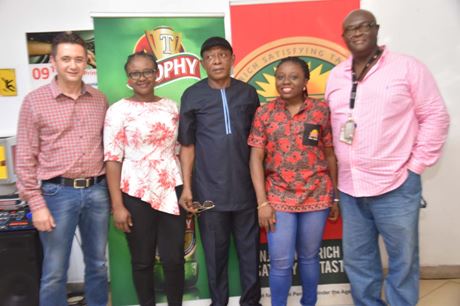
L-R: Brewery Operations Director, International Breweries Plc (IB Plc), Mr Johan Gouws; Country People Manager, IB Plc, Mrs Chinelo Obienyem; Nollywood actor and Brand Ambassador, Hero beer, Nkem Owoh; Marketing Director, IB Plc, Mrs Tolulope Adedeji; and Manager, Corporate Affairs and Sustainability, IB Plc, Mr Chuma Umuma, at an event at the Onitsha Brewery of IB Plc to celebrate Monde Selection awards won by IB Plc’s Trophy and Hero lagers, recently.
L-R: Brewery Operations Director, International Breweries Plc (IB Plc), Mr Johan Gouws; Country People Manager, IB Plc, Mrs Chinelo Obienyem; Nollywood actor and Brand Ambassador, Hero beer, Nkem Owoh; Marketing Director, IB Plc, Mrs Tolulope Adedeji; and Manager, Corporate Affairs and Sustainability, IB Plc, Mr Chuma Umuma, at an event at the Onitsha Brewery of IB Plc to celebrate Monde Selection awards won by IB Plc’s Trophy and Hero lagers, recently.