Tuesday, February 3, 2026
32 C
Lagos

Paylater, Credit Mobile App in Nigeria Tops 1m Customers

In Nigeria, a country of nearly 200 million people, 61% of the adult population is un- or underbanked. Fintech companies like Paylater represent a tremendous opportunity to get formal banking services in the hands of Nigerian consumers to provide much needed liquidity for entrepreneurial investment, personal development, or unexpected expenses.
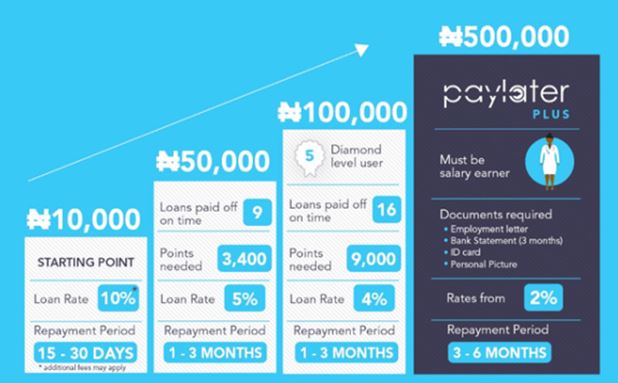
Consumer credit is nearly non-existent in Nigeria. But, Paylater is issuing loans to Nigerians completely digitally, without seeing or speaking to customers. Customers can receive funds in their account in as little as 5 minutes, with no need for paperwork, collateral or guarantors. Digital financial services platforms have been well received by consumers and it appears that fintech platforms like Paylater are here to stay.
The evidence is in the numbers. With over 800,000 registered users, across every Nigerian state, Paylater has loaned over $17M USD to Nigerian consumers in 2018 so far. The technology platform has supplemented that loan growth with very strong early adoption of its bill payments and investments features as well.
“We are very excited by the market adoption of Paylater and we believe there is still a significant growth opportunity ahead for digital financial services” – Co-founder and CEO, Chijioke Dozie
Before Paylater, only commercial banks — with physical branches nationwide and extremely large capital bases — had the reach, stability and customer trust to offer financial services to a variety of people. Unfortunately, these same institutions turned record profits by taking deposits from average consumers, and reserving actual ‘banking’ services like loans and investments for large corporate entities and high-net worth individuals.
Access to credit is a fundamental human need and the foundation on which most modern economies are built. Pioneers like Paylater have embraced the difficult task of unlocking the power of financial access for the underserved, and so far, it looks like they are winning.

spot_img
spot_img
spot_img

Hot this week

CBN Publishes Fintech Report: Shaping the Future of Fintech in Nigeria

The Central Bank of Nigeria has released a comprehensive...

Stanbic IBTC Bank Nigeria PMI: New Orders Broadly Stable at Start of 2026

Nigerian companies faced a muted start to 2026. A...

Mobile Performance in Nigeria: A Significant Improvement Driven by 4G

The latest data from nPerf reveal a marked improvement...

SanlamAllianz Women’s Network Leads Charge for Inclusive Education in Eti-Osa

In a global call to action to celebrate the...

Topics

Reps Commend NEXIM over Ladgroup Shea Butter Initiative

“…the interest of NEXIM Bank in Shea Nut processing...

Afreximbank, AFC, Gemcorp Partner on $335m Cabinda Oil Refinery Facility

    Gemcorp Holdings Limited (GHL), Africa Finance Corporation (AFC) and...

AstraZeneca Unveils Ambitious Plan to Expand in Africa

British pharmaceutical laboratory AstraZeneca Plc just launched an expansion...

Editors to Lay Plaza Foundation March 1

The foundation stone laying ceremony for the multi-purpose Editors’...

Covid-19: Ecobank Nigeria Restates Commitment to SMEs, Agric Sector

Ecobank Nigeria has restated its unwavering commitment to support...

Before You Switch From One PFA to Another

The pension industry in Nigeria has evolved over the...

Mark Zuckerberg: The Future of Facebook is Telepathy

Mark Zuckerberg just dropped a big clue about Facebook's future. The social network's founder and CEO believes that one day, we'll be able to share our thoughts directly -- brain to brain --using technology. "You'll just be able to think of something and your friends will immediately be able to experience it too if you'd like," Zuckerberg said. "This would be the ultimate communication technology." He made his comments during a public Q&A session on hisFacebook (FB, Tech30) page on Tuesday afternoon. The response was addressed to a user who asked about Facebook's long-term plans. In the past decade, the company has expanded the way users communicate on the platform. First there were plain profile pages. Next came comments, and then the Wall, Likes, Groups and News Feed.

African Union Unveils All-Africa Passport to Boost Travel, Trade

While is U.K. was busy separating from the European...
spot_img

Related Articles

Popular Categories

spot_imgspot_img