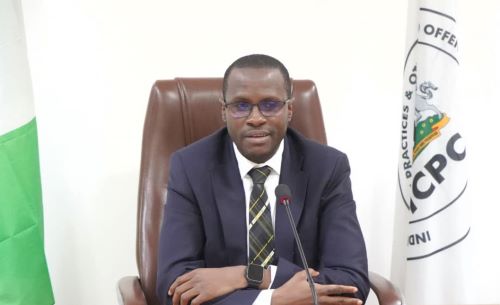




COURTESY VISIT: Managing Director/CE, Nigeria Deposit Insurance Corporation (NDIC), Thompson Oludare Sunday (right) presenting Deposit Insurance research publications to the President/Chairman of Council, Business Recovery and Insolvency Practitioners Association of Nigeria (BRIPAN), Chimezie Ihekweazu (SAN) during the latter’s courtesy visit to him at the NDIC’s Head Office in Abuja.
The Managing Director/Chief Executive (MD/CE) of the Nigeria Deposit Insurance Corporation (NDIC), Mr. Thompson Oludare Sunday, has stated that the Corporation now operates under stronger and more effective laws to carry out its bank liquidation mandate.
Mr. Sunday made this known when he received the President/Chairman of Council of the Business Recovery and Insolvency Practitioners Association of Nigeria (BRIPAN), Mr. Chimezie Victor Ihekweazu (SAN), and members of his council on a courtesy visit to the NDIC Headquarters in Abuja.
According to the NDIC Chief Executive, the Corporation’s powers in the area of the liquidation of failed insured institutions have been significantly enhanced with the enactment of the NDIC Act No. 30 of 2023, together with the Banks and Other Financial Institutions Act (BOFIA) 2020.
He noted that the NDIC is now better positioned to prosecute parties at fault for bank failures, unlike in the past when insufficient legal provisions allowed such individuals to evade accountability.
Sunday expressed his appreciation to the National Assembly for addressing the long-standing challenge of a weak legal framework that had constrained the Corporation’s operations.
He also commended the judiciary for its growing expertise in deposit insurance law and practice, as demonstrated by the effective adjudication of failed bank cases through judgments that have brought relief to depositors.
“The enhanced powers granted to the Corporation under the NDIC Act 30 of 2023, the BOFIA 2020 and the improved understanding of the judiciary, have made it impossible for individuals to hide under the law to escape liability,” the NDIC Boss stated.
“With stronger legal backing, individuals now approach the Corporation to settle out of court, not necessarily because the law has caught up with them, but because they can see that the noose is tightening around those responsible for bank failures.”
Sunday attributed the Corporation’s ability to realise sufficient assets to declare a first round of liquidation dividends to the uninsured depositors of defunct Heritage Bank Limited within one year of the revocation of its licence, to the positive impact of the new legal framework.
He reiterated that the NDIC would continue to leverage the strengthened laws while collaborating with BRIPAN and other stakeholders to enhance the effective discharge of its mandate.
In his remarks, the BRIPAN President/Chairman of Council, Mr. Chimezie Victor Ihekweazu (SAN), highlighted the association’s efforts and achievement in harmonising all insolvency-related laws in the country into a unified framework.
He noted that this has significantly addressed the challenges of ineffective insolvency and business recovery practices, while introducing more viable options for solvency resolution.
He also emphasised BRIPAN’s strong focus on capacity building, calling for further collaboration between the Corporation and his association.
Ihekweazu called for closer collaboration among stakeholders, to strengthen insolvency and business recovery practices in Nigeria.