


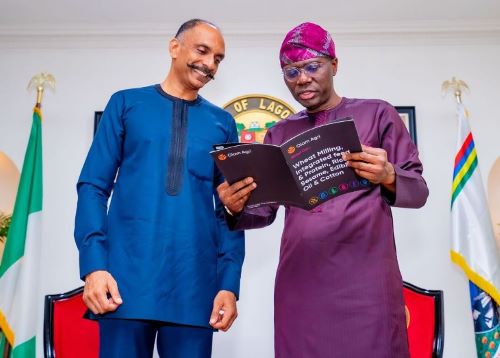

L-R: The Lagos State Governor, Babajide Sanwo-Olu (right) and Olam Agri Nigeria Country Head, Anil Nair, during a recent courtesy visit where the Governor commended the agribusiness for its contribution to food security.
Olam Agri, a leading agribusiness in food, feed, and fibre in Nigeria, is significantly expanding its Corporate Responsibility and Sustainability (CR&S) investment strategy to deepen its social, environmental, and economic development impact within the country.
The company has committed to a four-year development plan, allocating approximately ₦6.5 billion to various CR&S initiatives. These initiatives are designed to drive socioeconomic growth within the communities where it operates.
These initiatives are part of the award-winning Seeds for the Future (SFTF) programme – Olam Agri in Nigeria’s flagship sustainability effort designed to foster a brighter future for all. The initiative focuses on five key areas: supporting farmers and farming communities, enhancing education and skill development for young people, economic empowerment of indigent women, promoting health and nutrition, and reducing carbon emissions across its operations.
The expanded investment commitment will support Olam Agri’s purpose for sustainable development across its business portfolio of rice, wheat milling and pasta, animal feed and protein, sesame, cotton, and edible oils from 2024 through 2028.
For instance, in 2024 alone, the agribusiness plans to invest about $1.07 million into initiatives, which has already seen the presentation of education grants to 15 qualified students from the University of Lagos in January, awarding scholarships to 87 underprivileged students in Nasarawa State in June, manual harvesters for wheat farmers in Jigawa and empowering 118 agri-extension workers in Kwara State in July.
Significant provisions in the four-year plan also include smallholder farmer capacity building in rural communities to strengthen food security, rural road rehabilitation to reduce disruption of the value chain, distribution of harvesters to reduce post-harvest loss, participation in public-private partnerships in seed and product R&D, among others.
Anil Nair, Managing Director of Olam Agri in Nigeria, commented on the investment, stating, “as a business founded in Nigeria over 34 years ago, we are committed to investing in initiatives that positively transform lives and impact the livelihoods of our host communities while scaling food production in the country.”
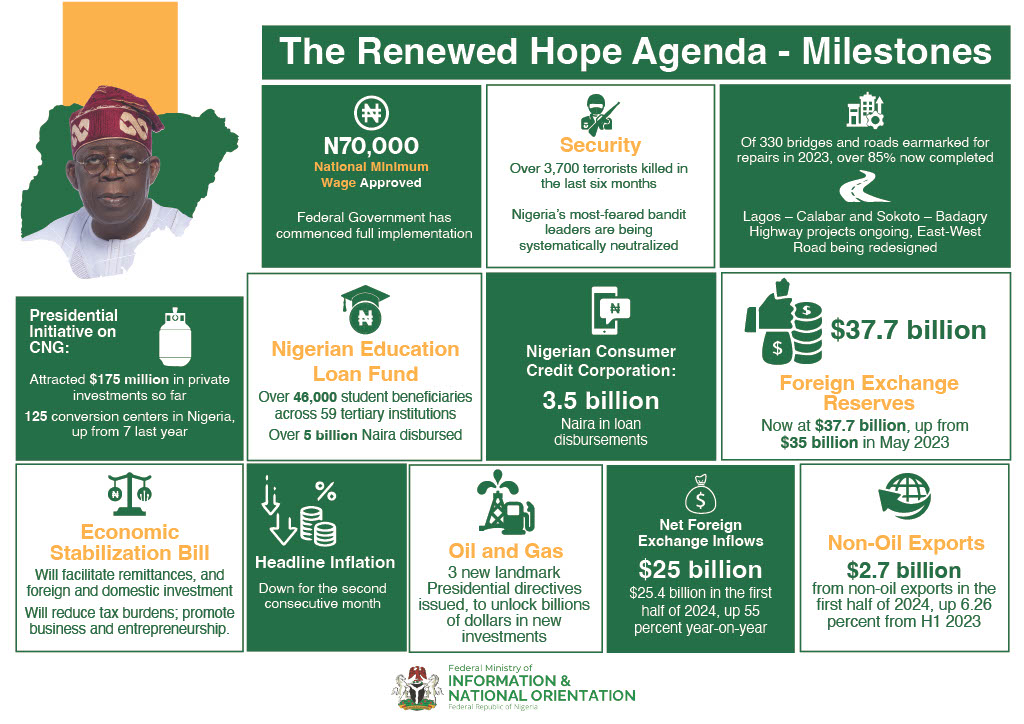
He added: “We are dedicated to turning our priorities into action by implementing key sustainability initiatives across our value chain to advance the current administration’s Renewed Hope Agenda. Our four-year implementation plan aims to make a real impact that benefits all.”
Demonstrating Olam Agri’s commitment to sustainable socioeconomic interventions and addressing the current food inflation and market challenges in the country, a high-level delegation led by the Managing Director of Olam Agri in Nigeria paid a courtesy call to the Lagos State Executive Governor, Babajide Sanwo-Olu, on Thursday, August 1, 2024.
During the visit, the Managing Director sought partnerships with the State Government to deepen investments for expanded food production and job creation, given the state’s strategic economic importance.
Governor Sanwo-Olu commended Olam Agri for driving productivity in the agricultural value chain and stressed the need for continued efforts.
He stated: “Olam Agri has positioned itself as a prominent leader in Nigeria’s agricultural industry. This meeting provided a great platform to exchange insights and discuss ways to strengthen our contributions to this crucial sector.”
He further emphasized: “Agro and food processing is a critical industry because food security is as vital as medical security or sovereign security in times of conflict. There is no greater security today than food security.”