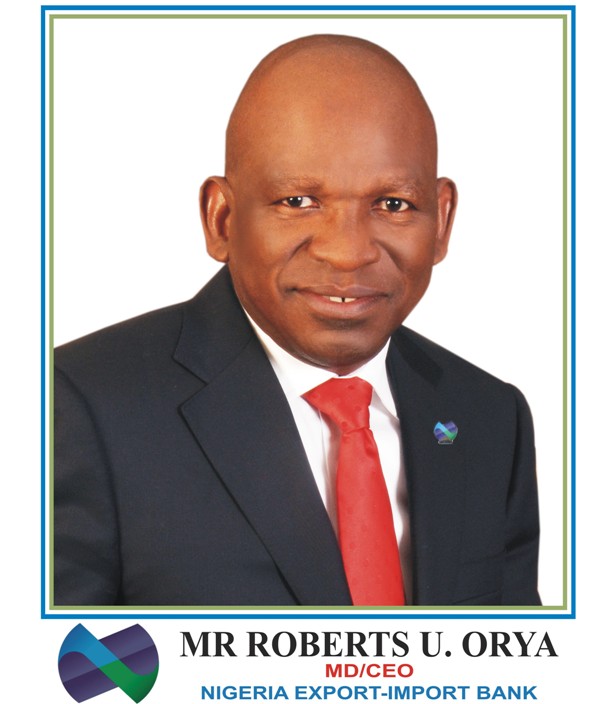

…The clear intention of The World Bank to collaborate with the NEXIM Bank towards a structured intervention in the Nigeria’s solid minerals sector is quite expedient. More so, with commitment and firm resolve of President Muhammad Buhari to diversify the economy, revitalize the mining sector towards boosting job creation and enhancing foreign exchange earnings – Orya
The Managing Director of the Nigerian Export-Import Bank (NEXIM Bank), Mr. Roberts Ungwaga Orya, received a team from the World Bank led by Dr. Francisco Igualada, Senior Mining Specialist, Energy & Extractives Unit, and Mr. Linus Adie Utsu of Mining Investments Consultthat visited the Bank to share ideas on how to provide structured intervention towards revamping and deepening Nigeria’s mining sector.
On the work of NEXIM, Mr. Orya informed the team that the Bank was set up to assist the Government in diversifying the Nigerian economy away from the oil through the provision of export credit facility, risk bearing facilities, trade and market information and export advisory services to export-oriented investors in the manufacturing, agro-processing, solid minerals and services (MASS) sectors.
Focusing on solid minerals extraction, Mr. Orya stated that Nigeria is endowed with huge solid mineral deposits, with about 34 products identified in commercial quantities in different parts of Nigeria. However, the failure of Nigeria, since independence in 1960, to put in place a structure that will make the benefits of the exploitation available to all Nigerians has been the bane of the country.
The low activity in the solid mineral sector is not yielding the desired financial revenues as there are scanty records of payment of taxes and royalty to the government. Nigeria is losing lots of resources from untapped mineral deposit as well as from the little that is being mined mostly by illegal miners who smuggle the products out of the country.
At the moment, according to Central Bank of Nigeria (CBN) reports, the sector accounts for only 0.14 per cent of GDP, and 3.8% of the non-oil export revenue.
Continuing, Mr. Roberts Orya stated that despite its huge potentials, the sector is still grossly underdeveloped and dominated by SME/ artisanal and informal miners using crude machinery and equipment. There are other challenges of poor access to long term funding due to the capital intensive nature of the industry; lack of accredited laboratory for testing and poor infrastructure – roads, rail facilities – to move the products.
Notwithstanding, according to Orya, NEXIM since inception till date has provided interventions to the sector to the tune of N7.17billion. This has created more than 4,302 direct jobs plus many indirect jobs in addition to facilitating foreign exchange flow inflow of US$80, 142 annually.
Besides direct funding, towards providing assistance to Nigerian miners, NEXIM had in 2013 supported the Miners Association to move from their inaccessible office in Jos, Plateau State and provided them with free office spaces and facilities at the Bank’s headquarters in Abuja.
Notwithstanding, Mr. Orya indicated that Nigeria could and should actually make the exploitation of solid minerals the mainstay of the economy. He pointedly queried how the country could be earning such paltry revenue and dividends with all the huge solid mineral reserves while in South Africa, the mining industryremains a cornerstone of the economy; making a significant contribution to economic activity (accounts for about 18% of GDP – 8.6% direct, 10% indirect and induced), job creation (one million jobs – 500 000 direct and 500 000 indirect); and foreign exchange earnings creates (more than 50% of all foreign exchange earnings).
Accordingly, for NEXIM, the critical issues ranges from how to get the Government and other stakeholders to properly structure the mining sector, increase funding, and attract much needed investment capital; infrastructural development for the industry, especially the establishment of internationally certified laboratories and setting up of internationally recognized and endorsed mining calendar for Nigeria as prevalent in other regimes with dedicated attention to solid mineral exploitation.
In his own views, Dr Francisco Igualada, the World Bank Senior Mining Specialist, expressed appreciation to the NEXIM MD and his colleagues for welcoming him and his team to the Bank. He shared his knowledge of the mining industry and his organisation’s intervention in the sector over the years indicating that it is fraught with risks and uniquely capital intensive.
He wondered why Nigeria, with all its huge resources and potentials has continued to earn less than Ghana, Mali and Burkina Faso from mining activities. According to him, the blame is on the overriding focus on oil and gas by the country at the detriment of neglecting the mining sector which is an enabler for manufacturing, services and other sectors.
This is addition to the huge opportunities of job creation, revenue earnings and the development of other support services in the value chain that could have boosted the economy especially with the decline in world oil prices.
According to Dr. Igualada, there is need for a structured consolidation of efforts towards developing the sector. This should focus on building the right capacity both at human and institutional levels; as well as establishing and enforcing the requisite legal and policy frameworks. To him, this is the difference between Nigeria and South Africa.
He pointed out that the World Bank has a PPP (Public Private Partnership) arrangement which it could recommend for the development of the solid minerals sector in Nigeria. He concluded by suggesting that there is a need to revamp efforts and link interventions to develop the sector through arrangements like the Solid Minerals Fund in addition to renewed involvement by the Government.
He stated that he will seek the commitment of his office on the development of the mining sector and collaboration with Nexim Bank, especially in regard to workshop participation and capacity training.
Sharing his views, Mr. Linus Adie of Mining Investments Consults indicated that there is a strong need to seize the prevailing opportunity to develop the mining sector. He expressed his dissatisfaction that the World Bank has not been manifestly keen in its approach to the Nigerian mining sector considering the huge potentials.
He cited the interventions of World Bank in the Sri Lankan gemstone industry, which is now a big business; and collaborations with Exim Bank in India, among others, through MIGA and IFC; and demanded that Nigeria should be accorded same through NEXIM Bank using same multi- sectorial approach.
In closing, Mr. Roberts Orya thanked the World Bank team and lauded Mr. Linus Adie’s strong advocacy for NEXIM Bank. He regretted the inability of the Solid Minerals Fund to fully take off, especially owing to unresolved legal and other bureaucratic issues.
He however reassured the World Bank team that with thecommitment and firm resolve of President Muhammad Buhari to diversify the economy, revitalize the mining sector towards boosting job creation and enhancing foreign exchange earnings, that solid minerals will now become the focal sector of the economy.
Accordingly, it is unlikely that the challenges of bureaucratic bottle necks and other such issues would continue to hinder the development and optimal exploitation of the mining sector.
Mr. Orya stressed on the need to work together with the World Bank and reiterated that the issues of capacity training, both at institutional and SME levels, is key to achieving meaningful success in the sector. He requested that the NEXIM and the World Bank should come up with an MOU, which Dr. Francesco Igualada agreed could, in the interim, be in the form of a ‘Letter of Intent’ to work together.