
Amid global concerns over energy security and a regional resolve on collaboration to deepen local content, the Executive Secretary, Nigerian Content Development and Monitoring Board (NCDMB), Engr. Simbi Kesiye Wabote, has proposed strategies that would break down barriers and promote cross-border collaboration amongst governments and businesses.
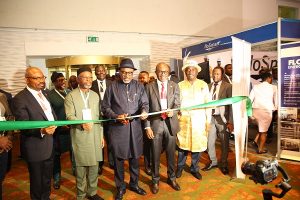
He made the suggestions in a presentation he made at the opening of the 7th SAIPEC Sub-Saharan Africa International Petroleum Exhibition and Conference in Lagos, hinting on the need for peer review mechanisms, and sharing of experiences and ideas on industry sustainability and growth.
The event provided a platform for the NCDMB to sign a memorandum of understanding (MoU) with the Technical Secretary of the National Content Monitoring Committee of Senegal (ST-CNSCL), the agency that is responsible for the coordination and supervision of the development and implementation of the local content strategies in the Senegalese oil and gas sector.
Under the terms of the MoU, NCDMB will offer ST-CNSCL strategic advice and guidance in the areas of laws, frameworks, knowledge exchange, procedures for baseline study, data collection on capacities that exist in Senegal, design of strategic plan for local content implementation in Senegal and other capacity development initiatives.
Speaking further, Wabote drew the attention of sub-Saharan Africa’s Ministers of Petroleum to the relatively high crude oil price levels and upswing potentials experienced from 2021 to date and the geo-political dynamics at play, highlighting the challenge for African oil and gas service providers “to partake in the development and maintenance of oil fields,” which could be best facilitated through a deliberate action plan.
In his paper entitled “Sub-Saharan Africa Local Content Collaboration Strategies,” the Executive Secretary said the action plan under consideration centres on legal framework, funding, infrastructure, human capacity development, and research and development. He equally highlighted initiatives and grounds covered by the Nigerian Government through the NCDMB in local content development and how other African oil producers could benefit from these.
A legal framework, as he pointed out, is an enabling legal or regulatory framework, a basic requirement “to drive and develop local content sustainability.” That would be the critical instrument “to forge a collaborative Africa local content strategy.” That requirement, he observed, has been taken care of by the African Continental Free Trade Agreement (AfCFTA), which he noted “created the world’s largest free trade area by integrating 1.3 billion people across 54 African countries, with the objective of tapping into a combined Gross Domestic Product (GDP) of over $3 trillion.”
In the area of infrastructure, he cited Dangote Integrated Refinery and Petrochemical Company, with an installed capacity of 650,000 barrels per stream day (bpsd), which he noted would “afford Nigeria and other African countries the partnership opportunities for sourcing petroleum products and fertilizer.” Other critical infrastructure cited were Lekki Free Trade Zone, SHI-MCI FPSO Fabrication/Integration Yard, Lagos, West African Gas Pipeline Project, the ongoing AKK gas transmission pipeline, and NCDMB’s seven Nigerian Oil and Gas Parks (NOGAPS), two of which are due for commissioning in 2023.
The occasion also became an opportunity for the Executive Secretary to invite business organisations from the sub-Saharan region interested in the manufacture of equipment, components and spares relevant to oil and gas operations to apply for spaces in the industrial parks at Emeyal II in Bayelsa State, and Odukpani, Cross River State.
With regards to funding, he expressed satisfaction for progress made towards establishing an Africa Energy Bank to address financing challenges of Africa’s oil and gas projects in an era of declining investments in fossil fuels.
For human capacity development, the NCDMB boss noted its importance “to the successful implementation of local content as every intervention will be powered by humans – either through intellect, skill set or both.” Research and Development is similarly pivotal to successful implementation of local content.
Engr Simbi was profusely thankful to the Petroleum Technology Association of Nigeria (PETAN) for “graciously hosting and dutifully organizing this auspicious event year after year.” In his concluding remarks he expressed the hope that the Association would look into “how to develop and showcase indigenous technology at SAIPEC.”