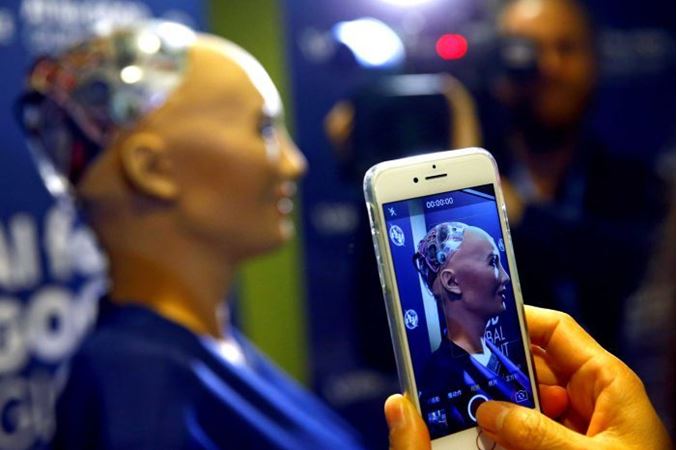

ITU has just published a new report that lays out how Artificial Intelligence (AI) could be used during the process of making and distributing television and radio content.
The report discusses how AI is now being used to optimise workflows for broadcasting programme making, to improve audio and visual quality evaluation, to efficiently utilize the frequency spectrum in television and radio distribution and recently even to create new programmes by mining archives as well as automatically targeting content to specific audiences or individuals.
For example, AI is being used for extracting content from vast archives; automatically localising content for international distribution; and generating access services such as captioning, audio description, text to speech and signing far faster and far more accurately than could be achieved in the past.
The report – Artificial Intelligence systems for programme production and exchange – reflects the work ITU has been doing on these issues, profiting from the experiences of programme makers and broadcasters who are doing just that.
“ITU is collaborating with stakeholders to harness the power of AI to improve lives worldwide and seek solutions to the world’s greatest challenges,” said ITU Secretary-General Houlin Zhao. “This helps us to identify practical applications of AI that can accelerate progress towards the UN Sustainable Development Goals, which is what we are doing this week at the AI for Good Global Summit.”
“There is still an incredible amount of work needed to ensure that the use of AI in programme making and content distribution is for the benefit of the audiences,” said Mario Maniewicz, Director of ITU’s Radiocommunication Bureau. “We also need to make sure that the systems employed interact with each other. This and other Reports and Recommendations from ITU help to achieve that.”
- Study Group 6 Expands Work on AI
ITU study groups are venues for ITU members to work collaboratively in responding to the priorities of the ITU membership. The groups develop the technical basis for ITU agreements and associated activities.
Study groups of the ITU Radio-communication Sector (ITU-R) address issues including the efficient management and use of the radio-frequency spectrum and orbit resources, radio systems’ characteristics and performance, spectrum monitoring, emergency radio-communications for public protection and disaster relief, interference-free radio-communications, radio and TV broadcasting, and new radio technologies.
The recent AI report is in response to Study Group 6 (Broadcasting Service) Question ITU-R 144/6 on Use of Artificial Intelligence (AI) for broadcasting, which was approved in January 2019.
Yukihiro Nishida, Chairman of ITU-R Study Group 6 (SG 6), said “The use of AI is becoming essential for broadcasting to increase productivity and reliability and is expanding its applications in the end-to-end chain of broadcasting, for which SG 6 is responsible. It is important to understand the impact to broadcasting. SG 6 will continue the study to help broadcasters make maximum advantage of its use.”
Andy Quested, Chairman of the ITU-R Working Party 6C that oversees the AI work, indicated that with the ever-expanding formats, platforms and regulations broadcasters are faced with, there is a demand for intuitive and learning technologies to be a vital tool for programme makers and broadcasters. AI is allowing programme makers to do what they are best at – creating the best, most compelling content they can.
Poppy Crum (USA), Vice-Chairman, ITU-R Working Party 6C has been leading this project working with members to create a unique overview Report of the current state of intelligent systems as they are applied to programme making and international programme exchange.
More than 5000 specialists, from administrations, the telecommunications industry as a whole and academic organisations throughout the world, participate in the work of the ITU-R Study Groups.