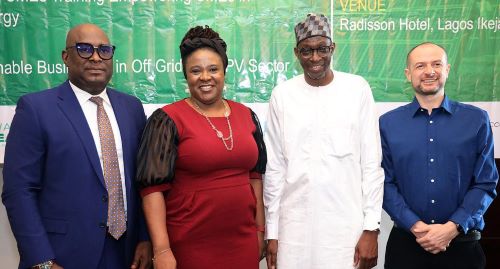

(L-R); Regional Manager, Apapa – Isolo, Ecobank Nigeria, Mr. Otega Odjegba; Team Lead, Entrepreneurship Support Facilities, Regional Off-Grid Electricity Access Project, Salamatu Baba Tunwzang; Senior Adviser/ Project Coordinator, Regional Off-Grid Electricity Access Project, Ecowas Commission Ei hadji Sylla; and Environmental Social Health and Safety Expert, Amani Mchugh at the Ecowas – ROGEAP Entrepreneurship Business Training for SMEs s in Solar Business in Lagos.
The Economic Community of West African States (ECOWAS), in collaboration with Ecobank Nigeria and the World Bank, has trained more than 100 entrepreneurs in Nigeria through a specialised program focused on small and medium-sized enterprises (SMEs) in the off-grid photovoltaic solar energy sector.
This initiative forms part of the Regional Off-Grid Electricity Access Project (ROGEAP), which seeks to promote the development of a regional market for standalone solar energy systems. ROGEAP is funded by the World Bank, with additional support from the Clean Technology Fund (CTF) and the Directorate General of International Co-operation (DGIS) of the Government of the Netherlands.
El Hadji Sylla, Senior Adviser at the ECOWAS Commission’s ROGEAP, disclosed this during a three-day Entrepreneurship Business Training held in Lagos, organised in collaboration with Ecobank. He noted that Nigerian SMEs have already benefited from grants totaling $800,000 under the project, aimed at increasing participation in the off-grid solar energy value chain.
Sylla explained that the capacity-building workshops, conducted in both Abuja and Lagos, were designed to enhance the technical and financial capabilities of SMEs focused on solar energy. The objective is to better position these businesses for growth and long-term sustainability in the renewable energy sector.
He also stated that ECOWAS is in discussions with Ecobank Group to establish mechanisms that would allow the bank to offer both technical and financial support to SMEs in the solar energy ecosystem. This includes extending direct credit lines to eligible businesses.
According to Sylla, the first component of ROGEAP—led by the ECOWAS Commission—centers on the creation of a strong regional market for off-grid solar solutions. A key strategy involves equipping SMEs with the skills to develop technically sound and financially viable projects that meet commercial lending standards.
“This year, we have worked closely with Ecobank Nigeria to align solar-focused SME portfolios with the bank’s financing requirements,” Sylla said. “Our goal is to ensure that the submitted projects are not only technically feasible but also bankable.”
Also speaking at the event, Salamatu Baba Tunwzang, Team Lead at ROGEAP’s Entrepreneurship Support Facilities, emphasized that the program goes beyond technical training. She highlighted that participating SMEs are also being prepared to access ROGEAP grants and other funding opportunities.
“When businesses join our network, they gain access to both technical assistance and financial resources,” she said. “We also build the capacity of technical installers, who can equally benefit from these opportunities. It’s a comprehensive support system—they receive funding, technical training, market intelligence, and valuable networking opportunities for collaboration.”
In his remarks, Managing Director of Ecobank Nigeria, Bolaji Lawal, reiterated the vital role SMEs play in driving economic sustainability and inclusion. Represented by Otega Aghogho Odjegna, Regional Head for the Apapa-Isolo Region, Lawal described SMEs as the “lifeblood of any economy,” pointing out that they contribute over 80 percent of employment across West Africa.
He further noted that this initiative aligns with Ecobank’s ELLEVATE program and the Single Market Trade Hub, both of which aim to equip SMEs with tailored financial solutions, digital tools, and strategic insights to help them scale and compete in broader markets.