

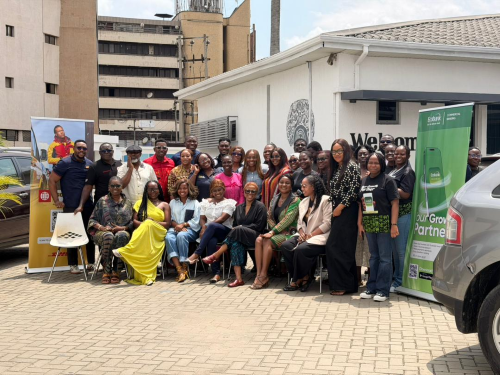

Participants with staff members of Ecobank and DHL at the capacity‑building programme.
Ecobank Nigeria, in partnership with DHL, has successfully concluded a three‑week intensive capacity‑building programme aimed at equipping Small and Medium Enterprises (SMEs) with the skills, tools, and insights required to scale beyond local markets and compete globally.
The programme brought together entrepreneurs across diverse sectors and focused on critical growth enablers such as cross‑border trade, e‑commerce opportunities, logistics, customs procedures, and international shipping—key pillars for sustainable expansion in today’s increasingly connected global marketplace.
Participants described the initiative as impactful, practical, and transformative. Founder of Lagos‑based fashion brand Debsfray, Dolapo Fatoki, said the training addressed long‑standing business challenges.
“The sessions were highly informative. I gained a deeper understanding of documentation and pricing, two areas that previously posed major challenges for me. The collaboration between DHL and Ecobank has been exceptional and truly beneficial,” she noted.
Similarly, Tosin Olukuade, Creative Director of FC Accessories, described the programme as “an eye‑opener,” adding that it reshaped his approach to business growth.
“The insights I gained will help me scale my business exponentially. I am grateful to Ecobank and DHL for creating this opportunity,” he said.
Reflecting on the programme’s digital focus, Mrs. Theresa Onwuka, CEO and Founder of Needle Point, highlighted how the sessions broadened her outlook on growth and innovation. “The class was so good—it got my mind thinking of possibilities. My main takeaway is clear: digitalisation is the way forward,” she remarked.
One of the programme’s sessions, titled “Trade and Grow Beyond Borders: Welcome to E‑commerce,” was delivered by Charles Eke, Relationship Channel Manager, DHL Customers/Global Express. He underscored logistics as a critical success factor for SMEs, identifying key challenges such as access to finance, markets, and efficient logistics. He also provided practical guidance on customs processes, international shipping, documentation, and shipment tracking, while emphasising the immense opportunities
e‑commerce presents for cross‑border expansion. According to him, international markets often offer greater growth potential than domestic markets for well‑positioned SMEs.
Speaking on the impact of the initiative, Omoboye Odu, Head, SMEs, Partnerships and Collaborations at Ecobank Nigeria, described the programme as a catalyst for meaningful growth and mindset change. “Over the past three weeks, something truly powerful has taken place. This programme has gone far beyond knowledge sharing—it has inspired new thinking and unlocked fresh possibilities for our SMEs. The message is clear: no business should be limited by geography,” she said.
Odu reiterated Ecobank’s deliberate focus on SMEs as key drivers of Africa’s economic development.
“Beyond building capacity, we are intentionally opening doors by connecting businesses to new markets and opportunities. With our presence in over 30 African countries, coupled with integrated payment, trade finance, and e‑commerce solutions, Ecobank is uniquely positioned as the Pan‑African bank enabling seamless cross‑border trade,” she added.
She also highlighted the Bank’s continued commitment to supporting women‑led businesses through Ellevate by Ecobank, which provides access to finance, business advisory services, and tailored solutions designed to help female entrepreneurs scale sustainably and compete globally.
“When businesses gain access to markets, ambition turns into action and growth accelerates. This initiative is not just training; it is transformation,” Odu concluded.
Ecobank Nigeria remains committed to driving innovation, fostering strategic partnerships and creating impactful platforms that enable African businesses to thrive on the global stage.