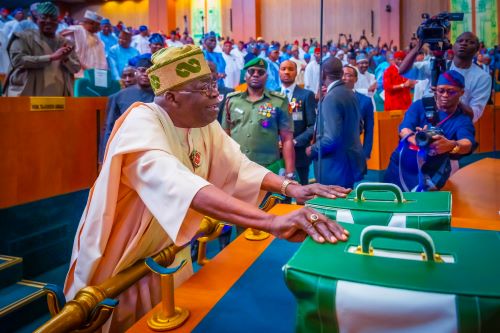

BudgIT, a civic tech organisation promoting transparency and accountability in Nigeria’s public finance, has uncovered 11,122 projects valued at N6.93 trillion inserted by the National Assembly into the 2025 Federal Government Budget.
What began as isolated irregularities has, over the years, evolved into a deeply entrenched culture of exploitation and abuse, with the budget process now a playground for self-serving political interests, led by top-ranking members of the National Assembly.
Our analysis reveals that 238 projects valued above N5 billion each, with a cumulative value of N2.29 trillion, were inserted with little to no justification. 984 projects worth N1.71 trillion and 1,119 projects within the range of N500 million to N1 billion, totaling N641.38 billion, were indiscriminately inserted, raising questions about their relevance and alignment with national priorities.
These insertions, far from promoting development, appear tailored to satisfy narrow political interests and personal gains rather than the citizens’ interests.
A closer look shows that 3,573 projects worth N653.19 billion are assigned directly to federal constituencies and 1,972 projects worth N444.04 billion to senatorial districts. Categorically, some of the most glaring anomalies include: 1,477 streetlight projects worth N393.29 billion; 538 boreholes totalling N114.53 billion; 2,122 ICT projects valued at N505.79 billion; and N6.74 billion earmarked for “empowerment of traditional rulers”
Shockingly, 39% of all insertions—4,371 projects worth N1.72 trillion—were forced into the Ministry of Agriculture’s budget, inflating its capital allocation from N242.5 billion to N1.95 trillion. The Ministries of Science and Technology and Budget and Economic Planning also saw bloated allocations of N994.98 billion and N1.1 trillion, respectively, from insertions alone.
Even more concerning is the targeted misuse of agencies like the Nigerian Building and Road Research Institute (Lagos) and the Federal Cooperative College, Oji River, as dumping grounds for politically motivated projects.
These agencies lack the technical capacity to execute such projects, leading to rampant underperformance and waste. For example, the Federal Cooperative College, Oji River—a training institution—was saddled with: N3 billion for utility vehicles to support farmers and distribution agents; N1.5 billion for rural electrification in Rivers State; and N1 billion for solar streetlights in Enugu State.
These are examples of agencies operating outside their mandates, managing projects unrelated to their statutory functions, and adding zero value to national development.
Despite these findings, the Presidency has remained conspicuously silent. Recall that in the third and fourth quarters of 2024, BudgIT launched the “The Budget is a Mess” campaign to bring these issues to light.
We submitted formal letters outlining our findings to the Presidency, the Budget Office, and the National Assembly. While these letters were acknowledged, no response was received from any of the institutions, and not a single institution has taken responsibility for the anomalies. Even more concerning is the silence from the Presidency—silence which, in the face of overwhelming evidence, amounts to complicity.
Commenting on the findings, Gabriel Okeowo, BudgIT’s Country Director, stressed the urgent need to restore integrity to Nigeria’s budgeting process, highlighting how unchecked project insertions by the National Assembly have derailed the purpose of national planning, weakened public trust, and diverted resources away from critical development priorities.
“The insertion of over 11,000 projects worth N6.93 trillion into the 2025 budget by the National Assembly is not just alarming—it is an assault on fiscal responsibility. This trend, increasingly normalised, undermines the purpose of national budgeting, distorts development priorities, and redirects scarce resources into the hands of political elites. Nigeria cannot afford to run a government of projects without purpose. We urgently need transparency, constitutional clarity, and a return to evidence-based planning that puts citizens, not politics, at the centre of the budget.” Okeowo said.
In light of the foregoing, we call on President Bola Ahmed Tinubu to exercise stronger executive leadership and reform the budgeting process to ensure alignment with the Medium-Term National Development Plan (2021–2025) and other national priorities. We urge the Attorney General of the Federation and Minister of Justice to seek a constitutional interpretation from the Supreme Court regarding the extent of the National Assembly’s appropriation powers, particularly its authority to unilaterally introduce new capital projects without Executive concurrence.
We hope that the anticorruption agencies, the Economic and Financial Crimes Commission (EFCC) and the Independent Corrupt Practices Commission (ICPC), will also take action to track these projects and ensure Nigeria gets value for money.
We also call on citizens, the media, civil society organisations, and the development community to speak out and demand reform. This is not merely about financial mismanagement—it is a matter of justice, equity, and the future of accountable governance in Nigeria. The 2025 Budget must serve the interests of the Nigerian people, not a privileged few.