


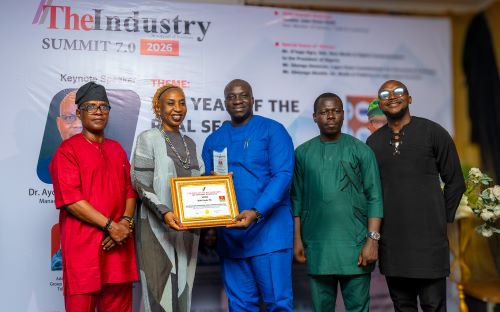

BUA Foods Plc has been recognised as the Outstanding Consumer Goods (Foods) Company of the Year at the 2026 Industry Award Night organised by The Industry Newspaper. The event, held in Lagos, brought together leading voices from across Nigeria’s industrial and business landscape.
According to the award panel, the company was recognised for “its impactful presence in Nigeria’s food industry, driving food security and delivering quality products to Nigerians,” underscoring BUA Foods’ sustained commitment to scale, operational excellence, and nationwide accessibility of essential food products.
This recognition comes amid a series of strong corporate milestones. BUA Foods closed 2025 as the most capitalised company on the Nigerian Exchange, reflecting growing investor confidence. Its audited full-year financial results also showed robust revenue growth and a significant increase in profitability, driven by efficiency gains and strong market demand.
Beyond financial performance, the company continues to play a critical role in advancing Nigeria’s food security agenda. Through its backward integration programme, LASUCO Sugar Company, BUA Foods is contributing meaningfully to Nigeria’s drive for sugar self-sufficiency while strengthening local production capacity.
Providing broader context on BUA Foods’ role in driving real sector transformation, the Managing Director, Engr. Ayodele Abioye, earlier delivered a keynote address at the Industry Summit, where he emphasised the urgent need to reposition Nigeria’s economy around value creation.
Speaking on the theme “Unlocking Value: BUA Foods’ Role in Transforming Nigeria’s Real Sector through Innovation and Sustainability,” he noted that long-term economic growth cannot be sustained on consumption alone. “The future of Nigeria’s economy will be determined by how effectively we produce, not just how much we consume,” he stated.
Engr. Abioye highlighted that while the non-oil sector accounts for over 96 % of Nigeria’s GDP, growth has remained uneven, pointing to the need for deeper investments in agriculture and manufacturing. He stressed that sustainable growth must be anchored in productivity, industrial capacity, and value addition. Using BUA Foods as a case study, he revealed that the company has increased its production capacity by over 40% in recent years and is on track to deliver an additional 55% expansion.
According to him, this scale is critical to improving food availability, reducing import dependence, and strengthening national food security.
He further noted the company’s role in inclusive development, with thousands of smallholder farmers integrated into its value chain through structured partnerships. BUA Foods has also created over 3,000 direct jobs and supports more than 10,000 participants across its supply chain nationwide.
Despite these gains, Engr. Abioye acknowledged persistent structural challenges, including infrastructure deficits, inconsistent policy implementation, and limited access to long-term financing. “Addressing these constraints requires deliberate alignment between policy, capital, and execution,” he said. “We must invest at scale in local processing, strengthen value-chain integration, and build globally competitive industrial platforms.”
He also recognised recent government reforms in agriculture, trade, and industrial policy as positive signals, while emphasising that sustained coordination and effective execution will determine their long-term impact. “At BUA Foods, we are not just producing food,” he added. “We are building systems, enabling productivity, and demonstrating that Nigeria can compete at scale in critical sectors.”
In his opening remarks, Goddie Efosa, convener of the summit and publisher of The Industry Newspaper, reinforced the importance of sustained collaboration between policymakers and industry leaders to accelerate Nigeria’s industrialisation.
As Nigeria navigates an increasingly complex economic landscape, BUA Foods’ recognition and expansion trajectory signal growing private sector confidence in the real economy—while reinforcing the broader imperative for coordinated action to unlock productivity, scale, and long-term national value.