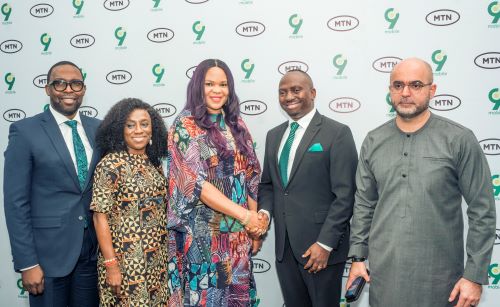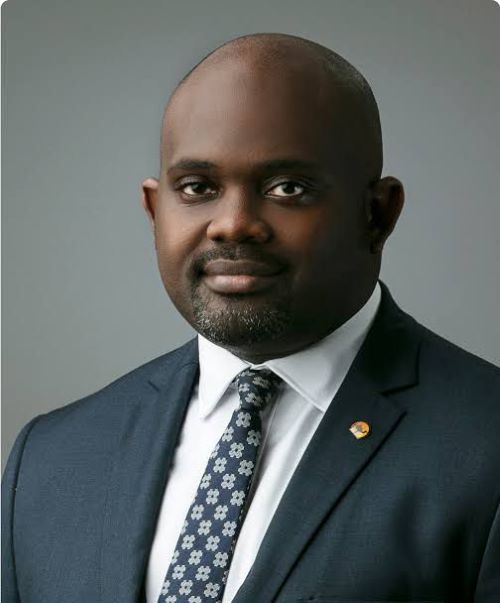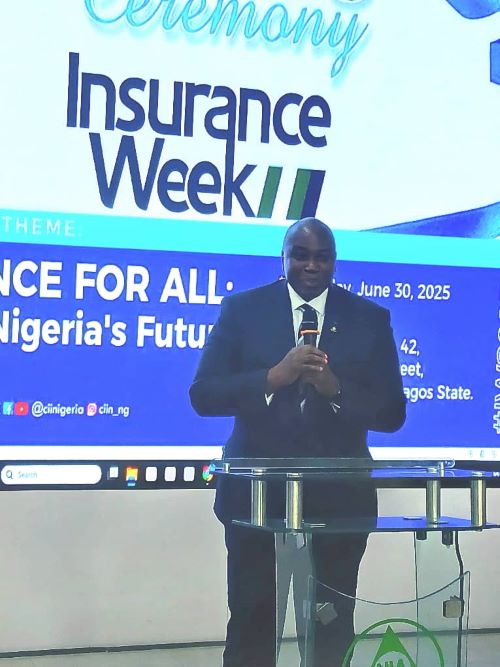
From Left: Executive Director – Technical; Mr. Okanlawon Adelagun; Managing Director/CEO, Linkage Assurance Ltd, Daniel Braie; Chief Human Capital Officer/Head Management Services, Humphrey Ozegbe; President, AIO-YIPs and staff of Linkage, Oluwaseun Oyelere at the AIO conference in Addis Ababa, Ethiopia.
Nigerian Delegates at 2025 AIO Conference in Addis Ababa, Ethiopia
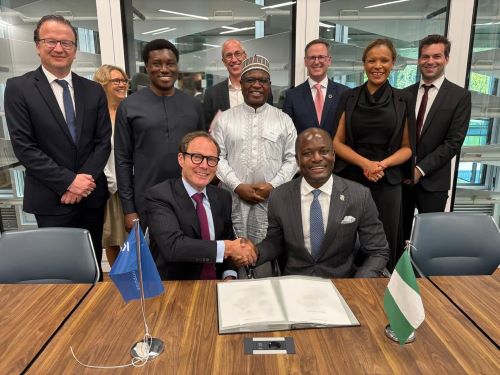
From Left: Managing Director/CEO, Cornerstone Insurance Plc, Stephen Alangbo; Chairman, FBS Re, Bala Zakariyau; Newly appointed Managing Director/CEO, Continental Reinsurance Plc, Nigeria, Dr. Fatai Kayode Lawal; Director, FBS Re, Fola Daniel; Former Secretary General, AIO, Prisca Soares; Commissioner for Insurance, NAICOM, Olusegun Omosehin; Chairman NAICOM; Ms. Halima Kyari; and Managing Director/CEO, Linkage Assurance Ltd, Daniel Braie at the African Insurance Organisation (AIO) conference held in Addis Ababa, Ethiopia.
2nd Year Anniversary: Tinubu Hails NASENI’s Contributions to National Economy
A special recognition of excellent performance toward fulfilling Federal Government’s socio-economic agenda has been accorded the management of the National Agency for Science and Engineering Infrastructure (NASENI) by President Bola Ahmed Tinubu.
President Tinubu in his nationwide address to mark the May 29-second-year anniversary of his administration, televised live to the nation, hailed NASENI under the leadership of the Executive Vice Chairman/CEO, Mr. Khalil Suleiman Halilu for the Agency’s numerous achievements of high impact projects and programmes that are steering Nigeria along the critical path of socio-economic development,
According to the President, NASENI has championed youth empowerment, skill acquisition and job creation initiatives for unemployed Nigerian youths, thus supporting the federal government’s plan to empower the next generation, bridge inequality and place young Nigerians at the heart of national development.
President Tinubu in his speech said: “Nowhere is placing young Nigerians at the heart of national development more evident than at the National Agency for Science and Engineering Infrastructure (NASENI), where the current management is making giant strides. NASENI has embraced a digital-first approach, introduced real-time dashboards, and implemented end-to-end e-procurement through its Unified ERP System—setting a new governance benchmark for public institutions.”
“Through bold, high-impact programmes like Innovate Naija, Irrigate Nigeria, the Asset Restoration Programme, and the Renewable Energy and Innovation Park in Gora, NASENI drives inclusive industrialization at scale”
“From assembling electric vehicles and reviving idle assets to launching Africa’s most advanced Rapid Diagnostic Kit Factory and training female drone engineers through the NASCAV programme, these initiatives are creating jobs, restoring dignity to work, and opening a future of possibilities for our youths. This is the movement we promised—a government of action powered by the energy and innovation of young Nigerians,” he said.
President Tinubu noted that Agriculture and food security are top priorities of his Renewed Hope Agenda of which NASENI is playing a pivotal role through the Irrigate Nigeria Project wherein the Agency has provided its state-of-the art Solar Irrigation Pump system to boost local food production, support farmers, and stabilize food prices through mechanised farming.
Under the leadership of Mr. Khalil Suleiman Halilu, NASENI is building urea and coal-based factories, lithium processing and manufacturing plant, drone assembly plants, expanding eco-friendly cookstoves production lines, rehabilitating abandoned farm tractors, building new Development Institutes and NASENI Skill Acquisition Centres (NSACs) nationwide and many more.
About NASENI:
The National Agency for Science and Engineering Infrastructure (NASENI) is the only purpose-built intervention Agency of the Federal Government under the Presidency whose mandate includes nurturing an appropriate and dynamic Science and Engineering infrastructure base for achieving home-initiated and home-sustained industrialization for Nigeria.
AIICO Insurance Brings Joy, Hope to Visually Impaired Children on Children’s Day
In commemoration of this year’s Children’s Day, AIICO Insurance Plc extended heartfelt support and companionship to the children at Bethesda Home & School for the Blind, as part of its ongoing commitment to inclusive and impactful corporate social responsibility.
The visit was a day filled with warmth, joy, and meaningful connection. Beyond the donation of essential food items and gifts, AIICO staff spent quality time with the 286 children at the home listening, learning, and sharing laughter. A beautifully decorated cake was also presented to the children, adding a celebratory note to a day that left lasting smiles and cherished memories.
Speaking during the visit, Mrs. Abimbola Shobanjo, AIICO’s Corporate Responsibility and Sustainability Manager, emphasised the importance of mindful inclusion in society:
“Children’s Day is a powerful reminder of the hope that young lives carry. At AIICO, we are intentional about reaching every child, especially those who are less privileged or differently abled. Our visit to Bethesda is about more than giving; it’s about recognizing their worth, reminding them that they matter, and reaffirming our belief that they belong and have a bright future ahead.”
The leadership of Bethesda Home & School for the Blind expressed deep appreciation for the visit and generosity shown by AIICO, noting the positive emotional impact it had on both the children and staff.
This initiative is part of AIICO Insurance Plc’s broader strategy to drive meaningful social change- championing education, inclusion, and the well-being of vulnerable groups across Nigeria.
About AIICO Insurance Plc
AIICO Insurance is a leading composite insurer in Nigeria, with a 60-year legacy of delivering quality service to its clients.
Founded in 1963, AIICO provides life and general insurance, health insurance, and investment management services to create and protect wealth for individuals, families, and corporate customers.
Orange Corners Nigeria Secures Financial Sponsorship from Stanbic IBTC
(From L-R: Michel Deelen, Consul General, Kingdom of the Netherlands; Wole Adeniyi, Chief Executive, Stanbic IBTC Bank; Adenike Adeyemi, Executive Director, FATE Foundation, Sonia Onovughakpo Fajusigbe, Economic Policy Adviser & Business Developer Entrepreneurship, Youth Employment and Healthcare of the Consulate General of the Kingdom of the Netherlands, Lagos and Jurriaan Middelhoff, Ambassador for Youth, Education & Employment, Ministry of Foreign Affairs, Netherlands at the partnership signing ceremony held in Lagos Nigeria).
Orange Corners Nigeria (OCN), an initiative of the Kingdom of the Netherlands, implemented by FATE Foundation, welcomed Stanbic IBTC, a leading financial services provider in Nigeria, as a private partner. This partnership marks a significant milestone in the programme’s mission to support young entrepreneurs in Nigeria with the skills, knowledge, and support they need to create sustainable economic opportunities within their communities and to build a thriving entrepreneurial ecosystem in Nigeria.
OCN was launched in Nigeria in 2019 with the support of the Consulate General of the Kingdom of Netherlands in Lagos.
The model in Nigeria is a Business Incubator, an innovation fund, and a student ambassador programme. OCN’s vision is to contribute to a thriving entrepreneurial ecosystem, by providing economic opportunities, skills, and the right networks for youth with innovative business ideas.
Michel Deelen, Consul General, Kingdom of the Netherlands, said while giving his welcome address, ’’Orange Corners is the expression of our belief in the youth of Nigeria. From inception the plan was to do this together with the private sector and we are very pleased to have found a partner in Stanbic IBTC”
The official partnership commemoration ceremony took place on Friday, May 16, 2025, at the Embassy of the Netherlands in Victoria Island, Lagos Nigeria.
“We’re excited to partner with Stanbic IBTC to advance Orange Corners Nigeria’s mission of fostering a thriving entrepreneurial ecosystem, where young people can turn their innovative ideas into successful businesses. This partnership will enable us to provide more comprehensive support, mentorship, and opportunities for growth, ultimately driving innovation and job creation in Nigeria.” Adenike Adeyemi, Executive Director, FATE Foundation said at the ceremony.
In attendance were Michel Deelen, Consul General, Kingdom of the Netherlands; Jurriaan Middelholf, Ambassador for Youth, Education & Employment, Ministry of Foreign Affairs, Netherlands, Wole Adeniyi, Chief Executive, Stanbic IBTC Bank; Adenike Adeyemi, Executive Director, FATE Foundation, Sonia Onovughakpo Fajusigbe, Economic Policy Adviser & Business Developer Entrepreneurship, Youth Employment and Healthcare of the Consulate General of the Kingdom of the Netherlands, Lagos Bambo Adebowale, Dean & Director, The FATE School; Tosin Leye- Odeyemi. Head Sustainability, Risk and Capital Management, Stanbic IBTC Holdings, Great Ukazim, Program Manager, Orange Corners Nigeria; and a few staff members of Stanbic IBTC and FATE Foundation.
Mr. Wole Adeniyi, Chief Executive, Stanbic IBTC Bank stated: “We are going to help catalyse more entrepreneurs and also help the youth. It goes with what we are doing with SME businesses, we are going to be able to scale more, empower them more, and also provide access to financing that will help to support the economy.”
At the ceremony, some current OCN cohort incubatees and alumni members had the opportunity to speak about their businesses, the positive impact that the OCN programme has had on them and their businesses, and the challenges that they are experiencing as aspiring entrepreneurs.
FATE Foundation is Nigeria’s foremost enterprise development organisation that seeks to harness the strong entrepreneurial culture of Nigerians by providing aspiring entrepreneurs with business incubation, growth, and accelerator support required to fully explore their innovative potential, to start, grow and scale their businesses with the mission to foster wealth creation by promoting businesses and entrepreneurial development among Nigerians.
NGX CEO, Temi Popoola, Urges Policymakers, Development Stakeholders to Rethink Africa’s Growth Model
Temi Popoola, Group Managing Director and Chief Executive Officer of Nigerian Exchange Group (NGX Group), has called on African policymakers, capital market leaders, and development stakeholders to collaboratively rethink the continent’s growth model, anchoring it on homegrown capital, tech-enabled integration, and bold partnerships as pillars of a renewed African development agenda.
Speaking at the 2025 Annual Meetings of the African Development Bank (AfDB) in Abidjan, Popoola emphasized that financial sovereignty and economic resilience must be built on deliberate domestic capital mobilization and scalable, tech-driven solutions.
Reflecting on lessons from the COVID-19 pandemic, he noted that, “when foreign capital dried up and domestic capital stepped in to fill the void, it revealed something powerful: the capital we often seek abroad already exists within our borders. What is needed now is intentionality and a clear plan to mobilise and deploy it effectively.”
Drawing on his leadership of one of Africa’s premier financial market infrastructure institutions, Popoola outlined three foundational pillars for Africa’s financial future: intentionality, financial literacy, and technology-driven inclusion.
He urged public and private institutions alike to “speak the language of capital” by designing frameworks that align with the realities and expectations of local investors. “Foreign capital follows local commitment,” he said. “When African institutions lead with clarity and confidence, others follow. But we must first trust and invest in ourselves.”
Popoola also called for greater cross-border collaboration to accelerate the integration of African capital markets. Referencing the African Exchanges Linkage Project (AELP), an AfDB-backed initiative, he described it as a model for regional capital connectivity while cautioning that regulatory silos and uneven infrastructure remain barriers.
He pointed to Nigeria’s InfraCredit as a successful model for unlocking institutional capital for infrastructure. “We already have the templates, the tools, and the capital. It’s time to act with intent and scale what works.”
Popoola’s call for African-led solutions comes at a pivotal moment for the continent’s premier development institution. The 2025 meetings marked the final one under the leadership of Dr. Akinwumi Adesina, whose decade-long tenure as AfDB President, saw the Bank’s capital base grow from $93 billion to $318 billion and more than 500 million lives impacted.
Commending these achievements, Popoola urged continuity with even greater ambition and urgency. “There’s now a broader awareness that Africa can solve its own problems. The incoming AfDB leadership and all of us across the public and private sectors must build on this momentum to deliver African-led growth.”
He concluded with a charge to the continent’s leaders and financial actors, stating, “Africa must stop waiting for rescue. Our capital, our ideas, and our partnerships are the keys to unlocking sustainable development from within.”
Popoola’s comments reflect a growing consensus among financial leaders that Africa’s next phase of growth must be self-directed, leveraging local capital and innovation to shape its own development trajectory.
PenOp Appoints Anthonia Ifeanyi-Okoro as Chief Operating Officer
The Pension Fund Operators Association of Nigeria (PenOp) is pleased to announce the appointment and resumption of Anthonia Ifeanyi-Okoro as its Chief Operating Officer (COO).
Anthonia brings with her over 15 years of extensive experience in business transformation, operations, and strategic delivery. She has worked in a range of high-impact roles across business member organizations and central government institutions in the United Kingdom. Her career has seen her lead and manage major portfolios, programmes, and stakeholder engagements—skills that are critical to the evolving needs of the Nigerian pension industry.
Welcoming her to the role, Oguche Agudah, Chief Executive Officer of PenOp, said: “Anthonia’s experience working with diverse and influential stakeholders, both in the private and public sectors, makes her a valuable addition to the PenOp team. A significant part of our work involves managing various interests across the pension ecosystem, and we are confident that Anthonia’s background equips her well to lead in this capacity. Her appointment is a strategic step toward strengthening our organization to better support the pension industry and deepen its role in Nigeria’s economic growth.”
In her remarks, Anthonia Ifeanyi-Okoro expressed her enthusiasm about joining PenOp at such a pivotal time:
“I’m excited to be part of an organisation that plays such a vital role in Nigeria’s financial and economic landscape. I look forward to bringing my experience to bear in helping move the association—and indeed the industry—forward. More importantly, I’m passionate about contributing to Nigeria’s economic development by supporting financial stability, improving retirement planning, and enhancing the long-term wellbeing of millions of Nigerians.”
PenOp remains committed to driving impactful investments and initiatives within the pension space and believes this appointment will significantly advance its mission.
Wecass Braun Integrated Energy Showcases Management Team
From left to right: Mrs. Ezeonuegbu Scholar Ifeyinwa – Managing Director, Wecass Braun; Engr. André Braun – International CEO, Wecass Braun and Engr. Forster Onyeka Edward – Nigeria CEO, Wecass Braun at the official unveiling of Wecass Braun’s latest German lighting and solar technologies in Nigeria.
The Puzzle of Nigerian Corporate Prosperity in Harsh Economic Times
By Elvis Eromosele
In the first quarter of 2025, a curious paradox is playing out across Nigeria’s economic landscape. Discerning observers will notice that the nation’s economic landscape tells a story of stark contrasts.
On the one hand, households groan under the weight of runaway inflation, forex instability, fuel price hikes, and an unrelenting surge in the cost of living. On the other, a stream of earnings reports from banks, telecoms, FMCGs, and even manufacturing firms show a steady rise in revenues and profits.
It almost feels surreal: while the average Nigerian tightens their belt to survive, boardrooms are raising glasses to another quarter in the black. How are companies thriving when their customers are barely surviving?
The answer appears to lie in a complex interplay of strategic pricing, market consolidation, cost-cutting measures, and, unfortunately, consumer sacrifice. Many of Nigeria’s leading corporates have adopted recession-proof strategies that prioritize shareholder value, often at the expense of affordability and accessibility for the average consumer.
Take the financial sector, for instance. Tier-one banks such as Zenith (PAT N312 billion), GTCO (PAT N258 billion), and Access Holdings (PAT N182 billion) all reported robust Q1 2025 profits. These were largely fueled by non-interest income, transaction charges, FX revaluation gains, and aggressive digital expansion.
While interest rates soared, banks reaped returns on government securities and leveraged forex differentials to boost their margins. Meanwhile, small business owners and salary earners struggle to get loans or survive excessive transaction fees.
In the telecoms space, MTN Nigeria (PAT N133 billion) and Airtel Africa (PAT $31 million) posted impressive earnings as data consumption remains inelastic, even during hard times. With more Nigerians relying on mobile data for work, education, and survival, telcos are cashing in. However, data costs have steadily increased, often quietly, adding to household burdens.
Fast-moving consumer goods (FMCG) giants like Nestlé (PAT N30 billion), Cadbury Nigeria (PAT N5.9 billion) and Unilever (PAT N5.2 billion) also joined the profit party.
With dollar volatility affecting import costs, many firms have localised production, increased prices, and reduced pack sizes (a practice known as “shrinkflation”). Consumers, in turn, are forced to adjust consumption habits, often choosing between quantity and quality.
The success of big business however raises uncomfortable questions: is Nigeria’s private sector truly growing sustainably, or merely extracting value in a way that widens the inequality gap?
What is emerging is a two-speed economy. On one track, corporates optimize profits through agility, digital transformation, and price adjustments. On the other, citizens face daily hardships, shrinking purchasing power, stagnant wages, and rising unemployment. The middle class is thinning, while poverty deepens.
I think that government inaction and weak regulation often compound the situation. There may also be companies that exploit regulatory loopholes or benefit from policies that insulate their sectors from real competition. While this fuels short-term gains, it does little to build long-term inclusive growth or economic resilience.
To align corporate success with citizen welfare, Nigeria must prioritize policies that channel profits into inclusive growth. First, the government should expand targeted cash transfers and food subsidies to shield the poorest households from inflation’s bite. Headline inflation stood at 24.23 per cent in the period under review. No wonder therefore that the World Bank’s call for accelerated social protection programs is urgent. Second, investing in labour-intensive sectors like manufacturing and agriculture could create jobs and reduce rural-urban disparities. In addition, addressing insecurity in farming regions would lower food prices, tackling inflation at its root.
Third, monetary policy must balance inflation control with economic stimulus. The Central Bank’s tight policy, while necessary, has raised borrowing costs, stifling small businesses that employ millions. A gradual easing, as inflation is projected to fall to 22.1 per cent in 2025, could spur growth without reigniting price pressures. (NB: A tight monetary policy, implemented by a central bank, aims to curb rapid economic growth and control inflation by slowing down spending and reducing the money supply.)
Finally, companies must share the burden. Corporate social responsibility initiatives, such as affordable pricing for essential goods or investments in community infrastructure, could ease public discontent and foster goodwill.
This is the core of the matter. The glowing quarterly results splashed across business pages paint a picture of corporate triumph, but it’s one cast against a backdrop of growing national despair. This contrast cannot be ignored, and it is also not sustainable.
The corporate sector’s resilience is a testament to adaptability and innovation, but it also underscores a troubling truth: economic growth alone does not lift all boats. Nigeria’s economic narrative cannot be solely about profits and stock valuations; it must include people.
If companies are winning while citizens are weeping, then we are all losing in the long run. What’s needed is a recalibration: one where businesses pursue profit with purpose, governments enforce equity, and the well-being of Nigerians becomes the bottom line that truly matters.
Eromosele, a corporate communication professional and public affairs analyst, wrote via: [email protected]
Fidelity Bank CEO Celebrates Children’s Day 2025 in Lagos
Managing Director/Chief Executive Officer, Fidelity Bank Plc, Dr. Nneka Onyeali-Ikpe (Middle); flanked by Fidelity Bank SWEETA kids at the Fidelity Fantasyland celebration in commemoration of the 2025 Children’s Day at the Fidelity Grounds, Oniru, Lagos yesterday.
Newly Appointed MD/CEO Of NAIC Resumes Office, Pledges Inclusive Reforms
The newly appointed Managing Director/Chief Executive Officer of the Nigerian Agricultural Insurance Corporation (NAIC), Mr. Yazid Shehu Danfulani, yesterday formally resumed office in Abuja, pledging to carry out reforms that would enhance inclusiveness in agricultural sector.
Speaking to members of staff of the Corporation and journalists at a reception organised in his honour at the Corporation’s headquarters in Abuja, Danfulani highlighted his plans for the Corporation, emphasising the importance for access to insurance, collaboration, sensitisation and access to finance to protect agro-allied projects against natural hazards.
He said the Corporation will collaborate with all states government and other stakeholders to enhance easy access to insurance for agricultural and agro-allied projects against natural catastrophes.
The NAIC boss expressed worries that many farmers lack awareness about the function of the Corporation, especially in providing insurance, stating that the Corporation would carry out sensitisation across the country to enlighten farmers on measures to access insurance.
“We will ensure collaboration from the Federal Government to the State Governments. Most of these farmers are not aware of what NAIC is all about. We are going to do a very comprehensive awareness. We are also going to provide more funds so that the farmers would benefit.
My immediate priority is to strengthen the effectiveness and efficiency of NAIC by ensuring our services are more accessible and are also beneficial to farmers in Nigeria. Agricultural sector possesses a lot of challenges due to climate change and other problems that may arise from our localities. We have already conducted the SWOT analysis on our Corporation.“
Danfulani solicited the support of the staff of the Corporation, urging them to be more innovative in tackling challenges in the nation’s agricultural sector, particularly climate change and access to finance. He thanked President Bola Tinubu for giving him the opportunity to serve the nation and promised to carry out reforms that would enhance inclusiveness in the agricultural sector.
Danfulani was appointed MD/CEO of NAIC alongside two other executive directors – Mr Abubakar Umar Jarengo (Executive Director, Operations) and Mr. Babafemi Ayandayo Rasheed (Executive Director, Admin and Finance) on May 21, 2025 by President Bola Tinubu for an initial term of four years.
Stanbic IBTC Holdings Shares Strategic Vision, Performance at 2025 AGM
Stanbic IBTC Holdings Plc, a member of the Standard Bank Group, recently held its 13th Annual General Meeting (AGM), where it presented its audited financial statements for the year ended 31 December 2024. The AGM highlighted a year marked by strong financial growth, operational resilience, and continued execution of the Group’s long-term strategic priorities.
According to the financial results presented, Stanbic IBTC recorded a net interest income of ₦823.31 billion – an increase of 78.26% from ₦461.86 billion in 2023. This impressive growth translated into a profit before tax of ₦303.80 billion and a profit after tax of ₦225.31 billion, representing a 60.23% year-on-year increase. Earnings per share rose to 1,710 kobo, while the Board proposed a final dividend of 300 kobo per ordinary share, bringing the total dividend for the full year 2024 to 500 kobo; reaffirming the Group’s commitment to delivering long-term value to shareholders
In her remarks, Sola David-Borha, Chairman of Stanbic IBTC Holdings Plc praised the Group’s ability to navigate economic headwinds while advancing its strategic agenda. “We are proud to report strong progress across our key focus areas as Nigeria’s leading end-to-end financial services provider. For the fourth consecutive year, our SME and retail banking businesses ranked first in the 2024 KPMG Nigeria Banking Industry Customer Experience Survey – a testament to our client-centric approach and unwavering commitment to service excellence.”
She added that the Group continued to broaden its product portfolio, scale its technology platforms, and deepen strategic partnerships. “We are continuously evolving to meet our customers’ changing needs while maintaining the standards of excellence that define Stanbic IBTC,” she said.
Adekunle Adedeji, Acting Chief Executive of Stanbic IBTC Holdings, attributed the Group’s achievements to strong financial results, a cultural fortification driven by innovation and a relentless focus on customers.
“Beyond the numbers, we strengthened our customer-first mindset, streamlined operations through digital innovation, and embedded sustainability across our business.”
Looking ahead, Stanbic IBTC reaffirmed its commitment to supporting Nigeria’s economic development by expanding access to credit, promoting financial inclusion, and empowering entrepreneurs and the youth.
The Group will continue to align with the Sustainable Development Goals (SDGs), integrating environmental, social, and governance (ESG) principles into its business strategy.
Despite prevailing economic challenges, the Group remains optimistic and committed to scaling impact, accelerating growth, and delivering value for all stakeholders. Through its focus on operational excellence, customer experience, and digital transformation, Stanbic IBTC continues to cement its leadership in Nigeria’s financial services sector.
Mutual Specialists CEO, Adetola Adegbayi, Identifies Requirements for Attaining Good Retirement
How to attain good retirement amid prevailing economic headwinds, has been a great challenge to many people but the Founder of Mutual Specialists, Adetola Adegbayi, has helped to provide an answer by identifying steps that should be adopted.
Adetola Adegbayi, who was the Keynote Speaker at the recently held 2025 Inspenonline Retirement Summit in Lagos, whilst speaking on the theme: ‘Attaining Good Retirement Amid Economic Headwinds’ shared practical steps that should be taken to attain good retirement.
According to her, there should be personal finance experts to effectively educate the public, as against product sales agents who are keen on just selling products.
She also noted that there should be financial risk management experts and not promoters of pseudo gambling.
Adetola craved financial structuring/engineering and not financial swindling.
Other solutions are: Financial education specialists and not just commissioned sales agents.
Adherence to 30-30-30-10 rule, which entails active life (Living expenses; discretionary spending; savings and debts repayment, while retirement plan (Bonds; stock & shock; real estate/property and cash)
She submitted that there should be a national wealth management initiative and not just a national budget and that there should be calculated risk taking and not greed, whereby those who want to take get taken.
Adetola Adegbayi’s submissions were supported by the former Commissioner for Insurance, Fola Daniel who was the Chairman of the event; Chairman, STI Leasing Limited, Tom Ogboi; Managing Consultat, Motodols Consults, Mrs. Folashade Onanuga, Commissioner for Insurance, Olusegun Omosehin and many other dignitaries, who advocated early planning and financial prudence as also good tools for good retirement.
P+ Measurement CEO, Philip Odiakose Launches Book on PR Measurement, Evaluation
Philip Odiakose, one of Africa’s leading media intelligence experts and PR measurement authority has officially launched his much-anticipated book, The Science of Public Relations: A Comprehensive Guide to Measurement and Evaluation.
The book is now available in paperback format in Nigeria and as a digital edition for readers globally.
Rooted in over a decade of hands-on experience, this definitive guide helps PR and communications professionals move beyond assumptions and perception-based reporting toward data-driven, objective-led measurement that commands credibility in boardrooms.
As Chief Media Analyst at P+ Measurement Services, Odiakose has long advocated for evidence-based PR strategies in Africa. His book provides practical frameworks, real-world case studies, and performance audit techniques that support a shift from vanity metrics to Return on Objective (ROO).
“Public relations has often been underestimated due to the lack of measurable outcomes,” said Odiakose. “This book delivers a real-world toolkit for proving value and positioning PR as a strategic driver of results.”
In a major endorsement, respected PR consultant and industry leader, McMedal Olusegun has been appointed as the official advocacy ambassador for the book.
Olusegun will lead efforts to promote its adoption across academic institutions, corporate organisations, and government agencies seeking to reform how communication success is evaluated and reported.
“This book comes at a crucial time for our profession,” said Olusegun. “It demystifies measurement and gives every PR professional—from entry-level to executive—the tools to show impact, not just effort.”
Readers of The Science of Public Relations will gain actionable insights grounded in global frameworks like AMEC, case studies tailored to African and international markets, guidance on building PR dashboards, auditing campaign performance, and a shift in focus from output to outcomes—moving from guesswork to data-led credibility.
Philip Odiakose is Chief Media Analyst at P+ Measurement Services and a global voice in media intelligence.
He is a member of the AMEC Member Lab, and a driving force behind PR measurement education in Africa.
Leadway Group Champions Literacy for 10,000 Children with Third Edition of ‘Pages to Places’ Initiative
Leadway Group, one of the foremost non-banking financial services groups, is set to roll out the third edition of its transformative Pages to Places campaign.
This initiative, a book reading and donation drive is designed to spark a lifelong love for reading among 10,000 Nigerian children across select states and ignite their imaginations about building a brighter future. This campaign reflects Leadway’s enduring commitment to shaping young minds and supporting educational development, particularly in underserved communities.
By promoting a vibrant reading culture, Leadway’s Pages to Places initiative aims to inspire dreams, reshape children’s narratives, and contribute meaningfully to Nigeria’s educational advancement. In previous editions, Leadway collaborated with prominent Nigerian authors such as Bunmi Aboderin-Talabi, Jude Idada, Titi Umaru, Victoria Afe Inegbedion and Ayo Oyeku to bring storytelling, book readings, and the love for literacy to life.
The campaign has reached 24 schools across nine states, providing books and mobile libraries while also encouraging the facilitation of after-school reading clubs, creating a lasting impact beyond the classroom.
This year, Leadway Group will collaborate with renowned author and culture advocate Lola Shoneyin and the convener of Akada Children’s Book Festival Bunmi Aboderin-Talabi in this third edition for a nationwide book reading and donation drive. The campaign will include visits to 10 public nursery/primary schools across Lagos, Kaduna, Ondo, Enugu, and Edo states, running from May 28 to June 5, 2025. This literary tour is poised to make a meaningful impact on the lives of the participating children, further reaffirming Leadway’s commitment to education, social impact, and the belief that every child, regardless of background, deserves access to knowledge, better dreams, and opportunities.
Aishat Bello-Garuba, Head of Corporate Services, Leadway Group emphasised the initiative’s importance.
“At Leadway, we understand that every child may not be opportune to explore the world, but we trust that children can be transported there through the power of stories. In communities where dreams are limited by circumstance, ‘Pages to Places’ becomes a launchpad for limitless imagination, determined to inspire and empower more children through reading”, she said.
“Our commitment goes beyond providing books and promoting reading culture. We are dedicated to nurturing creativity, learning, and personal growth among Nigerian children. We aim to build stronger communities and inspire hope by expanding access to meaningful literacy to every child, regardless of their background. We understand that empowering children today lays the foundation for tomorrow’s leaders, and through this initiative, we are investing in a brighter and more promising future for these children”, Bello-Garuba added.
About Leadway Group
Leadway Group is a non-banking financial corporation headquartered in Nigeria. Leadway provides non-banking financial solutions ranging from insurance, pension, trusts, health management, asset management, and hospitality.