Monday, December 1, 2025
29.6 C
Lagos
Home Blog Page 236

Court Again Restrains NAICOM on New Businesses by Guinea Insurance

0
Guinea Insurance Plc

A Federal High Court sitting in Abuja had on Monday, February 18, 2019 further upheld an earlier granted order restraining the National Insurance Commission (NAICOM) from suspending Guinea Insurance Plc from underwriting new insurance businesses in a suit that was filed by Guinea Insurance with suit No: FHC/ABJ/CS/151/2019 against NAICOM on February 6, 2019.

At the resumed hearing on Monday, Ebere Okonkwo, counsel to Guinea Insurance PLC, informed the court that the Commission did not appear in Court despite being served the Motion on Notice and a copy of the Court’s Order dated February 8, 2019 restraining the Commission from taking any step whatsoever against Guinea Insurance concerning the “compliance with directives contained in the letter dated January 28, 2019“ pending the hearing and determination of the Motion on Notice.”

The Court ordered parties to maintain status quo ante and consequently adjourned the suit to February 26, 2019 for further hearing of the Motion on Notice.

National Association of Microfinance Banks at NSE

0

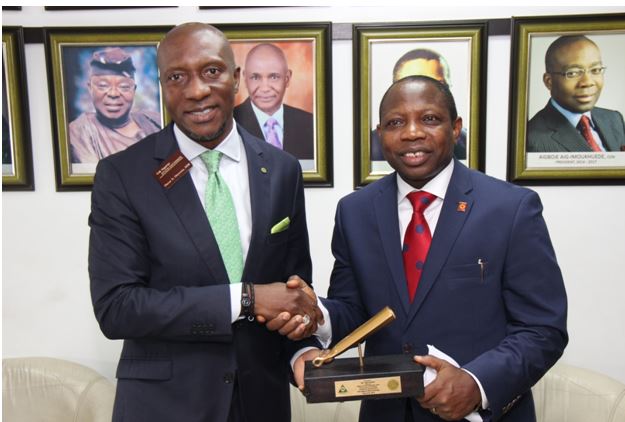
L – R shows Mr. Oscar N. Onyema, Chief Executive Officer, The Nigerian Stock Exchange (NSE) presenting a replica of closing gong to Mr. Rogers A.I. Nwoke, National President, National Association of Microfinance Bank (NAMB) during a Closing Gong Ceremony to address the grey areas or limitations that Microfinance Banks have in listing on The Nigerian Stock Exchange yesterday.

Equity Market Extends Gains to 2nd Consecutive Session… ASI up 64bps

0
nse

Yesterday’s trading session saw the domestic market extend its positive performance up 0.6% to 32,614.06 points due to gains in bellwether stocks – NIGERIAN BREWERIES (+10.0%), ZENITH (+1.8%) and GUARANTY (+0.8%).

Consequently, market capitalisation increased by N77.5bn to settle at N12.2tn while YTD gain stood at 3.8%. Activity level also strengthened as volume and value traded advanced 22.4% and 35.6% to 442.8m units and N5.6bn respectively.

The top traded stocks by volume were STERLING (105.8m units), GUARANTY (37.4m units) and UBA (33.0m units) while GUARANTY (N1.4bn), NESTLE (N1.2bn) and ZENITH (N434.0m) led the top traded by value.

Bullish Sector Performance
Performance across sectors was bullish as 4 of 5 indices under our coverage closed in the green. The Consumer Goods and Insurance indices led gainers up 1.4% and 1.2% respectively following buying interests in NIGERIAN BREWERIES (+10.0%), DANGFLOUR (+5.3%), PRESTIGE(+8.0%) and LAWUNION (+7.8%).

The Oil & Gas index and Banking indices trailed, up 1.0% and 0.8% respectively on the back of gains in MOBIL (+1.1%), ETERNA (+5.5%), ZENITH (+1.8%) and GUARANTY (+0.8%). On the flip side, sell pressures in DANGCEM (-0.1%) led to a 2bps decline in the Industrial Goods index.

Investors Sentiment Strengthens 
Investor sentiment as measured by market breadth (advance/decline ratio) strengthened to 1.6x from 1.1x recorded in the previous trading session as 26 stocks advanced against 16 decliners.

The best performing stocks were NIGERIAN BREWERIES (+10.0%), CAVERTON (+9.3%) and JAIZBANK (+8.9%) while GOLDINSURE (-9.4%), CUSTODIAN (-6.9%) and AFRIPRUD (-4.6%) led laggards. Following two consecutive sessions of positive performance, we do not rule out the possibility of profit taking in subsequent sessions.

Société Générale Bank in Partnership with Rugby Africa

0

Société Générale and Rugby Africa have agreed to join forces for the next two years to support the development of rugby in Africa, with a particular emphasis on rugby competitions for women and young athletes.
This new partnership is an additional milestone in Société Générale’s on-going commitment to supporting the development and openness of rugby in France and internationally, especially in Africa.
Rugby Africa is one of the six regional associations of World Rugby, the international body that oversees the organisation of the Rugby World Cup.
The partnership will focus specifically on:

  • World Rugby’s Get into Rugbyprogram, which aims to encourage everyone around the world to take up rugby
  • The two official competitions for women’s rugby, the Africa Women’s Sevens, and under-20s rugby with the U20 Barthès Trophy

“This partnership is the continuation of two of our long-term commitments: to rugby, of which we have been a reliable partner for over 30 years, and to Africa, with our Grow with Africa initiative, a program central to our priorities that aims to promote the sustainable development of the continent. African rugby is booming, and we intend, in association with Rugby Africa, to implement important rugby development projects as a force for social cohesion,” Caroline Guillaumin, Director of Human Resources and Communication for the Group, explained.
“This partnership uniting us with Société Générale will instill more vigour in the development of African rugby, especially with young people and women. Currently, around half a million children and teenagers are introduced to rugby every year in Africa. And the number of registered female players has more than tripled in recent years in Africa. This partnership is a decisive step forward for Rugby Africa as it brings the necessary investment to support this rapid growth. We thank Société Générale for the confidence they have placed in Rugby Africa and its federations,” commented Abdelaziz Bougja, President of Rugby Africa.
Société Générale and rugby, a commitment at the international scale.
Société Générale is a long-standing partner of rugby, a sport with which the Bank shares the common values of team spirit, commitment and respect.

The Bank supports the development of all forms of rugby, from the amateur level to the highest professional level:

  • In France: it is partner to more than 450 amateur clubs in France, the Top 14, PROD2, the French Rugby Federation (FFR) as well as the French national rugby team.

Internationally, it is a major partner and the official bank of the Rugby World Cup for the sixth time, a partner of Rugby India (Indian Rugby Federation) and title sponsor of the rugby sevens national teams in all categories (men, women and junior) since 2017, backer of the association Terres en Mêlées and  partner of the Algerian Rugby Federation.

Kaspersky Lab Reports 4% Revenue Growth to $726m in 2018

0

Kaspersky Lab continued to deliver stable growth in 2018 and increased its global unaudited IFRS revenue to a total of $726 million*, representing a 4% YOY revenue increase.

During a year of evolving market conditions and continuous geopolitical pressure, the company achieved success as a result of the trust customers and partners place in the company and its leading cyber-security solutions and services.
Among the strategic business areas that drove Kaspersky Lab’s growth in 2018 were Digital and Enterprise. The company saw an increase in digital sales (+4%**) and strong growth of 16%**in the enterprise segment, with 55%**growth in non-endpoint products and services in particular.

Overall, the company secured healthy results in these business areas by delivering some of the best products and services in the industry, as well as new solutions and technologies that prevent, detect and respond to the most sophisticated cyber threats.
Commenting on the year’s results, Eugene Kaspersky, CEO of Kaspersky Lab, said: “2018 was a crucial year for us. After all the challenges and unsubstantiated allegations we faced in 2017, we had a responsibility to show that the company and our people deserve the trust of our partners and customers, and in turn, to continue to clearly demonstrate and prove our leadership. Our continued positive financial results are proof of this, demonstrating that users prefer the best products and services on the market and support our principle of protecting against any cyber threats regardless of their origin.”
Globally, the company’s performance was driven by robust results, especially in META (+27%**), as well as in other regions, such as Russia, Central Asia and CIS***(+6%**), APAC (+6%**) and Europe (+6%**), while there was a slowdown in Latin America (-11%**) mainly caused by currency devaluation in the region.
The challenging geopolitical situation resulted in an overall slowdown in the North American market, where sales decreased by 25%**. Despite these challenges, Kaspersky Lab maintained and developed its presence in the market, with an 8% increase in new licenses sales in digital.
In 2018, Kaspersky Lab advanced the progress of its Global Transparency Initiative by undertaking a number of significant actions. Notably, the company began the relocation of its IT infrastructure to Switzerland and opened the first Transparency Center in Zurich.

Kaspersky Lab also implemented an audit by one of the Big Four professional services firms of the company’s engineering practices around the creation and distribution of threat detection rule databases.

Today’s ultra-connected global landscape requires increased transparency from organisations, and this unique initiative demonstrates Kaspersky Lab’s clear commitment to assuring the integrity and trustworthiness of its solutions in the service of the customers.

Leadway Assurance: ‘Nigerians Should Buy Term Life Assurance Policy’

0
leadway

Ms. Adetola Adegbayi, Executive Director, Leadway Assurance Company Limited has urged Nigerians to subscribe to Term Life Assurance product, saying, ‘people should form the habit of buying what they cannot save, through term assurance policy.’

Speaking at the Leadway Assurance Media Training for Insurance and Pension journalists in Lagos, Adegbayi stressed that with little premium, people can buy this unique product that has a minimum Sum Assured of N1 million, urging the middle and low income earners to see this package as an opportunity to enrich their lives.

Using Leadway Term Assurance product as an example, she said the plan is a simple but flexible life assurance product that pays out a lump sum if death occurs during the period of cover.

‘You choose the amount of that lump sum and the length of cover and your premium is calculated accordingly’, she said.

For an additional sum, she said, intending subscriber can extend cover to apply to critical illnesses or becomes permanently disabled because of an accident anywhere in the world.

“You can choose to pay your premiums in a way that suits you best: you can pay a single one-off premium, or you can pay monthly, quarterly, half-yearly or annually. The premium you pay qualify for tax relief and can therefore reduce your tax bill,” she noted.

He stated that a policyholder has the right to cancel his or her policy and receive a full refund of premiums paid if done within 30 days of receipt of the full policy documentation.

She added: “Take a little money to buy a N10million to N15 million policy. If anything should happen, your family has about N10 million to fall back to. It takes care of school fees of your children and other financial needs. May be, you can buy N10 million with N50, 000 premium for example.”

N411m Fraud: Ecobank Turns in Ex-Manager for Prosecution

0
EcoBank

A Federal High Court in Ikoyi, Lagos, has ordered the remand of Ifeanyi Chukwu Azike, a former manager of Ecobank Nigeria, over allegations of defrauding the bank’s customers to the tune of N411million.

Azike, who was handed over to the police by the investigative unit of the bank was arraigned before Justice Ayotunde Faji on Tuesday, by the Special Fraud Unit (SFU) of the Nigeria Police Force on a three-count charge bordering on obtaining money under false pretences, false representation and fraud. The defendant, however, pleaded not guilty to the charge upon his arraignment.

Following his plea of not guilty, police prosecutor, ASP Daniel Apochi urged the court to remand him in prison pending trial. Consequently, Justice Faji ordered that the defendant be remanded in prison till 8th of March, 2019 when his bail application would be heard.

In a charge marked, FHC/L/56c/2019, the police alleged that between 2016 and 2017, Azike fraudulently obtained N150 million from a customer of Ecobank Nigeria under false pretence of buying him Federal Government Treasury Bill in his bank.

Azike was also alleged to have forged the bank customer’s signature, picture and letter of Instruction which he used in opening another parallel account as Ikenna Okafor Kelvin with account number: 5333063028.

The police also alleged that the bank manager without the consent of the bank fraudulently converted the sum of N411 million belonging to the bank to his personal use.

The offences were said to be contrary to Sections 1 (1) (a), 15(1)(2) and 15(2) of the Advance Fee Fraud and Other Fraud related Offence Act No. 14 of 2006, and punishable under Section 1 (3) of the same Act.

Market Report: Local Bourse Rebounds…ASI Up 12bps

0
Nigerian stock exchange

The local bourse rebounded at the close of trade yesterday following price appreciation in UNILEVER (+6.8%), DANGCEM (+0.5%) and UBA(+1.3%).

As a result, the All Share Index (“ASI”) rose 12bps to 32,453.7 points, YTD gain improved to 3.4% and market capitalisation increased by N14.0bn to N12.1tn. On the flip side, activity level weakened as volume and value traded declined 10.1% and 12.1% to 422.7m units and N3.7bn respectively.

The most active stocks by volume were DIAMOND (97.6m units), TRANSCORP (41.1m units) and ZENITH (40.3m units) while by value, ZENITH (N997.1m), GUARANTY (N992.6m) and ACCESS (N263.7m) led.

Mixed Sector Performance
Across sectors, performance was mixed, albeit with a bullish bias as 3 of 5 indices under our coverage advanced.

The Insurance index rose 1.2% as NEM (+5.0%) and CUSTODIAN (+1.7%) recorded gains. Also, the Industrial and Consumer Goods indices inched 0.7% and 0.3% respectively, due to buying interest in DANGCEM (+0.5%), WAPCO (+3.1%), UNILEVER (+6.8%) and PZ (+5.2%).

On the other hand, the Oil & Gas and Banking indices declined, down 0.8% and 0.5% respectively on the back of profit taking in OANDO (-5.2%), ETERNA (-3.1%).ZENITH (-0.6%),and ACCESS (-0.8%).

Investors Sentiment Strengthens 
Investors sentiment as measured by market breadth (advance/decline ratio) strengthened to 1.7x, an improvement from the 0.7x recorded yesterday as 22 stocks advanced against the 13 stocks that declined. The best performers were LIVESTOCK (+10.0%), ABCTRANS (+10.0%) and UNITY (+9.6%) while UBN (-8.0%), OANDO (-5.2%) and DANGFLOUR (-4.6%) were the worst performing stocks.

Despite yesterday’s positive performance, we maintain a conservative outlook for tomorrow’s trading session. We expect profit taking activities in fundamentally good stocks as the market closes for the week.


Facebook: ‘We Are Preparing for Nigerian Elections’

0
facebook

By Akua Gyekye
Public Policy Manager, Africa Elections
Facebook

With a number of upcoming elections across Africa, we want to share an update on our work to reduce the spread of misinformation, protect election integrity and support civic engagement across the continent. We’ve dedicated unprecedented resources to these efforts globally — and our work across Africa is focused in eight key areas.

Fighting False News
We want to stop the spread of false news on our platforms. That’s why we’ve teamed up with local third-party fact-checkers across South Africa, Nigeria, Kenya, Cameroon and Senegal — including Africa Check (Africa’s first independent fact-checking organisation), AFP (Agence France-Presse – an international news agency), Pesa Check (a local Kenyan fact-checking organization) and Dubawa (a local Nigerian fact-checking organization). These independent groups help us assess the accuracy of news shared on Facebook, and when they determine content is false, we reduce its distribution in News Feed so fewer people see it. We also show related articles from fact-checkers for more context and notify users if a story they have shared is rated as false. Additionally, in Nigeria, WhatsApp has worked with Africa Check and CrossCheck Nigeria to let users send questions about potential rumors they have received through the platform. These fact-checking expansions are part of a broader strategy to fight fake news that includes extensive work to remove fake accounts; cut off incentives to the financially-motivated actors that spread misinformation; promote news literacy; and give more context so people can decide for themselves what to read, trust, and share.

Boosting Digital Literacy and Helping People Spot False News
We want to make sure people can spot false news and know how to flag it. That’s why we’ve rolled out educational tips on national and regional radio and in print media across Nigeria, South Africa, Zambia, Kenya and Zimbabwe. In Nigeria, WhatsApp has launched its “Share Facts, Not Rumours” campaign to help increase awareness about hoaxes. Additionally, at the end of last year Facebook began a new Online Safety Programme for students in Nigerian secondary schools. The 12-week workshop is designed to help teenagers understand the fundamentals of online safety and digital literacy, covering topics such as managing an online presence; social media and sharing; public Wi-Fi safety; building healthy relationships online; understanding password security and privacy settings; and identifying misinformation online.

Promoting Civic Engagement
Helping to build informed and civically engaged communities is central to our work around elections. In Nigeria, we’ve rolled out new options in English & Hausa so people can report posts that contain incorrect election information, encourage violence or otherwise violate our Community Standards. On Election Day, we’ll show a voting day reminder in English and Hausa at the top of Facebook’s News Feed.

Making Political Ads More Transparent
Earlier this month we began temporarily expanding enforcement and not accepting foreign election ads on Facebook in Nigeria to help prevent foreign interference. Already today you can see any ad that a Page is running on Facebook regardless if it’s shown to you.

Journalist Trainings
We continue to educate media groups and journalists across the country on best practices for sharing content on our platforms and online safety. We also provide trainings on our Community Standards  which govern what is and is not allowed on our platform.

Proactive Removal of Impersonation Accounts
We’ve always had policies against impersonation. Thanks to recent advancements in our detection technology, we’ve become much more effective at identifying these accounts.

Partnerships with NGOs and Civil Society
In order to better understand local issues and how we can tackle them more effectively, we work with a number of NGO and civil society partners across many African countries. These local partners have been instrumental in giving us feedback that we’ve incorporated into our policies and programs, including the aforementioned trainings with teens and journalists.

Connecting with Political Parties About Security
We’ve trained parties, campaigns and candidates on security best practices, including how to turn on two-factor authentication and how to avoid common threats online. For the Nigerian elections, we’ve trained vice presidential candidates, senatorial candidates and top advisors from over 35 major political parties — and the information included in these trainings is all available for anyone to access at politics.FB.com.
We want Facebook and WhatsApp to be places where people feel safe, can access accurate information and make their voices heard. We are making significant investments, both in products and in people, and continue to improve in each of these areas.

Soft Recovery in Non-Oil Sector Lifts Economic Growth to 1.9% in 2018 By Afrinvest Research

0

The GDP report which shows Nigeria’s economic performance in 2018 was published on Tuesday by the National Bureau of Statistics and the results were firmly in line with our expectations. Real GDP expanded by an improved 2.4% Y-o-Y in Q4:2018 (Q3:2018 – 1.8%), the strongest quarterly growth since Q3:2015.

This performance was mainly driven by an improvement in non-oil sector growth to 2.7% Y-o-Y, the highest since Q4:2015. Meanwhile, growth was weighed down by the oil sector which contracted 1.6% Y-o-Y in Q4:2018 as oil production reduced to 1.91mb/d in Q4:2018 from 1.95mb/d in the corresponding period of 2017.
In full year terms, economic growth reached the fastest in 3 years at 1.9% in FY:2018, compared with 0.8% in the preceding year. The performance was also more broad-based as the non-oil sector grew by 2.0% in FY:2018 compared with 0.5% in the previous year.

This is in sharp contrast to the previous year when growth was almost entirely oil driven. In the oil sector, growth decelerated to 1.1% from 4.7% in FY: 2017 as average oil production increased only marginally by 20,000 bpd to 1.92mb/d.

Agriculture Growth Slows to Weakest in 25 years
We saw a soft recovery in growth in the agriculture sector which expanded by 2.5% Y-o-Y in Q4:2018, above an average growth rate of 1.5% in the previous two quarters. This was mainly supported by crop production (90.0% of Agriculture GDP) which grew at 2.5% Y-o-Y due to better harvests in the latter part of the year.

However, this does not suggest that the conflicts that affected output in the middle-belt and some parts of Northern-Nigeria have been resolved. We believe security issues will limit current growth prospects below historical quarterly growth rate of 3.8%.
In full year terms, the agriculture sector slowed considerably as the growth of 2.0% in FY:2018 was the weakest in 25 years, compared with historical average growth of 7.6% between 1998 and 2017.

Across the two sub-sectors accounting for a share of 95% of total agriculture GDP – crop production and livestock – the slowdown was broad-based. Growth in crop production decelerated to 2.3% (2017: 3.6%) while livestock output growth was lower at 0.3% (2017: 1.6%).

Manufacturing Growth Reaches Positive Territory in FY: 2018
The manufacturing sector advanced by a stronger 2.4% Y-o-Y in Q4:2018, a modest improvement over 1.9% and 0.7% in Q3 and Q2:2018 respectively. This was partly driven by other manufacturing sub-sectors with a share of 23.3% of total manufacturing GDP which grew by 4.2% Y-o-Y.

Elsewhere, growth was positive but slightly weaker in major sub-sectors such as Cement (+1.0% Y-o-Y), Textile, Apparel & Footwear (+1.2%) and Food, Beverage and Tobacco (+2.2%).
In FY:2018, manufacturing sector growth which had persisted in the negative growth since 2015 turned positive at 2.1% (2017: -0.2%). We attribute this positive performance to exchange rate stability which ensured access to imported inputs as well as recovering consumer spending.

ICT Growth Drives Strong Rebound in Services
The services sector (52.6% of GDP) sustained a robust performance in Q4:2018, with growth advancing to 2.9% Y-o-Y from 2.6% in the previous quarter.  This was helped by an impressive outing yet again in the information and communication sub-sector which grew by 13.8% Y-o-Y, slightly better than 12.1% in the previous quarter. In other large sub-segments, the performance was mixed.

While insurance and trade recorded negative growth of -1.8% and -3.8% Y-o-Y respectively, growth in construction and trade sub-sectors was relatively better at 2.0% and 1.0% Y-o-Y in Q4:2018.
On an annual basis, services growth recovered to 1.8% in FY:2018 (FY:2017 – 0.9%), the highest since 2015. Among the large sub-sectors, construction and finance & insurance were the star performers as they grew faster at 2.3% and 2.0% respectively, from 1.0% and 1.3% in FY:2017.

In Trade, growth remained negative, although it improved at -0.6% (2017: -1.1%). Meanwhile, in the real estate sub-sector, growth slid deeper into the negative territory at -4.8% (2017: -4.3%).
Overall, we believe a slight improvement in consumer spending lifted services growth. However, sub-sectors such as real estate continue to be held back by structural issues such as high cost of credit for mortgage, FG’s failure to incentivise wide-scale housing supply by the private sector and overdue reforms pertaining to land administration.

Real GDP Growth Expected at 2.5% in 2019
In line with our 2019 economic and financial markets outlook titled “On the Precipice!”, we note that our growth expectation is unchanged at 2.5% for the base case. This will be supported by a continuous but slow recovery in agriculture and stronger performance in manufacturing and services.

In the oil sector, while production in the 200,000 bpd Egina field should lead to a faster expansion, we expect moderate growth due to OPEC output cap.

The risks to our GDP growth forecast in the base case are sub US$60.0/b oil prices, production disruptions that reduce output below 2.0mb/d in the Niger Delta, and a deterioration of security conditions in the country.

Dangote, Imouhkuede Launch Africa Business Coalition for Health

0

An ambitious platform designed to bring together business leaders in Africa to collaborate with heads of government and other stakeholders to tackle basic health challenges in Africa has been launched in Addis Ababa, Ethiopia with assurances from government to collaborate for a healthier Africans.
The platform, African Business Coalition for Health (ABC Health) was launched with commitments by all partners and stakeholders to put efforts together to improve basic health care services in the continent during the inaugural Africa Business: Health Forum 2019, which witnessed the launch of the official logo of the ABC Health.
The ABC Health is a joint initiative of Aliko Dangote Foundation; GBCHealth, and United Nations Economic Commission for Africa (UNECA), with the objective of driving business leadership, strengthening partnerships, and facilitating investments to change the face of healthcare in Africa.
Taking place on the margins of the 32nd African Union Summit Heads of Governments and Business Community leaders across Africa, the forum  examined opportunities to accelerate economic development and growth of the continent through a healthcare reform agenda that focuses on the wellbeing of employees for a more active and productive workforce.
The forum is expected to unify Africa’s key decision makers in exploring opportunities for catalysing growth in the continent’s economy, through business partnerships to invest in the health sector.
In his opening remarks, the Chairman of Aliko Dangote Foundation, Alhaji Aliko Dangote, who was represented by the Foundation’s Executive Director, Halima Aliko-Dangote said Africa Business Health Forum would identify issues and solutions to Africa’s health challenges with a view to mobilizing the will to confront it headlong.
He said it is a well-known fact that there is a vital relationship between health and economic growth and development in Africa as healthy populations live longer, are more productive, and save more. Access to essential health services is an important aspect of development.
Dangote stated that “Governments from both developed and developing countries are increasingly looking at public-private partnerships (PPPs) as a way to expand access to higher-quality health services by leveraging capital, managerial capacity, and know-how from the private sector.”
According to him, “Africa’s healthcare systems demand significant investments to meet the needs of their growing populations, changing patterns of diseases and the internationally-agreed development goals.
He said as a businessman, and through Aliko Dangote foundation, he is committed to working with governments and key stakeholders for the development of impactful health initiatives in Africa in the belief that private sector leaders have a strong role to play.
Back in his home country, Dangote informed his audience that in keeping with his passion to see a healthier African people and better continent he has proposed and charged business leaders to commit at least one percent of their profit after tax to support the health sector.
In his own remark, the Co-Chair of the GBCHealth, Aigboje Aig-Imoukhuede, said while Africa has made significant progress in the funding of healthcare, “we are still very far from where we need to be to achieve SDG Goal 3,”
He lamented that the healthcare in Africa is constrained by scarce public funding and limited donor support, and that the out of pocket expenditure accounts for 36% of Africa’s total healthcare spend pointing out that given the income levels in Africa, it is no surprise that healthcare spend in Africa is grossly inadequate to meet Africa’s needs leading to a financing gap of N66bn per annum.
Imhokuede said it was clear that African government alone cannot solve this challenge, which is further exacerbated by our growing population and Africa’s changing disease portfolio. Therefore there is no alternative but to turn to the private sector to complement government funding.
Said he “Our continent accounts for less than 2% of global health even though our very fertile people account for 16% of global population and carry 26% of the global disease burden. By 2050 Africans will account for more than 50% of global population growth much of that coming from my country Nigeria, a great opportunity and at the same time a ticking time bomb should we fail our health systems quickly.
“That is why we have gathered here in Addis Ababa today to see how together we can fix health in Africa. The private sector and the public sector working together as partners have the potential to change Africa’s healthcare from doom and gloom to progress and results. Africa’s private sector has great capacity to be relevant partners.
“The private sector must be encouraged to optimize and step up its involvement and contribution to health funding in Africa. We have seen what global private sector players accomplished in the fight against the AIDS epidemic through powerful coalitions such as GBCHealth. This is an indication of the power of consolidated effort which Africa’s growing private sector can bring to solving our health challenges.”
“African leaders now have a stronger sense of urgency to combat the lack of quality health care that Africans endure. The inequality of healthcare available to Africans compared to people in other parts of the globe is vast and unacceptably pervasive. With the cooperation of both the public and private sectors, there is a huge potential to boost health outcomes with significant financial gains,” said Aigboje Aig-Imoukhuede, Co-Chair GBCHealth.

Profit Taking in Bellwethers Drag Benchmark Index… ASI down 15bps

0
nse

In yesterday’s trading session, profit taking in bellwethers – GUARANTY (-2.6%), ACCESS (-6.3%) and SEPLAT (-3.3%) – dragged the benchmark index 15bps lower to 32,413.9 points. As a result, YTD performance fell to 3.1% while market capitalisation declined by N18.0bn to N12.1tn.

Similarly, activity level declined as volume and value traded fell 19.0% and 47.2% to N4.2bn and N470.3m respectively.

The top traded stocks by volume were DIAMOND (131.0m units), ZENITH (44.1m units) and UBA (40.6m units) while ZENITH (N1.1bn), DANGCEM (N0.6bn),GUARANTY (N0.5bn) led by value.

Mixed Sector Performance
Sector performance was mixed today with a bearish bias as only 2 out of 5 indices under our coverage advanced. The Industrial and Consumer Goods indices were the day’s gainers, up 1.6% and 0.9% respectively due to buy interest in DANGCEM (+0.4%), CCNN (+4.5%), NIGERIAN BREWERIES (+1.2%), OKOMUOIL (+3.4%) and DANGFLOUR (+6.1%).

On the flip side, the Oil & Gas index bucked gains recorded in previous trading sessions, declining by 2.2% as investors took profit in SEPLAT (-3.3%) and OANDO (-1.7%).

Also, the Banking and Insurance indices trailed, down 1.8% and 0.7%, dragged by losses in GUARANTY (-2.6%), ACCESS (-6.3%) CUSTODIAN (-3.2%) and NEM (-4.4%).

Investor Sentiment Softens
Investors sentiment as measured by market breadth (advance/decline ratio) softened to 0.9x from 2.7x recorded in yesterday’s trading session as 19 stocks advanced relative to 22 that declined.

The top performing stocks for the day were BERGER (+10.0%), UNILEVER (+10.0%) and UNITY (+9.5%) while CILEASING (-10.0%), CHAMPION (-9.6%), PZ (-9.4%) were the least performing stocks. We expect to see sustained profit taking in previous advancers in the last two sessions before the elections.

Employers Leverage New Technology in Hiring Process

0

In the next three years, top HR executives and employers have asserted that the biggest impact on recruitment will be Technology Augmenting the Hiring Process. In other words, how technology will make the hiring process more effective through easier filtering and more accurate matching.
This discovery, along with other invaluable insights into the evolution of the job market has been pioneered through in-depth research conducted by ROAM (Ringier One Africa Media).

ROAM encompasses the market-leading job portals in West Africa (Jobberman) and East Africa (BrighterMonday), as well as Executive recruitment and HR solutions firm, The African Talent Company. The company periodically surveys over 50,000 employers who use their services, to understand how employers see the hiring space and how ROAM’s brands can support the changes.
Matthew Page, ROAM’s Head of Jobs, credits a strong shift in the behavioral patterns amongst Millennial job-seekers as the main driver behind piloting research to better understand the trends.

He says: “As advocates for the use and power of technology in the hiring space, we are pleased to see technology is on top of the HR agenda. It aligns with our vision to transform productivity on the African continent. We’re seeing some pretty incredible trends coming out of our millennial users. Firstly, the growth in job activity is massive over the last 3 years. It differs by market but some countries are seeing as much as 50% of the workforce being made up of millennials – these users are actively searching and enquiring about opportunities. More than any other demographic we have seen before.”
The company’s research further brought to light that increasingly Millennials are moving away from having physical CVs, and instead, are opting to store their data in a digital profile via the Jobberman web portal in West Africa and the BrighterMonday portal in East Africa respectively.

“This is convenient”, says Page. “Job Seekers – and especially millennials – are mobile-centric. They are hungry for the right job and they are looking for an easier to use, digital application processes. Sending a CV over email or via post is slow, arduous and inefficient.”
This aligns with the trends ROAM has uncovered on employer beliefs for augmentative hiring processes. Page goes on to say: “Having structured data in a digital profile is good for the employer and the seeker. The data is in the cloud, is easily edited and allows for a seamless desktop to mobile experience.

For employers, filtering through 100 CVs in hardcopy is a nightmare task. Being able to match profiles to role requirements with technology takes out the manual element and allows for focus on what really matters – the top matching candidates.”
Clemens Weitz, CEO of ROAM, doubles down on the potential for growth in African productivity: “In the future, hiring decisions will be vastly improved through technology. The hard copy CV as the main instrument for candidate selection is a 20th-century practice that our generation will be the last to see. For both candidates and hiring managers, there are tremendous positives ahead. As more candidates embrace digital profiles, it is imperative employers leverage the sourcing technology available or risk missing out on ideal applicants.”

AfDB, AU Partner on African Economic Transformation

0

The Chairperson of the African Union Commission (AUC), Moussa Faki Mahamat and the President of the African Development Bank Akinwumi Adesina, met yesterday in Addis Ababa, Ethiopia to reaffirm their commitment to accelerate Africa’s economic transformation.

Mahamat and Adesina co-chaired a high-level consultative meeting attended by senior management of both institutions to take stock of the ongoing collaboration between the two institutions. Discussions focused on ways to strengthen partnership in delivering Agenda 2063 and other global frameworks for development.

AUC Chairperson Mahamat noted the strong alignment of the African Development Bank’s High 5 strategic priorities with the African Union’s Agenda 2063 and the United Nations Sustainable Development Goals (SDGs).

“The African Development Bank is the financial muscle of the African Union as far as Agenda 2063 is concerned, and we need to further institutionalize this partnership to make it more effective,” Mahamat said.

Addressing the audience, Adesina recalled that it was at the first meeting of the AUC, then known as the Organisation of African Unity (OAU) in 1963, that heads of state endorsed the establishment of the African Development Bank. Since then, there has been a long history of cooperation between the two institutions.

“We must, therefore, build on the long-standing relations between our two institutions and pool our collective expertise and resources in pursuit of the economic development and social transformation of our dear continent,” he said.

Adesina underscored the strategic importance of the Joint Secretariat Support Office (JSSO) for the African Union Commission, UNECA and the African Development Bank. He also reaffirmed the Bank’s need to position JSSO as a platform to foster effective coordination and collaboration, while leveraging the comparative advantages of the three pan-African institutions.

The Meeting welcomed the appointment of Lamin Barrow as the new Director for the JSSO and the Bank’s Permanent Representative to the African Union.

In a declaration issued at the end of the meeting, both leaders pledged to support the speedy implementation of various continental initiatives, Agenda 2063 and its 12 Flagship Programmes. These include the implementation of the Grand Inga Dam Port; the African Passport and Free Movement of People; the establishment of a Single African Air Transport Market; an African Virtual University; the Integrated High Speed Train Network and the establishment of a Continental Free Trade Area.

The institutions further recognized the need to continue to explore opportunities to accelerate the implementation of programmes with Regional Economic Communities and partners.

The communique resolved to prepare an action plan for the implementation of the resource mobilization strategy set in place to advance the continent’s development agenda.

The institutions also committed to work together for the successful replenishment of the African Development Fund and the Bank Group’s General Capital Increase.

Equities Market Sustain Bullish Performance… ASI up 2.1%

0
Nigerian stock exchange

In yesterday’s trading session, the domestic equities market maintained its bullish performance on the back of sustained buying interest in DANGCEM (+2.3%), NESTLE (+6.0%) and SEPLAT (+6.1%).

Consequently, the All Share Index (“ASI”) rose 2.1% to 32,462.3 points while YTD gain improved to 3.2% as market capitalisation increased by N253.7bn to N12.1tn. Activity level also improved as volume and value traded for the day increased by 5.5% and 42.2% to 580.4m units and N8.0bn respectively.

The most traded stocks by volume were DIAMOND(125.8m units), ZENITH (63.2m units) and GUARANTY (57.1m units) while for the most traded stocks by value, GUARANTY (N2.2bn),ZENITH (N1.6bn) and DANGCEM (N1.5bn) were the top stocks.

Positive Sector Performance
Across sectors, performance remained bullish with 4 of 5 indices under our coverage advanced. The Oil and Gas index gained the most, up 4.1% following price appreciation in SEPLAT (+6.2%) and OANDO (+7.1%).

The Consumer Goods and Banking indices trailed, up 4.0% and 1.3% respectively as investors rallied in NESTLE (+6.0%), NIGERIAN BREWERIES (+2.3%), UBN (+9.6%), and ETI (+3.2%). Similarly, the Industrial Goods index advanced, albeit flattish, up 3bps due to gains in DANGCEM (+2.3%) and WAPCO (+4.2%).

On the flip side, the Insurance index pared gains, down 0.2% due to profit taking in AIICO (-5.2%) and PRESTIGE (-3.9%).

Investor Sentiment Strengthens 
Investor sentiment as measured by market breadth (advance/decline ratio) strengthened to 2.7x from 1.3x recorded the previous session consequent on 38 stocks advancing against 14 that declined.

The top gainers for the day were JAIZ (+10.0%), LIVESTOCK (+10.0%) and DANGFLOUR (+10.0%) while REGALINS (-8.0%), UACPROP (-7.9%) and LASACO (-6.1%) led laggards.

In recent weeks, we have observed increased inflow into the domestic market despite the political risk. We believe concerns for post-election stability are beginning to moderate thus the increased appetite for cheap assets. Hence we expect the market to record gains in the near-term.