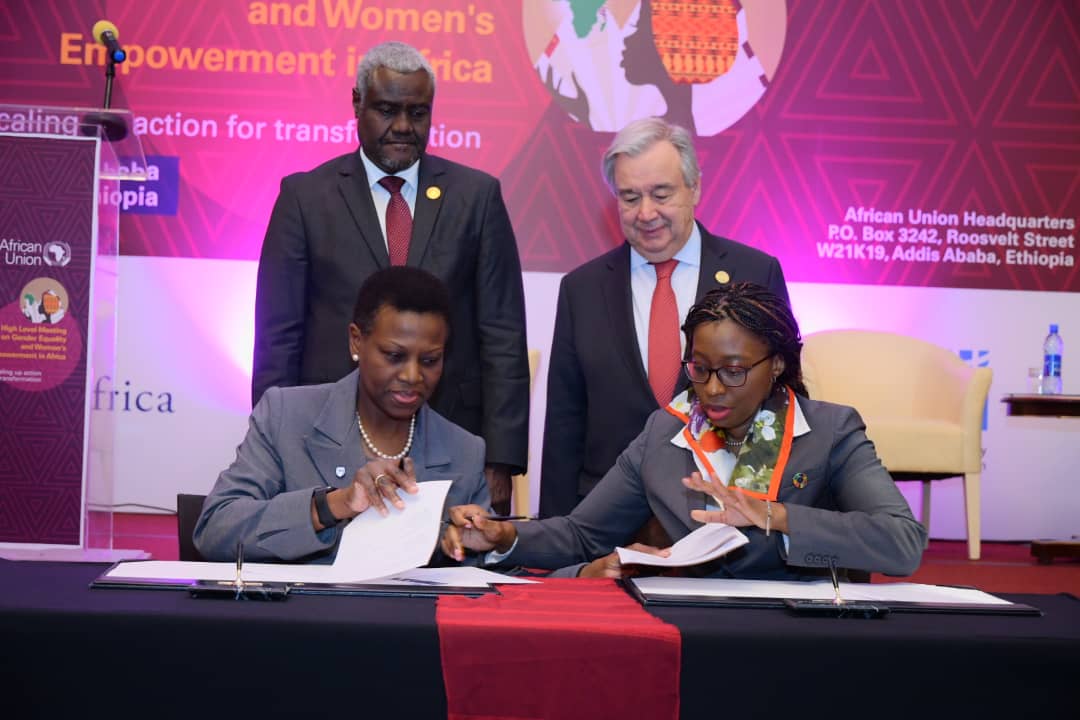

UN Secretary-General, Antonio Guterres, and African Union Commission Chairperson, Moussa Faki Mahamat, witness the signing of a partnership agreement between UNECA and Standard Bank Group represented by UNECA Executive Secretary, Dr. Vera Songwe (right) and Sola David-Borha, the bank’s Chief Executive for African Regions.
African leaders are putting women front and center of efforts to drive the continent’s economic growth through a game-changing fund that invests in women fund managers and also provides technical assistance.
The launch of the African Women Leadership Fund (AWLF) will provide capital to both first time and experienced fund managers in support of UN Sustainable Development Goals 5 (Gender Equality) and 8 (Decent Work and Economic Growth), and African Union Agenda 2063.
The ground-breaking partnership, formally signed at the weekend in Addis Abababetween the United Nations Economic Commission of Africa (ECA) and Standard Bank Group, will be transformational in breaking down structural barriers to inclusive investing in Africa.
Over $20 million was raised for the fund that has a current goal of $100 million. President Paul Kagame of Rwanda was instrumental in leading the way, pledging $500,000. Senegal’s President Macky Sall committed $500,000. South African President Cyril Ramaphosa also pledged to contribute to the fund.The private sector participants pledged the rest.
Prime Minister Justin Trudeau of Canada pledged $10 million to the African Union to boost gender parity. Norway Prime Minister Erna Solberg pledged $8 million to AU initiatives. A portion of these resources will be earmarkedfor the women’s initiative.
Among the world leaders who witnessed the official launch of this innovative impact investment fundwere UN Secretary-General, Antonio Gutteres, African Union Commission Chairperson, Moussa FakiMahamat, Ethiopian President Sahle-Work Zewde. Former Liberian President, Ellen Johnson Sirleaf was also in attendance, as were a number of former African heads of state.
“We are turning the tables and making women the decision-makers of investable money in Africa. We want women to be on the supply side of money, not only on the demand side,” said Dr. Vera Songwe, UN Under-Secretary General and Executive Secretary of ECA. A key goal of the fund is to empower women financial leaders who will drive economic growth, job creation, and create prosperity.
In Africa, women-owned funds and businesses struggle due largely to lack of successful fundraising, insufficient exposure to systems and procedures, and lack of track records, among others. They also contend with gender-based social expectation, resistance to women in leadership roles and lack of a support network. The fund will empower Africa’s women by giving them access to financial resources and investment management expertise.
Sola David-Borha, Chief Executive of Africa Regions at Standard Bank Group, says the fund aligns with the Bank’s purpose to drive Africa’s growth and “presents an opportunity for Standard Bank to leverage our footprint and expertise on the continent, and the relevant experience of our asset management arms, Melville Douglas and STANLIB Multi-Managers, to build Africa’s economies. Africa is our home, we drive her growth”.
Women fund managers will receive a deployment of capital, and subsequently invest in majority female-owned businesses. Even though the fund is sector agnostic, priority sectors will be education, manufacturing, healthcare, clean energy and agriculture. Additionally, technical assistance for fund managers and entrepreneurs will be offered through the initiative. This ranges from building capacity, direct mentoring to leveraging technology in health and education.
Songwe emphasised “The goal here is to give women-led financial investment activities a huge injection of jet fuelto bear out the proven positive correlation between gender balance, higher financial returns and developmental impact.”
In his remarks, Secretary-General Gutteres said, “power is not usually given, it must be taken.”