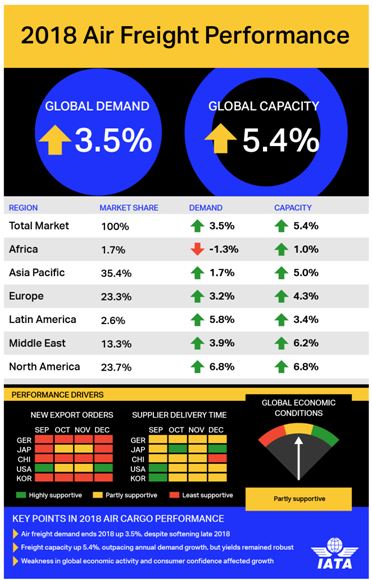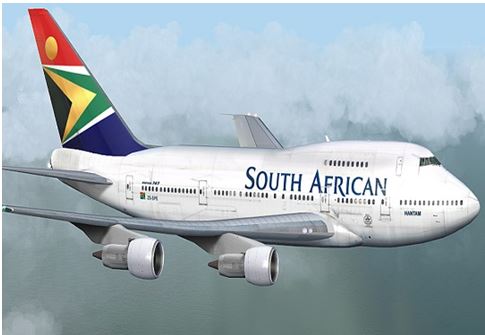

African carriers saw freight demand decrease by 2.2%, in December 2018, compared to the same month in 2017. This was significantly less than the 9.4% decrease the previous month. Capacity increased by 4.9% year-on-year.
It’s worth noting that seasonally-adjusted international freight volumes, despite being 7.7% lower than their peak in mid-2017, are still 50% higher than their most recent trough in late-2015. Annual growth in freight demand among Africa carriers in 2018 decreased by 1.3% and capacity grew by 1%.
The International Air Transport Association (IATA) released full-year 2018 data for global air freight markets showing that demand, measured in freight tonne kilometers (FTKs) grew by 3.5% compared to 2017. This was significantly lower than the extraordinary 9.7% growth recorded in 2017.
Freight capacity, measured in available freight tonne kilometers (AFTKs), rose by 5.4% in 2018, outpacing annual growth in demand. This exerted downward pressure on the load factor but yields proved resilient.
Air cargo’s performance in 2018 was sealed by a softening in demand in December. Year-on-year, December demand decreased by 0.5%. This was the worst performance since March 2016. Freight capacity, however, grew by 3.8%. This was the tenth month in a row that year-on-year capacity growth outstripped demand growth.
International e-commerce grew in 2018 which was a positive factor for the year. Yet, there was a softening of several key demand drivers:
· The restocking cycle, during which businesses rapidly built up inventories to meet demand, ended in early 2018;
· Global economic activity weakened;
· The export order books of all major exporting nations, with the exception of the US, contracted in the second half of 2018;
· Consumer confidence weakened compared to very high levels at the beginning of 2018.
“Air cargo demand lost momentum towards the end of 2018 in the face of weakening global trade, sagging consumer confidence and geopolitical headwinds. Still, demand grew by 3.5% compared to 2017. We are cautiously optimistic that demand will grow in the region of 3.7% in 2019. But with the persistence of trade tensions and protectionist actions by some governments there is significant downside risk. Keeping borders open to people and to trade is critical,” said Alexandre de Juniac, IATA’s Director General and CEO.
“To attract demand in new market segments, the air cargo industry must improve its value proposition. Enabling modern processes with digitalization will help build a stronger foothold in e-commerce and the transport of time- and temperature-sensitive goods such as pharmaceuticals and perishables,” said de Juniac.