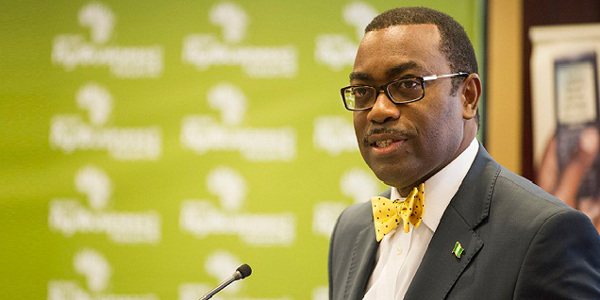

The African Development Bank (AfDB) and the African Securities Exchanges Association (ASEA) signed a 5-year Memorandum of Understanding (MoU) to amplify the impact of their strategically aligned joint efforts to promote resources mobilisation to fund Africa’s economic growth.
This MoU will provide a collaborative framework for harmonizing and co-ordinating the efforts of AfDB, the premier international development financial institution for Africa, and ASEA, the premier body of African stock exchanges, towards deepening and connecting African financial markets.
The partnership will facilitate various projects of mutual interest to both the Association and the Bank targeting areas such as financial markets infrastructure development, introduction of new products in the market, improving market liquidity and market participation, information sharing and capacity building amongst other programs.
The President of AfDB, Dr. Akinwumi A. Adesina thinks that the strengthening and deepening of Africa’s financial markets, as a powerful tool to mobilise domestic and international savings at an efficient cost, and channel them towards funding Africa’s private sector, is critical to accelerate the pace to achieve the Bank’s Ten Year Strategy 2013-2022 for green and inclusive growth in Africa.
It is therefore integral to the Bank’s High 5s Priority Agenda to “Light up and Power Africa”, to “Feed Africa”, to “Integrate Africa”, to “Industrialise Africa” and to “Improve the Quality of Life of Africans”, all of which embody core elements of the 2030 Agenda for Sustainable Development Goals (SDGs).
The maiden project to be undertaken under this cooperation initiative will be the African Exchanges Linkage Project (AELP). Collaboration will extend to other joint projects or programs over time.
Co-initiated by ASEA and the Bank, the AELP is aimed at addressing the lack of liquidity in African capital markets by creating linkages across markets.
It is envisaged that the linkage would allow cross border visibility and open-up markets for investors to trade in any of the linked markets.
The African Exchanges Linkage Project (AELP) will primarily commence with the four (4) pilot Exchanges selected by ASEA as regional hubs during the incubation phase of the project, namely the Casablanca Stock Exchange (CSE), the Johannesburg Stock Exchange (JSE), the Nairobi Securities Exchange (NbSE) and the Nigerian Stock Exchange (NiSE), and will eventually be rolled out to include the other ASEA Member Exchanges.
With regards to the AELP, according to the ASEA President Oscar N. Onyema, these linkages will support innovation, stimulating the creation of suitable products in relations to 2 instruments listed on the various linked markets creating more investment opportunities for the investor community.
The linkages will afford issuers access to deeper pools of capital and a wider community of investors and analysts. The AfDB and ASEA are devoted to see the continent achieve its full economic potential through the AELP and a continuous robust relationship.