Tuesday, February 10, 2026
26.2 C
Lagos

ADB Plans $10bn Investment in Nigeria by 2019

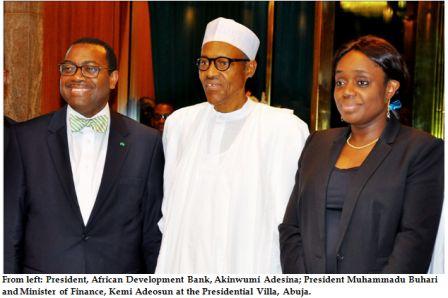
Dr. Akinwumi Adesina, President, African Development Bank (AfDB) has promised strategic investment of $4.1 billion in 2016 and 2017 and up to $10 billion in Nigeria by 2019.

Adesina said in Abuja after meeting Vice President Yemi Osinbajo and the Economic Management Team that ADB will fully support the efforts of the Federal Government to address the current economic challenges in the country.

“We will support Nigerian government with the budget support to be able to deal with some of the domestic fiscal imbalance that they have. We are looking to consider for the Board $1 billion to help them to deal with that particular deficit that is there. In addition to that, there are other challenges that the economy has which is in terms diversifying and deepening the level of diversification in critical sectors. So agriculture, solid minerals very important; manufacturing as well as industrial sector is very important.

So the bank will provide in total between 2016 and 2017 a total of $4.1 billion to Nigeria in various areas of power, infrastructure to agriculture and the private sector for SME financing and lending. I expect that our portfolio in Nigeria will not decrease; it will actually grow. We expect to invest in Nigeria by 2019 a total of $10 billion in terms of our portfolio.’’

In terms of power, Adesina said: “We also recognize that power is perhaps the most important challenge that is driving inflation in the country. We expect from our portfolio this year to invest in over 1,400 megawatts of projects that are going to be focused on the energy sector. By 2017, we plan to invest in about 1,387 megawatts of generation projects for the sector.’’

Mrs. Kemi Adeosun, the Minister of Finance said the government went to ADB and the World Bank Group for loans because of the cheap conditions attached.

“We have stuck to that strategy and we have very conservative debt profile. That is a great flexibility on the comfort of the country and we have not over-borrowed. What we have to do and what we are doing is to make sure that this money we borrowed is used on key infrastructure that will drive the economy.”


spot_img
spot_img
spot_img

Hot this week

Stanbic IBTC Insurance Triumphs at 2025 Risk Analyst Awards, Showcase Institutional Excellence

Stanbic IBTC Insurance, a subsidiary of Stanbic IBTC Holdings,...

NCDMB Webinar Unlocks AfCFTA Market Access for Energy Sector

The Nigerian Content Development and Monitoring Board has outlined...

Moniepoint Targets Downstream Sector with Innovative Financial Solutions

In a move to strengthen Nigeria's downstream oil and...

Reputation Economy: How Nigerian Brands Won, Lost Public Trust in 2025

P + Measurement Services, Nigeria’s leading independent media intelligence...

Topics

NCC Mandates Service Providers to Inform Consumers about Major Outages on Networks

The Nigerian Communications Commission (NCC) has mandated telecom licensees...

Equities Market Extends Bearish Performance… NSE ASI down 12bps

Equities Market Extends Bearish Performance… NSE ASI down 12bps The...

Jonathan, Attah, Others Win Champions of Nigerian Content Awards 

Champions of Nigerian Content Awards:  Former President, Federal Republic...

Stock Market Statistics: Tuesday, 17th January, 2017

Market Cap (N'bn)              ...

Union Bank, PAPSS Simplify Cross-Border Transactions

To deliver simpler, smarter banking solutions, Union Bank of...

Stanbic IBTC: 2022 Economic Outlook Webinar Targets Planning, Investment

Stanbic IBTC Holdings Plc, a member of Standard Bank...

Non-payment of Salaries: Matters Arising

At first, it was a rumour. Then, the rumor became stronger. And then, the rumour became political allegation that the federal and state governments could no longer pay salaries because public funds were deployed by the two major political parties to prosecute the 2015 general elections. Today, the situation has become a national embarrassment that Nigeria cannot pay its civil servants-from federal government to state governments. While actual figures of the total indebtedness at the federal and state levels is difficult to ascertain, various media reports quoted N110 billion as the total sum due to the unfortunate government employees.

Emirates Clinches 3 Gongs at World Travel Awards

Emirates has been named as the World’s Leading Airline...
spot_img

Related Articles

Popular Categories

spot_imgspot_img