
Three women each with a large basket full of fresh fruits, sat under the shade of a wide signpost just outside the main gate of Mulungushi International Conference Centre where the 51st Annual Meetings of the African Development Bank held.
Apart from being aware of the presence of an unusually large number of foreign guests in their city, it’s unlikely that the three women outside the Mulungushi gate knew what business the delegates are discussing in the meetings.
It is a few minutes past noon on Wednesday, May 25, Day 3 of the Annual Meetings and a particularly interesting session has just ended. It was about the AfDB’s new program “Affirmative Finance Action for Women in Africa (AFAWA).”
The session attracted a full house, a veritable Who’s Who among Africa’s prominent and successful women seated both on the panel and in the audience; nonetheless, they were there to talk about affirmative action.
For whom? Perhaps the three women outside the Mulungushi? Those women are present across Africa-struggling to raise money through running small informal businesses, amidst challenges of raising capital to grow their enterprises.
The moderator, Nicholas Norbrook, from the Paris-based publication, The Africa Report, invited Geraldine Fraser-Moleketi the AfDB’s Special Envoy on Gender, to take the floor and set the stage for the discussions.
“AFAWA,” Fraser-Moleketi announced, “is a new program of the AfDB, to demonstrate the Bank’s commitment to advancing the Gender Equality Agenda by, in particular, addressing the challenges that women face in an attempt to access finance.”
In AFAWA, Fraser-Moleketi will lead the AfDB efforts to engage its partners in mobilizing funding of up to US $300 million to finance African women.
The full objective is to run a US $3-billion fund that will be available through the AfDB’s non-concessional window and channeled to worthy women through intermediary institutions.
With that, AFAWA will help address the financing gaps estimated to be over US $30 billion that currently exist with respect to women’s access to finance.
Daunting statistics
There’s more daunting statistics availed by studies on the subject. They indicate that only 16 to 20 percent of women in Sub-Saharan Africa are able to access long-term financing from formal financial institutions.
They also show that although women-owned business enterprises account for only 25 percent of all businesses in Sub-Saharan Africa, the median capital available to male entrepreneurs is more than twice that of women is some of Africa’s largest economies, including Nigeria and Kenya.
It is a situation that varies from one country to another. For instance in Kenya, despite women owning 48 percent of the micro and small enterprises, they access only 7 percent of the credit.
A 2011 study by the International Finance Corporation found that three to four million formal women-owned enterprises had an estimated total financing gap between US $21 billion and US $26 billion.
These are some of the daunting statistics that inspired the establishment of AFAWA.
So do women need affirmative action to fill their financing gap?
A quick vote by show of hands found that majority of those in the room believed affirmative action is needed, but the room wasn’t short of those that thought otherwise. Deeper insight into the matter was provided by a high-level panel that had four women and two gentlemen.
They included Sahar Nasr, Egypt’s Minister of International Cooperation; Jennifer Riria, Group Executive Officer for Kenya Women; Ngozi Okonjo-lweala, Nigeria’s former Finance Minister; Marisa Lago from the US Treasury; Ashish Thakkar, Founder Mara Group and Mara Foundation; and Admassu Tadesse, President and CEO of PTA Bank.
In principle, the panel agreed that while affirmative action is needed in certain areas such as legal framework, women actually don’t need special treatment but rather equal treatment in facilitating them to access finances in their respective countries.
According to Ngozi Okonjo-Iweala, Africa has one of the world’s highest female labour participation rates at about 63 percent compared to 50.3 percent globally which goes to show how women are very active in the African economies.
“If we have women who are very active but they don’t have access to something that can make them more productive in the economies, then we are missing something,” she argued, adding that the actual value added by women in African economies is undervalued which breeds the negative perception that they don’t play a major role.
Okonjo-Iweala said there’s need to invest in data, citing the recent ‘Women Deliver Conference’ in Copenhagen, where the Bill and Melinda Gates Foundation announced an US $80-million fund to invest in collecting data of the value added by women.
“The AfDB should add a data component to AFAWA and seek partnership with the Gates Foundation,” she advised.
Ashish Thakkar made a case for mentorship and backed the need to invest in data, noting that there is a huge bias against young female entrepreneurs.
Thakkar, who runs a mentorship program for young African entrepreneurs, said his foundation currently supports more than 850, 000 young people in Nigeria, South Africa, Ghana and just recently in Zambia. Fifty percent of those young people are women.
“Women are extremely competent; they are more reliable than men in terms of finance and I have never heard women seek special treatment, nor do I think they need it. What they need and deserve is a level playing field for both men and women,” he said.
Egyptian Minister Sahar Nasr argued that there’s a misguided perception that women are high-risk customers to lend but that data shows the opposite, with women having their non-performing loans lower than those of men across the globe.
She called for affirmative action in the area of legal and regulatory framework because African tradition stands in the way of most women to own property, which limits their access to finance efforts as they don’t have collateral.
“Also, to avoid distortion in the finance sector, we need to avoid using the term ‘affirmative action’ and use a more inclusive term such as ‘diversification.’ What women need is equal opportunity but not special treatment,” she said.
Marisa Lago added a US perspective to the conversation noting that those who want to help women need to take a step back and learn how women use money.
“It is not enough to make money work for women. We must make the entire finance system work for them. That calls for increased access to financial services,” she said, and quickly reemphasized the need for reform of the legal regulatory framework.
All panelists agreed that African Central Banks have a central role to play in reforming legal and regulatory frameworks and remove barriers that play against women.
A more radical view came from Kenya’s Jennifer Riria, who said women activists have talked so much but done so little over the years. She called for action backed by clear KPIs to be able to measure the walk against the talk.
“After all the speeches by these clever people I don’t know what to say other than the truth. I come from 26 years of working with low-income Kenyan women, now three million in number.
“From UN conferences in 1975, to Beijing in 1995 to today, we have had meetings like this; we shall continue talking and talking, but we are like a team that gets to the pitch, half the team plays and the other half does nothing. This is what we have done over the years,” she said.
Last to speak on the panel was PTA’s Admassu Tadesse. He said his institution appreciates the constraints of finance by SMEs especially those owned by women and pledged to work together with AfDB’s AFAWA to address the challenges.
“I agree with what everyone has said. The analysis is first class. The real issue now is execution and the AfDB, through AFAWA, has done excellent work to bring out the issue in such a clear way,” he said.
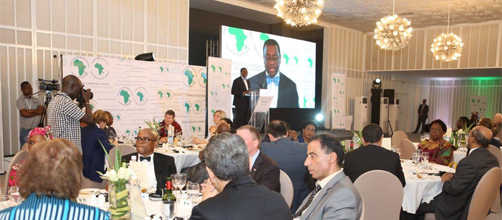
As the debate raged, the President of the AfDB, Akinwumi Adesina walked in and added his voice on why AFAWA was an important initiative of the Bank.
Adesina explained that the success of the AfDB’s High 5s depends on what is done, first, for women.
“When women are supported, they deliver. When you empower women, everything changes. When women win, Africa wins. About 97 percent of women pay back their loans and the 3 percent are stopped by husbands on their way to pay,” he said.