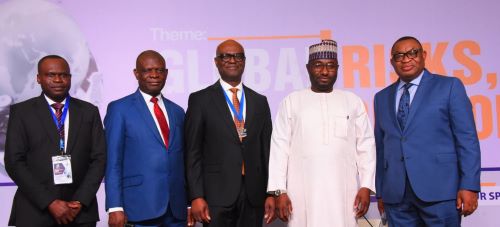

L-R: Registrar/CEO, Chartered Risk Management Institute of Nigeria (CRMI), Victor Olannye; Permanent Secretary, Special Duties, Federal Ministry of Finance, Raymond Omachi; Executive Director/Chief Risk Officer, Fidelity Bank Plc and President/Chairman of Council, CRMI, Kevin Ugwuoke; Technical Adviser to the President on Economic and Financial Inclusion, Nurudeen Abubakar Zauro; and Director, Risk Management, Central Bank of Nigeria (CBN), Blaise Ijebor; at the CRMI 24th Annual International Conference in Lagos recently.
Vice President Senator Kashim Shettima has called on the African Union (AU), African Development Bank (AfDB), and Afreximbank to support the efforts of the Chartered Risk Management Institute of Nigeria (CRMI) in tackling the growing wave of global risks confronting Africa.
Speaking at the 24th International Conference of CRMI in Lagos, the Vice President, represented by the Technical Adviser to the President on Economic and Financial Inclusion, Dr. Nurudeen Zauro, emphasized the need for strengthened continental collaboration in addressing risks ranging from climate change and cybersecurity to pandemics, terrorism, and disruptive technologies.
“For over two decades, the Institute has been a beacon of foresight, resilience, and preparedness,” Shettima said. “Risk management is not just a profession—it is a discipline of national importance. The establishment of the Federation of African Risk Management Association marks a historic milestone, positioning Africa to address risks on its own terms.”
The Vice President reaffirmed the Federal Government’s commitment to risk mitigation, noting ongoing initiatives such as #SheIsIncluded, launched in January 2025, to support Nigerian women’s inclusion and resilience in economic participation. He also stressed the importance of community-based early warning systems for floods and droughts, microinsurance schemes, and social protection for farmers as tools for building resilience and national prosperity.
Speaking at the conference themed, “Global Risks, Local Solutions,” the President/Chairman of CRMI’s Governing Council, Kelvin Ugwuoke, underscored the importance of adopting homegrown strategies in addressing global disruptions such as climate change, cyber threats, pandemics, food insecurity, and the implications of artificial intelligence.
“We are witnessing risks driven by climate change, cyber threats, Artificial Intelligence, and geopolitical conflicts such as the Russia–Ukraine war, which have direct consequences on food security and economic stability,” Ugwoke said. “Our mandate is clear: to develop home-grown solutions that help Nigeria and Africa withstand and prosper amid global uncertainties.”
Ugwuoke who also serves as Executive Director, Risk Management at Fidelity Bank Plc, also disclosed that a bill is currently before the National Assembly to formally entrench risk management into national policy, underscoring CRMI’s advocacy for stronger integration of risk principles in both public and private sector decision-making.
Also speaking at the Conference, the Governor of the Central Bank of Nigeria (CBN), Mr. Olayemi Cardoso, represented by Dr. Blaise Ijebor, Director of Risk Management at the CBN, commended CRMI’s leadership in advancing risk management in Nigeria.
“Global risks do not respect borders. Our reforms are designed to integrate risk awareness into financial planning, ensuring economic stability amid evolving uncertainties,” he stated.
Similarly, Minister of Finance, Mr. Wale Edun, represented by Permanent Secretary Raymond Omachi, highlighted the necessity of recent policy reforms such as fuel subsidy removal and exchange rate unification. “Risk management is not about predicting the future, but preparing for it. The future will not be defined by the storms we face, but by the solutions we craft together,” he said.
The 24th International CRMI Conference convened policymakers, business leaders, and experts to deliberate on localized strategies for addressing global risks. It reinforced Nigeria’s leadership role in advancing risk management as a critical tool for economic stability, resilience, and sustainable development.
About CRMI
The Chartered Risk Management Institute of Nigeria (CRMI), established by Act No. 39 of 2022 and founded on March 29, 2000, is the national professional body for risk management in Nigeria.
The Institute promotes best practices, education, research, and advocacy in risk management across industries. Through its flagship Chartered Risk Manager (CRM) certification, professional training, and Mandatory Continuing Professional Education (MCPE), CRMI sets the national standard for excellence in risk management and supports a community of professionals dedicated to advancing the discipline.