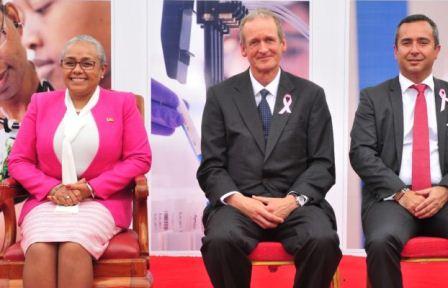

First Lady Margaret Kenyatta, Kenya Ministry of Health and Roche Pharmaceuticals Limited have launched key activities that will facilitate access to improved care for patients with breast cancer in Kenya.
The launch builds on the country’s 2015-2020 National Strategy for the Prevention and Control of Non-Communicable Diseases and represents a comprehensive approach to battling the disease.
The program also complements the campaign from the African First Ladies who are committed to expanding access to prevention and treatment services for women with breast cancer.
The public-private partnership’s planned activities include breast cancer awareness programs, improvements in screening and diagnostics, including the placement of a diagnostic instrument capable of advanced testing for seven types of cancer.
Additionally, the collaboration will train five new oncologists and six oncology nurses, provide surgical oncology training, support the development of best practice national treatment guidelines and an increase the number of cancer treatment centers in Kenya.
Access to medicine will be made available patients seeking treatment at public institutions with the government of Kenya and Roche jointly covering the costs. The aim of these measures is to improve access to timely and precise diagnostic services and tailored cancer treatment to make cancer therapy much more effective.
“Strong, healthy women are the foundation of families, of our country, and today in Kenya their health is threatened by a disease that we must catch early. Many women are being diagnosed with breast cancer too late and are dying needlessly when there are treatments available that give them a chance to fight this disease,” said First Lady Margaret Kenyatta.
and Roche demonstrates that we all must play our part to ensure that our mothers, sisters and daughters have the opportunity to fight and win the war against breast cancer.”
Breast cancer remains the leading cause of cancer in women in Kenya with more 50 percent of the cases presenting in women below the age of 50. This places their families and the economy at a great disadvantage.
Every year approximately 4,500 patients are diagnosed with the disease and 2,000 patients lose their lives to this disease. This burden reflects an increasing trend in the number of women being diagnosed with the disease. Early diagnosis and treatment could greatly reduce the burden of breast cancer and improve treatment outcomes.
The Kenya agreement is part of Roche’s Africa Strategy which began in 2015 in seven countries: Nigeria, Ghana, Kenya, Côte d’Ivoire, Angola, Ethiopia and Gabon.
Based on country needs and capabilities, Roche is implementing a wide selection of activities in collaboration with local partners, including healthcare system strengthening, such as local data generation and advocacy for healthcare prioritisation; disease management support, such as awareness, advocacy campaigns and treatment guidelines; and education and market access solutions, including healthcare professional training, private health insurance with local companies and price-volume agreements with governments.
“We are honored to have First Lady Margaret Kenyatta here to launch this important initiative for breast cancer patients and to demonstrate Kenya’s commitment to improving cancer care,” said Markus Gemuend, Head of Roche, Sub-Saharan Africa Region.
“With access to healthcare, women are empowered to build the futures they want for themselves and their families. This comprehensive agreement ensures that breast cancer patients in Kenya will have not only improved access to care and life-changing medicines, but also that the overall healthcare system is stronger to support all Kenyans battling cancer.”
Breast Cancer in Kenya
Breast cancer is the second most common type of cancer in Kenya recording 4,500 new cases every year with 1,969 deaths. Although it occurs in both men and women, more than 90 percent of the cases present in women.
Risk factors include: gender (being female), family history, alcohol and tobacco use, being obese or overweight and exposure to estrogen hormones through contraceptives. In terms of frequency, breast cancer comes second after cervical cancer and is followed by prostate cancer.
Aside from the investments in public-private partnerships, the Ministry of Health is installing mammography machines through the Managed Equipment Services project to enhance early detection and diagnosis of breast cancer countrywide.
It is also providing specialised training opportunities for cancer healthcare professionals to boost capacities at the county level.