


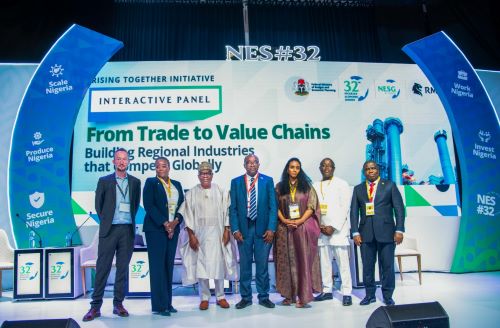

Moderator, Nicholas Norbrook, Managing Editor of The Africa Report; Yetunde Ogunremi, Executive Director and Treasurer, Rand Merchant Bank Nigeria; Ambassador Sola Enikanolaiye, Nigeria’s Minister of State for Foreign Affairs; Niyi Yusuf, Chairman NESG Board; Lillian Kidane, Africa Director at Dalberg; Kelvin Banda, Principal Economist at the African Development Bank Group (AfDB); and Dehpue Yenpea Zuo, ECOWAS Commissioner for Economic Affairs and Agriculture after the #NES32 RMB Nigeria-sponsored panel session titled “From Trade to Value Chains: Building Regional Industries that Compete Globally.”
Aligned with the NES #32 theme, “Growth That Works: Delivering Jobs, Productivity and Shared Prosperity,” industry and finance leaders examined how financing, infrastructure investment and cross-border collaboration can transform regional market access into competitive manufacturing value chains, industrial growth and shared prosperity across Africa.
Rand Merchant Bank Nigeria (RMB Nigeria) reinforced the importance of financing, infrastructure development and regional collaboration in advancing West Africa’s industrialisation agenda following its sponsored interactive session at the 32nd Nigerian Economic Summit (NES #32).
The session, titled “From Trade to Value Chains: Building Regional Industries that Compete Globally,” was held on Monday, 26 October 2026, as part of the Summit’s Rising Together Initiative. It brought together leaders from regional institutions, development finance institutions and the private sector to examine practical approaches to strengthening regional manufacturing and building competitive value chains across West Africa.
Discussions focused on how African countries can move beyond exporting raw commodities to developing stronger production capacity, expanding regional supplier networks and capturing greater value from the continent’s resources. Panellists also explored the role of financing, infrastructure, regulatory coordination and private-sector investment in translating the opportunities presented by the African Continental Free Trade Area (AfCFTA) into sustainable industrial growth.
Speaking during the session, Yetunde Ogunremi, Executive Director and Treasurer, Rand Merchant Bank Nigeria, highlighted the role of financial institutions in supporting the development of regional industries:
“Africa’s opportunity lies not just in trading more, but in producing more and creating greater value within the continent. This requires long-term capital, innovative financing and strong partnerships to build competitive industries and regional supply chains. At RMB Nigeria, we are committed to supporting businesses with the financial solutions they need to turn regional integration into sustainable economic growth.”
Opening remarks were delivered by Ambassador Sola Enikanolaiye, Nigeria’s Minister of State for Foreign Affairs, while Dehpue Yenpea Zuo, ECOWAS Commissioner for Economic Affairs and Agriculture, delivered a goodwill address on behalf of H.E. Dr. Omar Alieu Touray, President of the ECOWAS Commission.
The interactive panel discussion was moderated by Nicholas Norbrook, Managing Editor of The Africa Report, with Cecilia Akintomide, Chairperson of the UN Sanitation and Hygiene Fund, providing technical contributions.
The panel featured Kelvin Banda, Principal Economist at the African Development Bank Group (AfDB); Dehpue Yenpea Zuo, ECOWAS Commissioner for Economic Affairs and Agriculture; Lillian Kidane, Africa Director at Dalberg; Banji Fehintola, CFA, Executive Director at the Africa Finance Corporation (AFC); Oluwole Dada, General Manager, SecureID Limited; and Yetunde Ogunremi, Executive Director and Treasurer, Rand Merchant Bank Nigeria.
From Trade Integration to Industrialisation
A key focus of the discussion was the need to connect regional market access with the financing, infrastructure and productive capacity required to establish competitive industries. While regional trade agreements create opportunities for businesses to access larger markets, realising these opportunities depends on the ability to produce, process, transport and distribute goods efficiently across borders.
Commenting on this, Ogunremi said:
“Access to larger regional markets is only meaningful when businesses have the capacity to produce competitively and at scale. Unlocking this potential requires deliberate investment in infrastructure, efficient logistics, reliable energy and innovative funding structures that support long-term industrial growth. It also requires large corporates to serve as anchors for regional value chains, alongside efficient foreign exchange markets and sufficient liquidity to support seamless cross-border payments through platforms such as PAPSS. Strengthening these foundations will be critical to building resilient regional value chains and positioning African industries to compete globally.”
The discussion highlighted opportunities across sectors including agro-processing, pharmaceuticals, automotive, textiles and digital services, while emphasising the importance of reliable power, industrial infrastructure, efficient logistics and stronger regional supply chains. Panellists also explored how commercial banks, development finance institutions, governments and private investors can collaborate to mobilise long-term capital, manage investment risks and address structural barriers that constrain industrial development.
The session underscored the importance of coordinated action among policymakers, financial institutions and businesses to build industries capable of competing in both regional and global markets.
Discussions provided a platform for examining how innovative financing solutions, strategic partnerships and regional cooperation can help bridge the gap between Africa’s trade ambitions and the investments required to expand productive capacity, strengthen regional value chains and accelerate industrialisation.
For RMB, supporting conversations around trade, investment and industrial development aligns with its role as a corporate and investment bank serving corporate, institutional and public-sector clients. Through its financing, advisory and banking capabilities, RMB works with businesses and institutions to address complex funding requirements, unlock investment opportunities and support sustainable economic growth.
About RMB Nigeria
Rand Merchant Bank (RMB) is a leading African corporate and investment bank providing innovative advisory, funding, trading, corporate banking and principal investing solutions to corporate, institutional and public-sector clients.
Through its presence across Africa and partnership with the wider FirstRand Group, RMB delivers sector expertise, market insights and tailored financial solutions that help clients grow, invest and operate across the continent.