


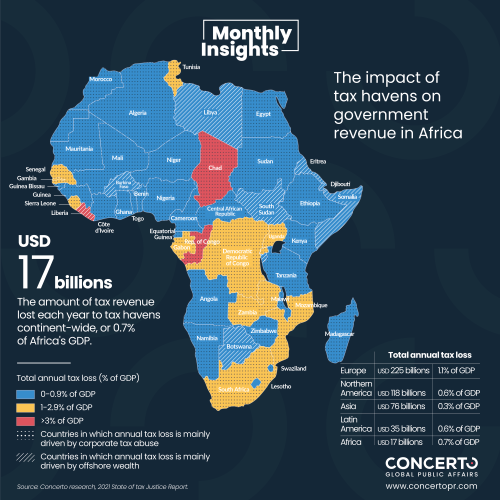

- Nigeria ($2.77 billion), South Africa ($2.31 billion) and Egypt ($2.19 billion) have the largest estimated annual losses, according to the Tax Justice Network. Nigeria’s losses exceed its public health budget.
- African tax authorities have identified €4.6 billion in tax, interest and penalties since 2009 through information sharing under OECD-backed standards and related voluntary disclosure programs.
- Seven European countries called in August for negotiators to remove the information-sharing provision from the draft UN tax convention. Negotiators will discuss the revised text in Nairobi starting November 30.
African countries lose an estimated $20.9 billion a year to cross-border tax abuse, according to the Tax Justice Network’s State of Tax Justice 2026.
The network published the report on November 24, six days before negotiators meet in Nairobi for the sixth round of talks on a United Nations Framework Convention on International Tax Co-operation.
The estimate, based on 2023 data and expressed in 2025 prices, includes $16.1 billion in tax revenue lost when multinational companies shift profits and $4.7 billion lost on offshore wealth that African residents do not declare. The total is equivalent to 32.6% of government health spending in Africa.
Figure 1. Nigeria’s annual losses from tax abuse exceed its public health budget
Estimated annual tax losses in the 10 African countries with the largest losses, based on 2023 data at 2025 prices.
Source: Tax Justice Network, State of Tax Justice 2026, country results.
Nigeria’s estimated annual loss of $2.77 billion is equivalent to 120% of its public health budget. South Africa follows at $2.31 billion, Egypt at $2.19 billion and Morocco at $1.99 billion.
The Tax Justice Network (TJN) estimates corporate tax losses using aggregate country-by-country reporting data for 2016 to 2023 from the Organisation for Economic Co-operation and Development (OECD).
It treats profits that companies report in a jurisdiction above what their workforce and sales there would warrant as shifted profits. The sample covers about 85% of profits, and TJN scales up the estimate to cover all multinationals. Without that adjustment, the total estimated loss for Africa is $18.5 billion.
Seven European countries called for the information-sharing provision to be dropped
The UN talks stem from a resolution Nigeria introduced on behalf of the African Group. The General Assembly’s Second Committee approved it on November 22, 2023, by a vote of 125 to 48. Most of the opposing votes came from developed countries.
The full General Assembly adopted Resolution 78/230 on December 22, 2023, by a vote of 111 to 46. At the fifth round of talks in New York, held August 3–13, 2026, Austria called for negotiators to remove Article 11, which covers the exchange of information.
Czechia, France, Italy, Norway, Poland and the United Kingdom backed the request. Germany said provisions of this kind did not belong in a framework convention. Austria said it supported information sharing but did not want the convention to set a separate legal standard. Norway said the draft differed from the existing standard of the OECD-hosted Global Forum on Transparency and Exchange of Information for Tax Purposes.
Zambia, a Global Forum member speaking for the African Group, argued that the convention still needed information-sharing provisions to carry out commitments such as the one on illicit financial flows. It warned that removing Article 11 would reopen debate over those commitments. Brazil noted that about 60 UN member states do not belong to the Global Forum.
The European Union has expanded its own rules. Since January 1, 2026, its DAC8 directive has required crypto-asset service providers to collect data on users who live in the EU. Tax authorities are due to exchange that information for the first time by September 30, 2027.
Six African countries have committed to the OECD’s Crypto-Asset Reporting Framework: Kenya, Mauritius, Nigeria, Seychelles, South Africa and Uganda. South Africa and Uganda are among the jurisdictions scheduled to begin exchanging information in 2027.
€4.6 billion in 17 years, equivalent to about three months of losses
African tax authorities identified €417 million in additional revenue in 2025 through information sharing and related voluntary disclosure programs.
Since 2009, they have identified €4.6 billion in tax, interest and penalties, according to Tax Transparency in Africa 2026, published June 30 by the Global Forum and the African Tax Administration Forum (ATAF). At the European Central Bank’s November 17 reference rate of $1.0989 per euro, the 17-year total comes to about $5.1 billion.
That is close to three months of losses at TJN’s estimated annual rate of $20.9 billion, according to Ecofin Agency calculations. The Global Forum counts amounts assessed by tax authorities, including penalties. TJN estimates tax revenue lost.
A record 25 African countries used the system for exchanging information on request in 2025. By year-end, more than 3,500 information-sharing relationships were in effect across the continent, 85% of them under the Multilateral Convention on Mutual Administrative Assistance in Tax Matters.
Of the Global Forum’s 39 African members, eight were automatically receiving information on foreign financial accounts at the end of 2025: Ghana, Kenya, Mauritius, Nigeria, Rwanda, Seychelles, South Africa and Uganda. Six others have committed to doing so: Cabo Verde, Cameroon, Morocco, Senegal, Tunisia and Zambia.
In 2025, the eight participating countries received data on nearly 3 million accounts holding €259 billion in assets abroad. The Global Forum reported that close to 70% of its African members had satisfactory ratings for exchanging information on request. It also noted weaknesses in how countries oversee and enforce beneficial ownership rules.
Figure 2. A smaller share of offshore wealth is hidden, but tax losses have risen in low-income countries
Share of offshore wealth undeclared worldwide and tax losses on offshore wealth in low-income countries, 2016–2023.
Source: Tax Justice Network, State of Tax Justice 2026, executive summary and section 4.4.
TJN estimates that the share of offshore wealth hidden from tax authorities worldwide fell from about 78% in 2016 to 39% in 2023, when offshore wealth reached $13.3 trillion. Over the same period, tax revenue lost on untaxed offshore wealth rose 37% in low-income countries and 10% in lower-middle-income countries.
According to the report, through 2023 no low-income country had received information on its residents’ offshore accounts under either of the two automatic exchange systems.
The draft convention’s information-sharing provision remains in brackets
In the revised draft circulated on November 16 (A/AC.298/CRP.38, Rev.1), all of Article 11 remains in square brackets, indicating that negotiators have yet to agree on the text. Two options remain open for determining what information countries would share: information that “may be” relevant or information that “is foreseeably” relevant.
The latter is the OECD standard. The article would cover information on assets and instruments identified as ways to bypass existing automatic exchange systems. It would also cover transaction data that would allow authorities to match exports of goods and services with corresponding imports to detect tax-related illicit financial flows.
Under the draft, a state could not refuse to provide information on the grounds that a bank holds it or that it concerns ownership interests in a person. The term “beneficial ownership” does not appear in the draft.
Article 10 lists help with tax collection, simultaneous tax examinations and tax examinations abroad as forms of mutual administrative assistance “under procedures to be specified in future protocols or other instruments.” The revised text also removes the definition of tax-related illicit financial flows that appeared in Article 3 of the July draft.
Draft disputes protocol allows arbitration on request and grants no new rights to information
The revised draft Protocol on the Prevention and Resolution of Tax Disputes, dated November 16 (A/AC.298/CRP.39, Rev.1), creates no new rights to information.
Under Article 20, parties may exchange information only to the extent that an agreement already in force between them permits it. Article 13 says that issues still unresolved after three years under the mutual agreement procedure “shall be submitted to arbitration if any of those competent authorities so requests.” Article 31 allows a state to enter a reservation on mediation and conciliation under Article 12 and on arbitration under Article 13. Article 14, which concerns limits on the use of investment treaty procedures to settle tax disputes, reads simply, “To be discussed.”
Negotiators are not scheduled to adopt any text in Nairobi. The session at the United Nations Office at Nairobi runs from November 30 to December 10. Negotiators will discuss the revised convention through December 8 and the disputes protocol on December 9 and 10.
The protocol on taxing cross-border services, which addresses how taxing rights are allocated, is not on the agenda. The seventh session is scheduled for January 18–29, 2027. Under its terms of reference, the negotiating committee is to submit the convention and its two protocols in 2027 for consideration by the General Assembly during the first quarter of its 82nd session, which opens in September 2027.
Credit: Idriss Linge