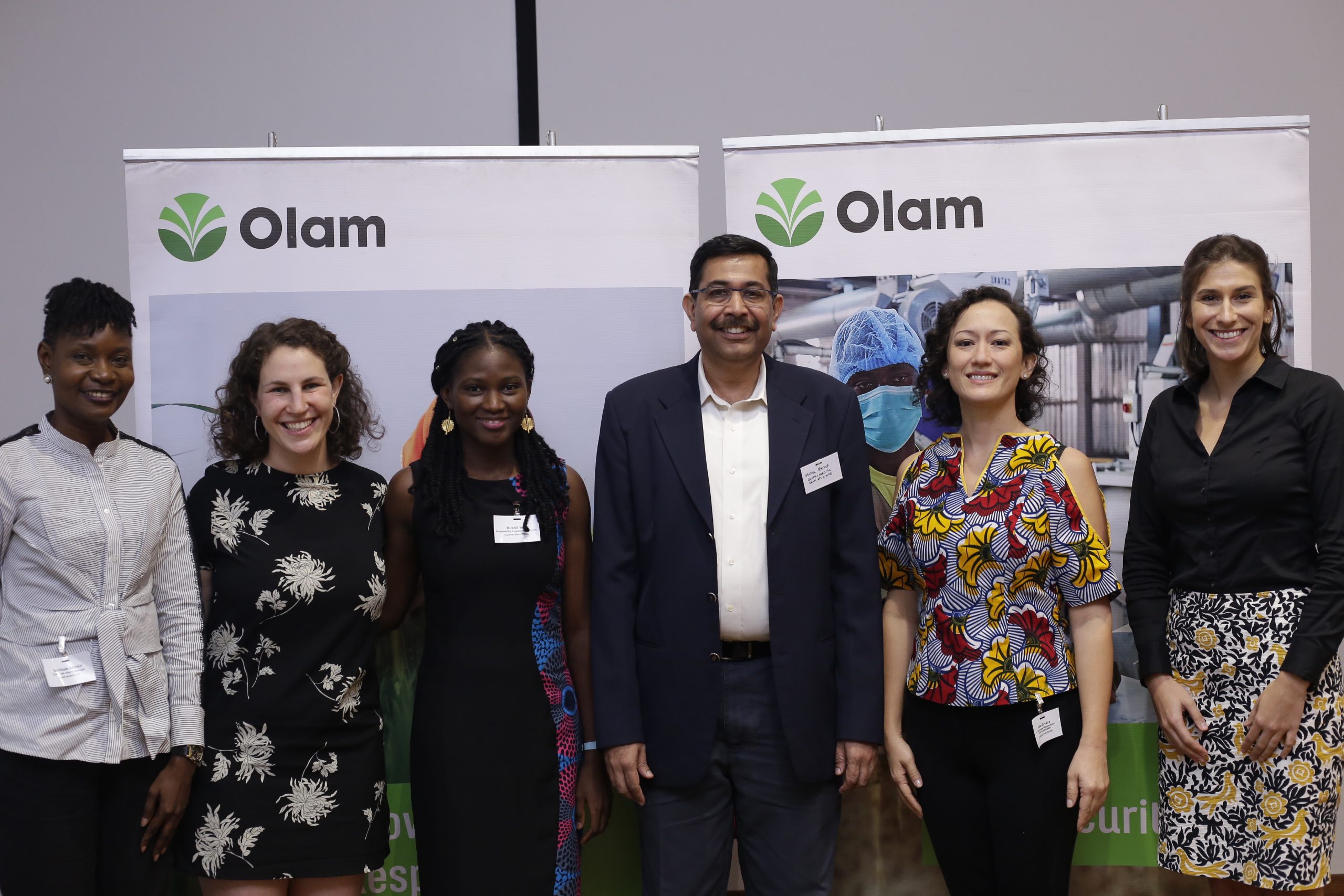

(L-R) Damilola Adeniyi, Corporate Affairs Manager, Olam Nigeria; Sharon Bort, Officer, Sustainability Community, Massachusetts Institute of Technology (MIT) Solve; Mireille Wondia Yeo, Programme Associate, Corporate Responsibility and Sustainability, Olam International; Mukul Mathur, Country Head, Olam Nigeria; Julie Greene; Vice President, Corporate Responsibility & Sustainability, Olam International and Sarah Rawson, Social Sustainability Officer, Corporate Responsibility & Sustainability – Africa Region, Olam International at the Challenge Design Workshop, co-hosted by Olam International and MIT Solve in Lagos.
Olam International, a leading global agri-business, has partnered the Massachusetts Institute of Technology Solve (MIT Solve) to design a Challenge aimed at addressing the issues around sustainable food systems in Nigeria. Olam International and MIT Solve co-hosted a Challenge Design Workshop which held in Lagos.
’MIT Solve is a hybrid business incubator and business ideas marketplace from the Massachusetts Institute of Technology, that advances solutions from tech entrepreneurs to address pressing global issues. MIT Solve connects innovators with resources such as expertise, human capital, technology, and funding’.
The workshop was designed to engage cross-sector stakeholders in Nigeria, to deliberate on issues affecting the country’s agri-business ecosystem and aid MIT in designing Solve’s 2020 Global Challenges. The event was also aimed at building connections amongst individuals and organisations with an interest in innovation, to address social and environmental challenges.
Addressing the audience on the rationale behind the event, Mukul Mathur, Country Head, Olam Nigeria said: “Olam started as a single-man, single product operation in Nigeria and we have managed to achieve massive growth over a 30-year period. However, we still face problems and we cannot fix these challenges alone. We realise the value of having an ecosystem which can help in proffering solutions, especially around sustainable food systems in Nigeria. It is important to have such an ecosystem of likeminded people. I know that together, we can fix these problems.”
Sharon Bort, Officer, Sustainability Community for MIT Solve, described the programme as an initiative of the MIT aimed at solving identified global challenges. According to her, the MIT Solve cycle which starts in February of each year initiates competitions in the areas of Economic Prosperity, Health, Learning and Sustainability. Bort added that MIT Solve decided to focus on challenges associated with food in an attempt to find solutions to issues around sustainable food systems.
According to Julie Greene, Vice President, Corporate Responsibility and Sustainability, Olam International, the rise in the world’s population presents an opportunity for players in the agricultural value chain with the rapid rate of urban migration resulting in mass movements away from farms where crops are harvested. She said: “For most part of history, people lived near their food sources, they grew their own food. Today over 50% of the population lives in the cities. This has huge implications because of the channels through which these food products are transported and stored. The bigger challenge is that it inhibits people from having a healthy diet.”
Ms. Green pointed out that agriculture also has its negative impacts, despite its positive effects. She said: “Agriculture and other land uses are responsible for a quarter of greenhouse gas emissions from fertilizers, deforestation and transportation. Agriculture is responsible for 70% of freshwater withdrawals. While these are critical to productivity, they also have polluting effects on the environment. We only grow enough food to feed the population, but the problem is that 1/3 of that food never actually reaches our plates due to food loss and waste. Therefore, the food system needs innovation and that is why we are here today to answer the question “what are the various opportunities for a sustainable food system?’”
Reji George, Vice President, Farming Initiatives, Olam Nigeria identified food loss and wastage amongst some of the challenges encountered in agribusiness. He said: “One third of the global food production is wasted; and this is estimated to be around 1.3 billion tonnes of food. If food losses can be improved upon, global food security, food systems and nutrition will also improve.”
He however added that Olam has commissioned surveys in some selected states in Nigeria, while also working with farmers to know the extent of losses incurred during harvest and find ways of reducing such losses.