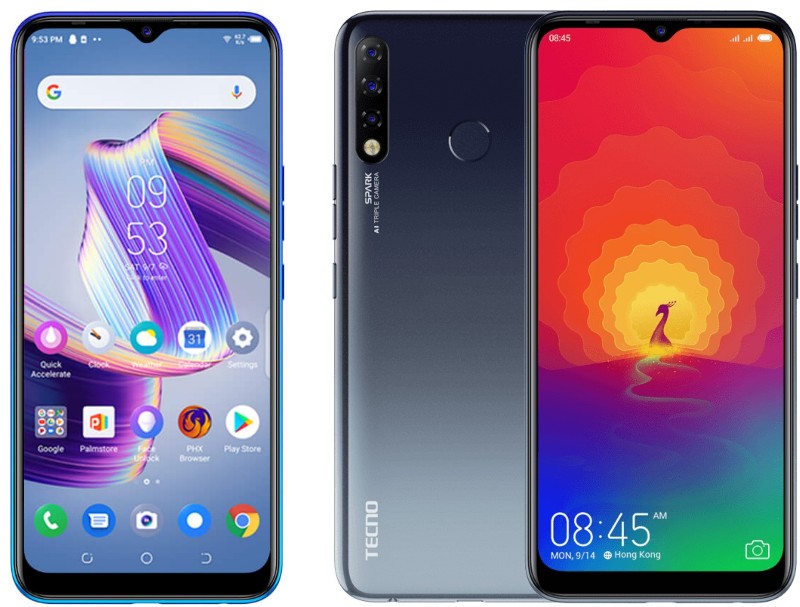

Nigeria’s smartphone market grew 5.3% quarter on quarter (QoQ) in Q4 2019, according to the latest figures from global technology and consulting services firm International Data Corporation (IDC).
This growth comes on the back of a 3.2% QoQ increase in Q3 2019 after the market suffered a slow H1 2019, which translated into a 3.5% year-on-year (YoY) decline for 2019 as a whole.
The decline in Nigeria in H1 2019 was caused by the closure of airports February, which led to a considerable slowdown in imports. The extended campaigns for the 2020 general elections also impacted the market, while the dollar was also unstable during this same period, which had the effect of reducing smartphone shipments to the country.
Together, Transsion brands (i.e., Tecno, itel, and Infinix) held the biggest market share in 2019 as they launched a number of successful models with big screen sizes and mid-range prices, including the Spark 4, Phantom 8, and Camon 12, among others.
In addition, Transsion experienced strong demand for its wide range of models in low price bands ($0<$100). Huawei had a major comeback to the market, benefiting from an increased marketing budget and the launch of new products in the mid-range price bands.
Samsung benefited from its A series models, which had a wide market audience due to the affordability and rich features of these devices.
The Nigerian government raised VAT from 5% to 7.5% effective from February 1st, 2020. This new regulation is likely to lead to an increase in smartphone prices, leading to slower smartphone adoption in the market. With VAT averaging 5% in the markets directly neighboring Nigeria, gray market re-exports of smartphones into the country are likely to increase.
As per the most recent Situation Report (#56) from the World Health Organisation, there are now 167,511 confirmed cases of the COVID-19 virus worldwide, with 6,606 deaths. In response to the pandemic, IDC has developed three possible scenarios – Optimistic, Probabilistic, and Pessimistic – and currently believes that the Probabilistic scenario is the most likely to occur, with both supply- and demand-side concerns alleviating by the second half of 2020.
Under this Probabilistic scenario for Nigeria and Ghana combined, IDC expects smartphone shipments to decline 15.4% in QoQ in Q1 2020 and 3.9% in Q2 2020.
As most consumer devices in West Africa are imported from China, the disruption to supply chains caused by the COVID-19 outbreak will have a particularly severe impact on this sub-region. Most of the major smartphone brands (i.e., Tecno, Itel, Infinix, Xiaomi, Huawei, Oppo, and Vivo) are of Chinese origin and they control over 85% of the regional market. Other brands such as Nokia and Samsung, with their partial production outside China, cannot fill the gap as they also source parts and components from China.
The impact of the COVID-19 outbreak on Nigeria is double sided. While the supply of smartphones will inevitably be restricted on the Chinese side, Nigeria’s oil revenues are also likely to suffer as China is Nigeria’s the largest customer for crude oil and other raw materials.
“While the spread of COVID-19 presents a significant threat to Nigeria, a country with insufficient health infrastructure, the negative impact on oil revenues poses a larger threat in the short to medium term, and this will negatively impact the country’s fragile economic development and the purchasing power of consumers,” says Dr. Ramazan Yavuz, a Senior Research Manager at IDC.
“While the impact of the spread of the virus is expected to lessen and a return to normalcy is awaited in H2 2020, the volatility and uncertainty in oil markets will continue to take a bigger toll on the Nigerian economy, which will subsequently stifle demand for consumer devices, including smartphones.”
IDC expects that the shortage of smartphone supply will drive an increase in gray market imports from other markets. “If the supply chain is not back to normal and distributors run out of stocks, the average selling prices for smartphones are likely to go up because of the shortage in supply,” says George Mbuthia, a Research Analyst at IDC. “The increase of VAT to 7.5% in Nigeria will push costs further upwards, slowing smartphone penetration in the short term.”