Nigeria’s GDP Expands by 1.50% in Q2-2018

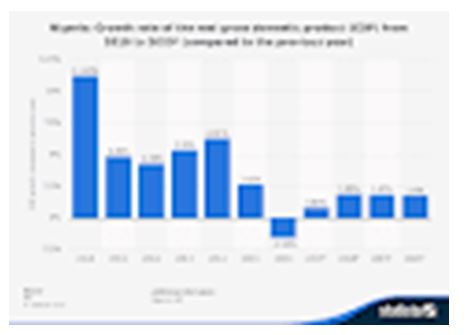
The National Bureau of Statistics (NBS) just released Nigeria’s Q2-18 GDP figure, showing that the domestic economy expanded for the fifth consecutive quarter, with real GDP growing by 1.50% y/y (vs. 1.95% y/y in the previous quarter and 0.72% y/y in Q2-2017).

The growth estimate came in 46 bps and 120 bps lower than Bloomberg‘s compiled average estimate of 1.96% and Cordros’ forecast of 2.70%, respectively.

According to Cordros Capital, the breakdown of the GDP figure shows that the oil sector contracted by 3.95% (compared to growth of 14.77% in Q1-18 and 3.53% in Q2-17). The NBS estimated crude oil production during the three months period to be 1.84mb/d, 0.16mb/d and 0.03mb/d lower than the 2.0mb/d and 1.87mb/d reported in Q1-18 and Q2-17.

The sector contributed 8.55% of total GDP (vs. 9.61% and 9.04% in Q1-18 and the corresponding quarter of 2017 respectively) during the review period.

Output in the non-oil sector expanded, growing by 2.05% y/y in Q2-18, 129 bps higher than the rate recorded in Q1-18 and 59 bps higher when compared to the growth rate achieved a year ago. The non-oil sector contributed 91.45% to total GDP (vs. 90.39% and 90.96% in the three months to March 2018 and Q2-17 respectively).

Also, a breakdown of three of the biggest components of the GDP shows that Services expanded by 2.12% y/y (vs. -0.47% y/y in Q1-18 and -0.85% y/y in Q2-17).

In the same period, agriculture grew by 1.19% y/y, 181 bps and 182 bps lower than growth rates recorded in Q1-18 and Q2-17 respectively. Manufacturing grew by 0.68% y/y – 271 bps lower and 4 bps higher than growth rates recorded in Q1-18 and Q2-17 respectively.

In terms of contribution, services, industries, and agriculture, respectively, accounted for 54.0%, 23.2%, and 22.9% of overall output growth.


spot_img
spot_img
spot_img
spot_img

Hot this week

Rethinking How Nigeria Supports SME Growth

  By Olajumoke Bello Head, Enterprise Banking Stanbic IBTC Bank Across Nigeria, small...

Customers Applaud Mutual Benefits as Insurer Pays Over ₦3.9bn in Claims

Mutual Benefits Assurance Plc has reaffirmed its unwavering commitment...

FG: Local Content Must Create Value for Nigerians

By Olu Verheijen For twenty-five years, NOG Energy Week has...

NAICOM Boss, Segun Omosehin, Extols Yetunde Ilori’s Leadership at CIIN, Reaffirms Commitment to Institute

L-R: Mr. Ekerete Ola Gam-Ikon, Deputy Commissioner, Finance and...

NAICOM Holds One-Day Training for Police Officers on Compliance with Compulsory Insurance Policies

The National Insurance Commission (NAICOM) has organised a one-day...

Topics

NAICOM Commends Passage of Insurance Reform Bill

The National Insurance Commission (NAICOM) welcomes the passage of...

NA to Strengthen NIMC’s Regulatory Function with New Act

The National Assembly, as part of the moves to...

From Market Stall to Millionaire: How Fidelity Bank GAIM 6 Transformed My Life – Fufu Seller

Question: Let’s start this interview with a general introduction...

‘Insurers Must Close Communication Gap to Grow Sector’

Insurers must bridge the communication gap that exists between...

Aligning Talent Strategy with Business Strategy

   By Kazeem Olayemi Odeyeyiwa, FCA  Talent management is of strategic...

Investec to Manage $670m Fund for Infrastructure in Africa

South African assets manager Investec Asset management has been...

Corruption Killing African Businesses

An estimated 34% of African businesses reported losing out on deals to corrupt competitors in an annual survey of business attitudes comprising interviews with 824 companies worldwide. The survey was conducted by Control Risks, a global business risk consultancy. Corruption is still a major cost to international business, with 34%* of respondents from Africa reported losing out on deals to corrupt competitors. Corruption risks continue to deter investors. 30% say they have decided not to conduct business in specific countries because of the perceived risk of corruption.
spot_img

Related Articles

Popular Categories

spot_imgspot_img