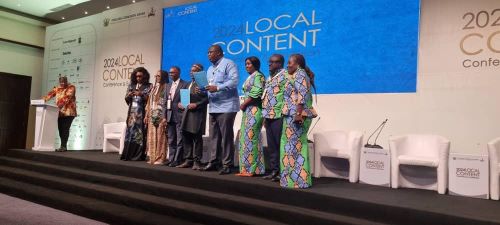

Executive Secretary, Engr. Felix Omatsola Ogbe, represented by Director of Monitoring and Evaluation, Mr. Abdulmalik Halilu, and the Director Legal Services, Mr. Naboth Onyesoh, Esq, signed on NCDMB’s side, while the Executive Secretary/Chief Executive Officer of Petroleum Commission, Ghana, Mr. Egbert Fabille Jrn and the Acting General Counsel, Nana Akua Agyei signed on behalf of their organisation.
The Nigerian Content Development and Monitoring Board (NCDMB) has signed a Memorandum of Understanding (MoU) with the Petroleum Commission, Ghana (PCG) towards developing and deepening local content regulations in Ghana’s upstream petroleum sector.
The signing ceremony took place at the sidelines of the 2024 Annual Local Content Conference and Exhibition held at Takoradi, Ghana.
The MoU is valid for three years and it is centred on the desire to build synergies through information sharing and transfer of skills of mutual interest and benefits.
Under the MoU, NCDMB will offer PCG strategic advice and guidance in the areas of laws, frameworks, knowledge exchange, procedures for baseline study, data collection on capacities that exist in Ghana, design of strategic plan for local content implementation in Ghana and other capacity development initiatives.
The MoU would also foster collaboration, provide opportunity for global experience, and facilitate advancement of knowledge, leading to local content development in the upstream petroleum sector.
In addition, NCDMB will offer technical support in the development of the framework in the formulation of regulations and policies for PCG Local Content laws.
NCDMB was established in 2010 by the Nigerian Oil and Gas Industry Content Development (NOGICD) Act, and is mandated to monitor, guide, develop, and promote local content practice in the Nigerian oil and gas sector and linkage sectors.
On the other hand, the PCG was established by the Petroleum Commission Act, 2011 (Act 821) to regulate and manage the utilisation of petroleum resources and coordinate the policies in the upstream petroleum sector under the laws of the Republic of Ghana.
On NCDMB’s side, the MoU was signed by the Executive Secretary, Engr. Felix Omatsola Ogbe, represented by Director of Monitoring and Evaluation, Mr. Abdulmalik Halilu, and the Director Legal Services, Mr. Naboth Onyesoh, Esq, while the Executive Secretary/Chief Executive Officer of Petroleum Commission, Ghana, Mr. Egbert Fabille Jrn and the Acting General Counsel, Nana Akua Agyei signed on behalf of their organisation.
NCDMB had signed a similar agreement with the Technical Secretary of the National Content Monitoring Committee of Senegal (ST-CNSCL) in February 2022.
The ST-CNSCL is the agency responsible for the co-ordination and supervision of the development and implementation of the local content strategies in the Senegalese oil and gas sector.
Speaking earlier at the conference in Ghana, the Executive Secretary NCDMB urged African oil and gas service companies to collaborate among themselves and leverage their unique capabilities and capabilities.
This approach would grow African local content sustainably and help meet the aspirations of the African Continental Free Trade Area (AfCFTA), he noted.
He expressed delight at the collaborative spirit displayed by African countries, noting that “this event is a testament to our unwavering commitment to fostering strategic partnerships and driving sustainable growth within our sector.”
Commenting on the theme of the conference, which is “Attracting E&P Investments to Boost Local Content: New Pathways,” the Executive Secretary underscored the necessity for innovative approaches and collaborative efforts to unlock Africa’s hydrocarbon resources, estimated at over 125 billion barrels, accounting for about 10% of global reserves.
He reiterated the role of NCDMB as a business enabler, supporting the development of an efficient indigenous supply chain and delivering quality service competitively in the oil and gas industry.
Reflecting on NCDMB’s achievements, Engr. Ogbe noted significant progress in local content development, with an increase from less than 5% in 2010 to 54% in 2023, attributing the growth to the robust NOGICD Act, strategic implementation by the Board and collaboration by industry stakeholders.
He further highlighted the importance of economies of scale in attracting new investments and optimising capacity utilisation in the Exploration and Production (E&P) value chain.
He also celebrated the establishment of the African Energy Bank by the African Petroleum Producers Organisation (APPO) and the African Export–Import Bank.
The bank is expected to fund major oil and gas projects across the continent, mitigating the reluctance of western financial institutions to support new investments in the sector.