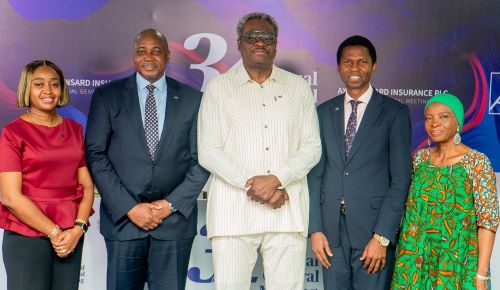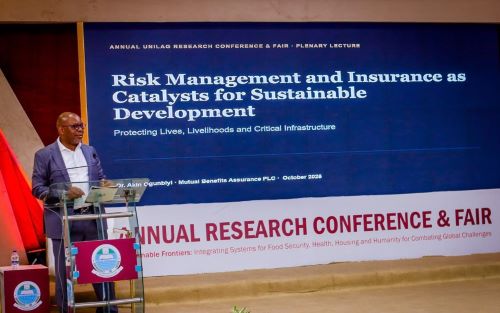

- MD/CEO, Femi Asenuga, representing Group Chairman Dr. Akin Ogunbiyi, warns that Nigeria’s development gains will keep slipping away unless risk is managed and insured.
Nigeria must integrate risk management and insurance more deliberately into its sustainable development agenda to protect households, businesses, public institutions and critical infrastructure against shocks, the Managing Director/Chief Executive Officer of Mutual Benefits Assurance Plc, Mr. Olufemi Asenuga, has said.
Asenuga made the call while delivering a plenary paper on behalf of the Group Chairman of Mutual Benefits, Dr. Akin Ogunbiyi, at the 19th Annual Research Conference & Fair of the University of Lagos, Lagos.
Titled “Risk Management and Insurance as Catalysts for Sustainable Development: Protecting Lives, Livelihoods and Critical Infrastructure,” the paper examined how insurance can help individuals, businesses and governments withstand financial shocks, preserve development gains and recover from unexpected losses.
“Development is not what a nation builds. Development is what survives,” the presentation declared, emphasising the importance of protecting investments and livelihoods against preventable and unforeseen risks.
Aligning his arguments with the conference’s focus on food security, health, housing and humanity, Asenuga described insurance as an essential component of national development, rather than a peripheral financial service. While risk management helps identify and reduce potential losses, insurance provides financial protection against covered events, enabling households, businesses and public institutions to recover and maintain continuity.
He noted that the United Nations Sustainable Development Goals recognise the importance of resilience and financial protection, particularly Target 1.5, which promotes the resilience of vulnerable populations, and Target 8.10, which encourages access to insurance and other financial services.
The presentation highlighted Nigeria’s growing insurance market but cautioned that rising premiums do not necessarily translate into broader access to protection. Industry figures cited in the paper put gross insurance premiums at approximately ₦2.3 trillion in 2025, up 47 per cent from about ₦1.56 trillion in 2024. However, low insurance penetration continues to leave many households and businesses exposed to financial shocks arising from illness, death, fire, flooding and business interruption.
Asenuga identified low incomes, limited insurance awareness, public distrust, weak enforcement of compulsory insurance, inflation and the largely informal structure of Nigeria’s economy as key barriers to wider insurance adoption.
He stressed that expanding coverage would require affordable and relevant products, transparent policy terms, prompt settlement of valid claims, stronger regulatory enforcement and distribution channels suited to how Nigerians live and earn.
The paper outlined insurance’s contribution across three critical areas of sustainable development. For households, life assurance, health insurance and personal property protection can help prevent unexpected losses from depleting savings, disrupting children’s education or pushing families into poverty.
For businesses, particularly micro, small and medium-sized enterprises, insurance can support recovery and business continuity following covered losses. Agricultural and index-based insurance can also help farmers manage climate-related risks, protect livelihoods and strengthen food security.
At the infrastructure level, construction and engineering insurance can protect projects, while appropriate risk assessments promote safer development. The presentation also highlighted the potential role of insurance and pension funds in financing well-structured infrastructure investments.
To strengthen insurance’s contribution to national development, Asenuga called for coordinated action by insurers, government, regulators, academia and citizens. He urged insurance operators to build public confidence through ethical practices, efficient claims management, transparent communication, relevant products and greater investment in technology and professional capacity.
He also called on government and regulators to enforce existing insurance requirements, protect public assets, strengthen disaster-risk financing and prioritise preventive measures such as effective drainage, sound building standards, fire safety and flood-risk mapping.
Addressing the university community, Asenuga advocated stronger partnerships between academia and the insurance industry through joint research, internships, data sharing and the integration of risk management and insurance literacy across disciplines. He further encouraged citizens to understand their policies, obtain appropriate protection and embrace preventive practices, noting that cooperatives and esusu groups could help expand access to group insurance.
He emphasised that insurance does not replace sound public policy, preventive measures or investment in social infrastructure. Rather, it complements these interventions by helping individuals, businesses and institutions absorb the financial consequences of covered losses without sacrificing the progress they have achieved.
For Mutual Benefits, the message reinforces the importance of positioning insurance as a practical tool for financial resilience, business continuity and long-term security.
As Nigeria pursues its development ambitions, the central challenge, the presentation concluded, is not merely to build more, but to protect the lives, livelihoods and infrastructure that sustain national progress for generations to come.
Mutual Benefits Assurance Plc is one of Nigeria’s leading insurance companies with over 30 years of experience in providing reliable and innovative life and non-life insurance solutions to individuals, families and businesses. Through innovation, customer-centricity and a commitment to financial inclusion, the company continues to deliver value, protection and peace of mind to customers across Nigeria.